Archive for March 7th, 2009
07/03/2009
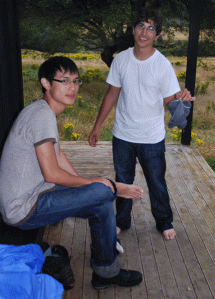
Wet Socks in the Backcountry
The adventurers from Singapore, Shaun Lee and Karan Puri, (see earlier post) took me up on my offer in joining me in New Zealand’s backcountry. I don’t think the two would have ventured out in this territory on their own, in fact they mentioned the whole concept of “backcountry” didn’t exist in their country. Singapore is compact. Their eyes were wide when they first came up on the Rob Roy Glacier after a few miles up a steep trail, after a small swinging bridge. They then made the two hour trek to the Aspiring Hut with me. Their shoes were a bit wet after the hike, but after a warm meal they were feeling great. The following morning, they were on their way back to the trailhead, as they had reservations on the mountain shuttle. They were a bit nervous, heading out in the rain, but I assured them they would make it. I assume they did! I’ve not heard from them.
Tags:adventure travel, Aspiring Hut, Bob Stremba, Brenda Dowst, Cindy Heath, Craig Cimmons, Dexter R. Richards, ecospiritual psychology, Experiential Education, Holistic Living, Karan Puri, Mountain Spirit, Mountaineering, Mt. Aspiring National Park, mtnspirit.org, New Hampshire, Peru, Randy Richards, Shaun Lee, Singapore, Spiritual, Sunapee, Sustainability
Posted in Health, New Zealand, Traveling | Leave a Comment »
07/03/2009
Three cups of Tea
A Mountain Spirit Board member, plus a few others, have been telling me I need to read “Three Cups of Tea” by Greg Mortenson and David Oliver Relin. It’s a great story about persevering a dream of building a school for the children of Korphe, Pakistan. One passage, quoted below, reminds me of how gravitating back to sustainable cultures can make our lives saner. If you’ve not read Three Cups of Tea, I suggest you pick up a copy.
An excerpt from the book that caught my eye:
“A book he’d read , Ancient Futures, by Helena Norberg-Hodge, was much on Mortenson’s mind. Norberg-Hodge has spend seventeen years living just south of these mountains in Ladakh, a region much like Baltistan, but cut off from Pakistan by the arbitrary borders colonial powers drew across the Himalaya. After almost two decades studying Ladakhi culture, Norberg Hodge has come to believe that preserving a traditional way of life in Ladakh-extended families living in harmony with the land- would bring about more happiness than “improving” Ladakhis’ standard of living with unchecked development.
Ancient Futures
“I used to assume that the direction of ‘progress was somehow inevitable, not to be questioned,” she writes. “I passively accepted a new road through the middle of the park, a steel-and-glass bank where a 200-year-old church had stood…and the fact that life seemed to get harder and faster with each day. I do not anymore. In Ladakh I have learned that there is more than one path into the future and I have had the privilege to witness another, saner, way of life- a pattern of existence based on the co-evolution between human beings and the earth.”
Norberg-Hodge continues to argue not only that Western development workers should not blindly impose modern “improvements” on ancient cultures, but that industrialized countries had lessons to learn from people like Ladakhis about building sustainable societies. “I have seen,” she writes, “that community and close relationship with the land can enrich human life beyond all comparison with material wealth or technological sophistication. I have learned that another way is possible.”
Norberg-Hodge admiringly quotes the king of another Himalayan country, Bhutan, who say the true measure of a nations success is not gross national product, but ‘gross national happiness.”
Tags:adventure travel, Ancient Futures, Bob Stremba, Brenda Dowst, Cindy Heath, Craig Cimmons, Dexter R. Richards, ecospiritual psychology, Experiential Education, Greg Mortenson, Helena Norberg-Hodge, Holistic Living, Ladakh, Mountain Spirit, Mountaineering, mtnspirit.org, New Hampshire, Peru, Randy Richards, Spiritual, Sunapee, Sustainability, Three Cups of Tea
Posted in Books, Mountain People, Sustainable Living/Communities, Traveling | 2 Comments »
07/03/2009

The Bagers in their "mountain classroom"
The Danish family of five had headlamps but had decided they didn’t need them. The moonlight illuminated their way. They left the trailhead around dark and rode their mountain bikes on the single, sometimes double track up the valley, being sure to keep the Matuktuki River on their right. Dennis, the father, aside from briefly looking at the map, was going on memory. He had been in this place some 15 or twenty years prior, but that time he was high above this place, and almost slid off Cascade Pass on snow covered wet grass, losing his fingernails while self arresting with hands and nose. This return trip had a different sense of adventure. He was returning with his wife Birgette and his three children Manus 10, Rasmus, and their little sister Frederikke, 7. And this trip was part of a bigger adventure. He and Birgette were about a third of their way through a two year round-the-world educational odyssey with their kids. They pedaled into Aspiring Hut around 11pm, tip toeing into the hut with their gear, careful not to disturb sleeping climbers and hikers. I had heard they had just arrived , and what’s more that they had shipped their 1990 VW oversized camper complete with school books and bikes from Denmark through Asia, Australia, and were headed to South America after a good long stint in New Zealand I had to find out more. The next morning I asked if I could interview them. Dennis jokingly said no but later agreed and even said I could get more info off their website.
MSI: Do you mind if I ask? How are you able to afford to take two years off with your whole family?
Dennis Bager: In Denmark there has been a law that allows either a man or a woman to take a family leave before their child is nine years old. This law has existed for two reasons. (more…)
Tags:adventure travel, Alternative Learning, Bager Family, Bob Stremba, Brenda Dowst, Cindy Heath, Craig Cimmons, Dennis Bager, Dexter R. Richards, ecospiritual psychology, Experiential Education, Holistic Living, Home Schooling, Mountain Spirit, Mountaineering, mtnspirit.org, New Hampshire, New Zealand, Peru, Randy Richards, Spiritual, Sunapee, Sustainability
Posted in Health, Holistic Living, Inspirational People, New Zealand, Peru, South America, Sustainable Living/Communities, Traveling | Leave a Comment »
07/03/2009

Woman's Hking Club, NZ
These ladies were seen at Aspiring Hut the other day. They walked in for the day. They hail from Timaru, New Zealand in the central part of the South Island. Some members of this group have been hiking together for over twenty years. Some of them were carrying beautiful walking sticks made by a local craftsman in Timaru. Some of these inspirational woman also had their sticks for the same amount of time. The average age of the group was 73 (which was later confirmed by a comment on this blog)!

Inspirational Group? Yep!
One of ladies had been at the Aspiring Backcountry Hut fifty years ago on her honeymoon. That’s the one in the back of the line with the red shirt and blue hat. The group had lunch, relaxed and started heading back down the trail, not without giving us a wave.
The next time I’m complaining about my joints or back, I’ll remember my encounter – running into this wonderful and inspirational group of mountain women.
Posted in Health, Holistic Living, Inspirational People, Mountain People, New Zealand | 4 Comments »


 Mountain Spirit's Blog