A New Zealand Farmer Does Good by Following His Passion
Tom O'Brien of High Country Walks
Tom O’Brien, owner of Blackmore Farm and founder of High Country Walks has followed his passion by offering up a little hut on the back side of his 5000 acre farm. Called the Chinaman’s Hut, it was restored some years ago, by local volunteers, Tom and his father. The hut is situated on the rolling mountains of the Slate Range, just south of the Remarkables Mountains, on the border of Otago and Southland. Tom took the afternoon to show me his farm, the backcountry and the Chinaman’s Hut. below is a short piece on the hut, and a chat with Tom about his philosophy and passion of sharing this part of the world with others.We’re in hopes, here at Mountain Spirit Institute of collaborating with Tom by running some programs on the Slate Range and Blackmore Farm. We chatted about providing Solo’s and other types of programs.
Thanks for the time you took to show me around Tom!
Note: I’ve met one of the volunteers who helped restore the Chinaman’s Hut, a neighbor of ours here in Kingston named Dusty, who I’ll see if I can get on tape in the next few days. He has an interesting story to tell of not only this restoration project by many others.
I’m in the middle of a book called “A Man’s Country? The image of the Pakeha Male“ by Jock Phillips. It’s a well-known fact that the New Zealand male, and Aussie as well, has a “She’ll be right” attitude. All is well and good, but what happens when things go wrong, or life events happen that one didn’t plan for, doesn’t want and has no intention of participating in. Is “opening up” an idea who’s time has come?
A Man’s Country? From the back cover:
” A rugged practical bloke – fixes anything, strong and touch, keeps his emotions to himself, usually scornful of women. Yet at heart a decent bloke, loyal to his mates, provides well for the wife and kids…
Few Pakeha (white) men grow up in New Zealand without a strong sense of the Kiwi bloke they are expected to become. Jock Phillips’ book is a penetrating, provocative history of that stereotype.
Where did that stereotype come from? How has it changed? What truths does it hide? At what costs? The book begins with the Pakeha colonial society of the nineteenth century – the absence of women, the harsh physical conditions, the growth of an exclusively male ethic. It then examines in detail the image of the Pakeha male, as booze, as rugby player, as soldier, as family man, in the 1980’s, says Phillips, the stereotype has been well and truly exposed as a role model. We now know the costs we have paid as both men and women. After reading this book, no New Zealand man will quite be the same.
Published by Penguin
For another take, see my post on the movie The Men’s Group
If We End Corporate Personhood We Can Define the Terms of a New Economy by: Thom Hartmann, Berrett-Koehler Publishers | Book Excerpt
The prevalence of the corporation in America has led men of this generation to act, at times, as if the privilege of doing business in corporate form were inherent in the citizen; and has led them to accept the evils attendant upon the free and unrestricted use of the corporate mechanism as if these evils were the inescapable price of civilized life, and, hence, to be borne with resignation.
Throughout the greater part of our history a different view prevailed. (more…)
3 guys, 44 days, 11 countries, 18 flights, 38 thousand miles, an exploding volcano, 2 cameras and almost a terabyte of footage… all to turn 3 ambitious linear concepts based on movement, learning and food ….into 3 beautiful and hopefully compelling short films….. = a trip of a lifetime.
Life has such an ebb and flow. One minute you can be riding the wave, the next minute you are under the wave. One minute you can feel safe and secure in your life, and the next minute you can feel totally threatened by something.
I find that when I meditate it helps me to separate myself from the sting of something to realize that it is all coming from God’s Divine Will. Usually the most emotionally charged things aren’t really that big of a deal anyway. (more…)
O’Hare Aeroponic Garden Provides Fresh Produce to Airport Eateries From: Chicago Department of Aviation
The Chicago Department of Aviation (CDA) and HMSHost are pleased to announce the grand opening of the O’Hare Urban Garden, a cutting-edge, environmentally friendly aeroponic garden located in the mezzanine level of Terminal 3, G Concourse.
“On behalf of the City of Chicago and Mayor Rahm Emanuel, we are delighted to open the world’s first airport aeroponic garden at O’Hare and invite passengers to take a few minutes to visit the calming garden and learn more about this unique and earth-friendly type of gardening,” said CDA Commissioner Rosemarie S. Andolino. Read the rest of this story…
Editor’s Note: It seems the Juice Plus company is behind this technology, (or at least has marketing rights) and will be rolling it out to distributors sometime in the next year. While I’m not a huge fan of MLM companies, (Juice Plus says it’s not multi-level) I have been taking Juice Plus for years, so expect their Hydroponics to be something worth looking into.
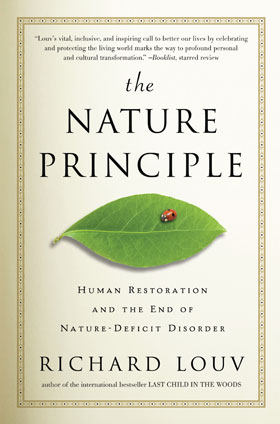
“The future will belong to the nature-smart—those individuals, families, businesses, and political leaders who develop a deeper understanding of the transformative power of the natural world and who balance the virtual with the real. The more high-tech we become, the more nature we need.”
—Richard Louv
Now, in The Nature Principle, Louv reaches even further with a powerful call to action for the rest of us.
Our society, says Louv, has developed such an outsized faith in technology that we have yet to fully realize or even adequately study how human capacities are enhanced through the power of nature. Supported by groundbreaking research, anecdotal evidence, and compelling personal stories, Louv shows us how tapping into the restorative powers of the natural world can boost mental acuity and creativity; promote health and wellness; build smarter and more sustainable businesses, communities, and economies; and ultimately strengthen human bonds. As he says in his introduction, The Nature Principle is “about the power of living in nature—not with it, but in it. We are entering the most creative period in history. The twenty-first century will be the century of human restoration in the natural world.”
Richard Louv makes a convincing case that through a nature-balanced existence—driven by sound economic, social, and environmental solutions—the human race can and will thrive. This timely, inspiring, and important work will give readers renewed hope while challenging them to rethink the way we live.
Editor’s note: I saw Mr. Louv speak in Park City about three years ago. He was a down-to-earth, (one would hope with a subject such as he covers) and passionate speaker. If you get a chance, go hear him speak, you can see his schedule on his website’s Appearances Page and if you can hear him speak, do so. Better yet, read his three books.
We’re honored to see that Mr. Louv has started to follow Mountain Spirit Institute‘s Twitter account. We’ve been at it since 1998, and started this blog in 2008 with 64,000 views since. We feel a kindred spirit with Louv, with our mission “to facilitate one’s connection to the natural environment, to each other and a deeper connection to one’s self”. Mr. Louv has had great success in spreading the word about getting kids of all ages outside, and we’re effectively joining him in that cause.
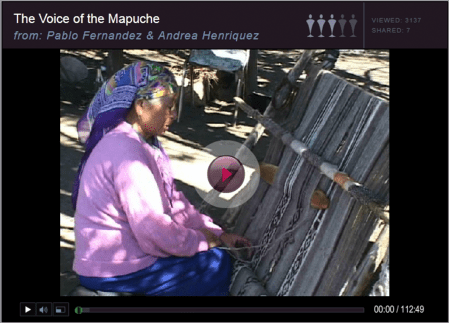
The Mapuche are an indigenous people living in central Chile. Their cultural center is the town of Temuco. This film was voted the People’s Choice on Culture Unplugged. To view the
When the Mountain Bites Back, And What Are the Lessons To Be Learned
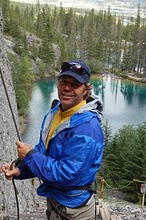
Mountain guide, writer and longtime friend from Outward Bound days, Ken Wyle is writing a book about his accounts the day he was caught in the La Traviata avalanche in Canada that killed seven people. I had heard through the grapevine that Ken had been caught in a big one, and I felt a wrench in my gut. Mountaineering accidents, in which friends are involved affect me more than most things in life. Alan Bard was one of my ski-guiding mentors, and he goes and dies on the Grand Teton. One’s teacher isn’t supposed to do that. There was a cloud over me for a time after I had heard the news, and I did’t feel comfortable on the rock for a time too. There have been other friends too that are no longer with us, and I ask myself the same questions that we all do about events like this, and the meaning of it all.
Reading a few of Ken’s Facebook posts and on his blog, give me the impression, he too has been asking some questions. And while the answers are secondary, the questions he’s asking have weight, at least from my humble perspective. While compassion is one of outcomes of teaching an Outward Bound course, it looks like Ken is living it.
I caught up with Ken on Facebook last week, and he suggested I check out his blog The Energies of Adventure. Some glimpses of what will most likely be included his book can be seen on his blog.
Here’s the lead-in to his first post on that blog:
Seven Cairns
Chapter 1, “Lost in the Fog”
January 20th 2003, deep in the Selkirk mountains of Canada’s British Columbia. It is overcast and white out. Snow flakes are lightly falling from the clouds. The air is moving softly out of the southeast. Two groups of backcountry ski tourers collect at the frozen, snow covered, Tumbledown Lake for our first tea break of the day. My smaller group of read the rest of this story..





 Mountain Spirit's Blog