Archive for the ‘Power of Place’ Category

A Restored Mountain Hut Getaway with Good Energy

11/01/2012

A New Zealand Farmer Does Good by Following His Passion

Tom O'Brien of High Country Walks

Tom O’Brien, owner of Blackmore Farm and founder of High Country Walks has followed his passion by offering up a little hut on the back side of his 5000 acre farm. Called the Chinaman’s Hut, it was restored some years ago, by local volunteers, Tom and his father. The hut is situated on the rolling mountains of the Slate Range,  just south of the Remarkables Mountains, on the border of Otago and Southland. Tom took the afternoon to show me his farm, the backcountry and the Chinaman’s Hut. below is a short piece on the hut, and a chat with Tom about his philosophy and passion of sharing this part of the world with others.We’re in hopes, here at Mountain Spirit Institute of collaborating with Tom by running some programs on the Slate Range and Blackmore Farm. We chatted about providing Solo’s and other types of programs.
Thanks for the time you took to show me around Tom!
Note: I’ve met one of the volunteers who helped restore the Chinaman’s Hut, a neighbor of ours here in Kingston named Dusty, who I’ll see if I can get on tape in the next few days. He has an interesting story to tell of not only this restoration project by many others.

11/11 in New Zealand

11/11/2011

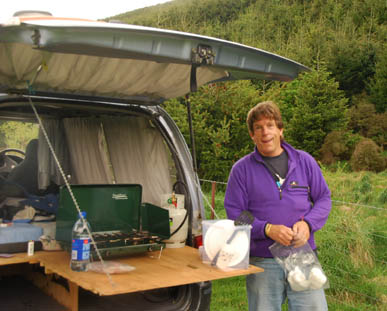
We had 11/11 a bit earlier than most of the planet (if you’re going by clock-time). We decided to kick ours off with a picnic, a short sage ceremony, and finished it off with an evening rainbow. Welcome – The Age of Aquarius.

11 min after 11AM on 11/11

The Author, another tailgate picnic in Roberts Canyon, NZ

Evening Rainbow with Mtn Shadow Cutting In

Double Rainbow on 11/11 New Zealand


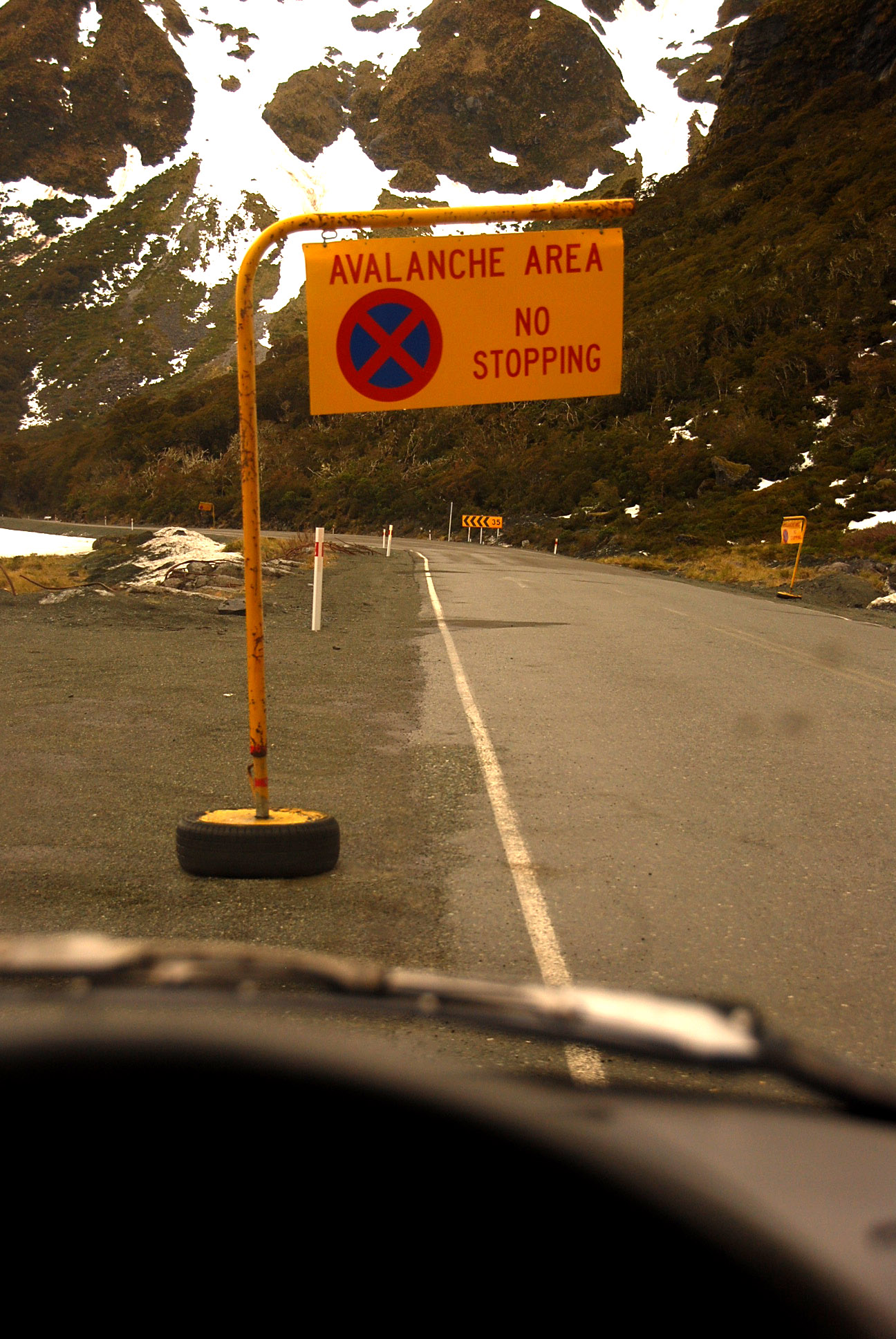
Along the Road to Milford Sound, NZ

01/11/2011

Nothing to see here, keep moving..

Milford Sound is renowned for its world class beauty, its fjords, hikes, and waterfalls, wildlife and dramatic alpine terrain. It’s something to put on your “must do” list, despite its popularity with so many that come to New Zealand. However, the drive through (and under) the mountains,  on NZ Highway 97 and its  the 1270 meter Homer Tunnel also got my attention. I’m looking forward to getting out into the Darran Mountains soon, where there’s granite and lots alpine adventure to be had.

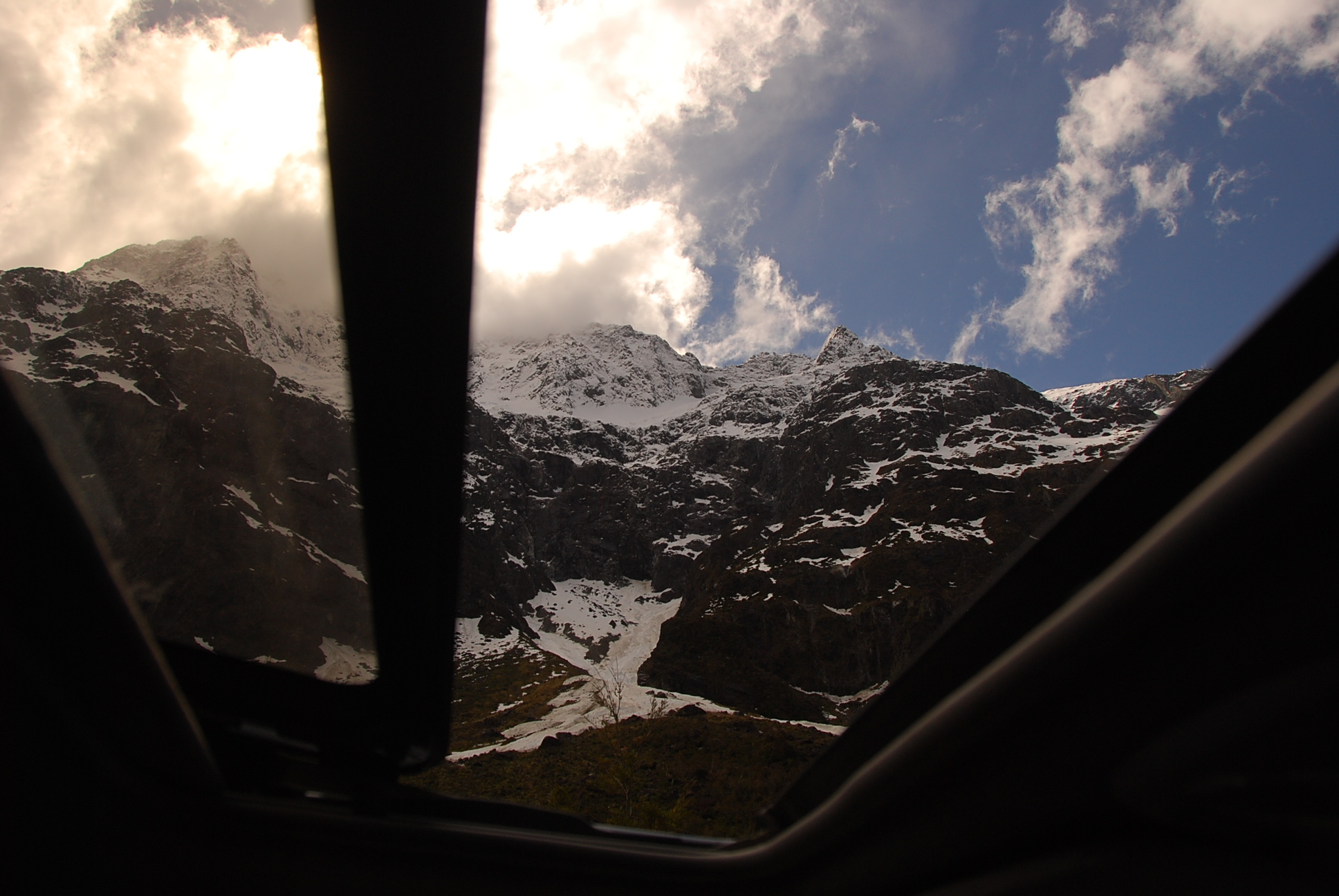
A sense of perspective and vertical relief from our sunroof

A sense of perspective and vertical relief from our sunroof

We took a day off, and drove over to Milford last month, and thought we’d share a few images.

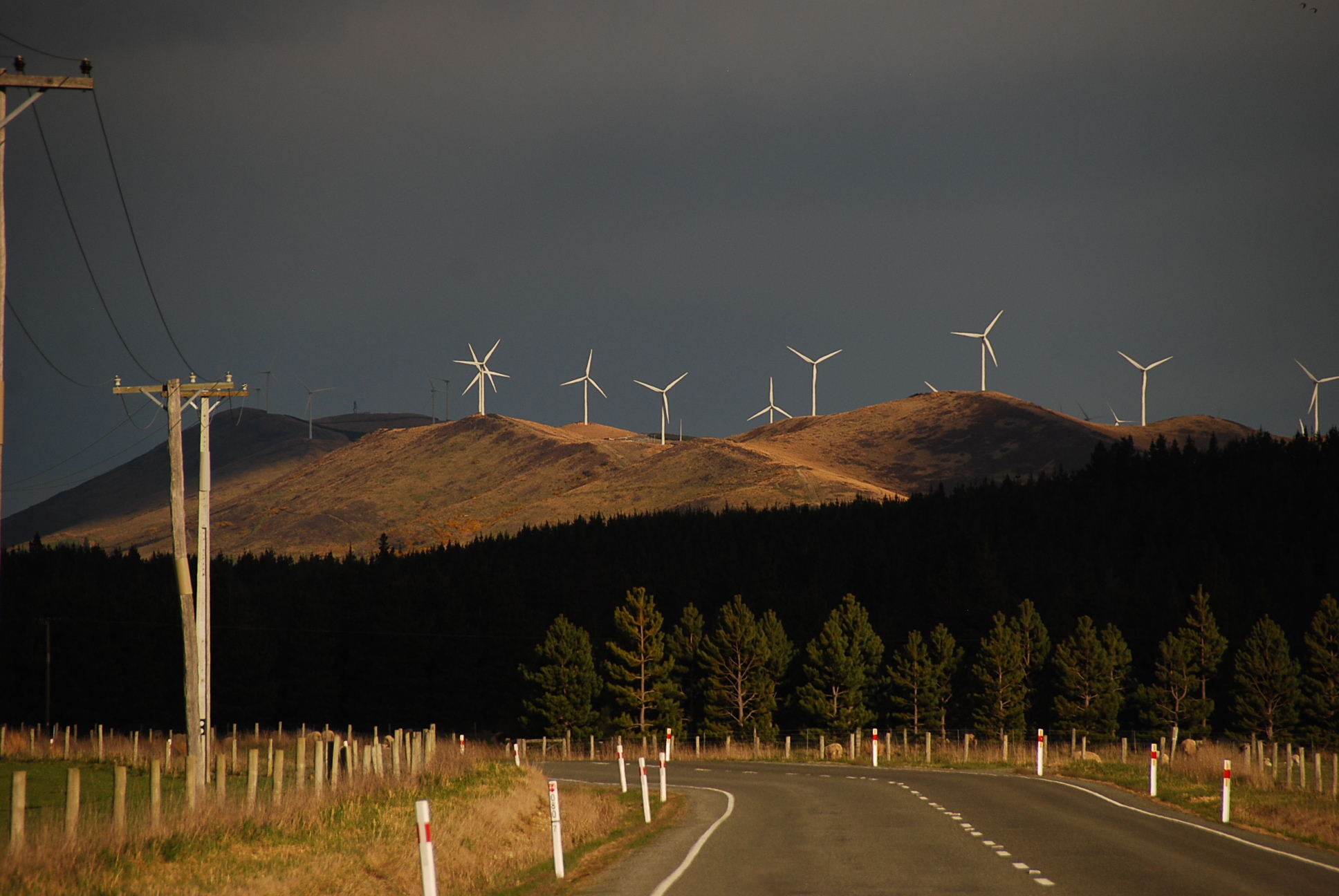
Heading back to Kingston, we caught a glimpse of the wind farm, which is somewhat controversial in this area, and stopped to take an image of the huge blades above the fields of sheep.

Yep, we did get out of the car, these are just some images taken along the road. More on the backcountry and Milford Sound in another post.

Windmills in New Zealand

Spring Skiing in New Zealand’s Backcountry

16/10/2011

The View of Kingston/Lake Wakatipu From Above

“Now I see the secret of making the best person: it is to grow in the open air and to eat and sleep with the earth.” Walt Whitman

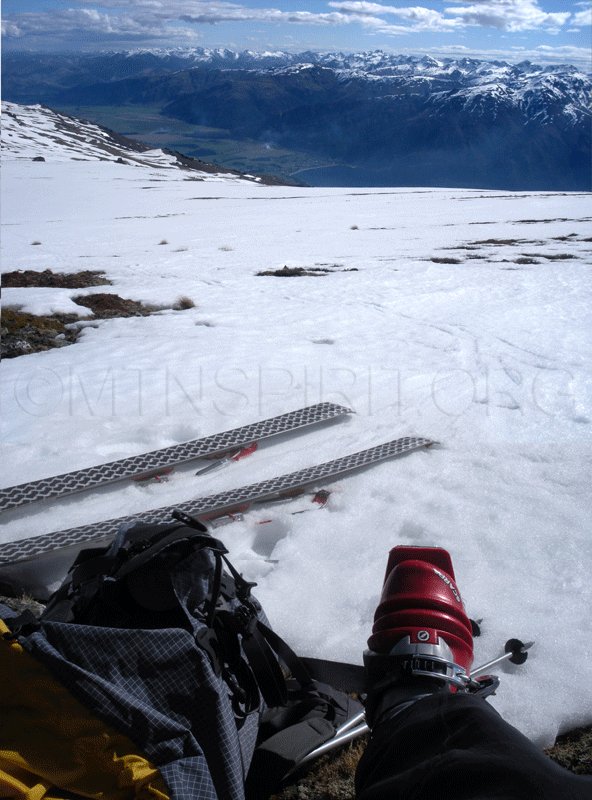
The other day, as the spring corn was coming onto the scene, I finally decided to investigate the moderate ridgetops of our valley here in the Wakatipu Basin in Kingston, New Zealand. The skiing wasn’t the steepest, and the “peaks” aren’t the sharpest in the Southern Alps, but the snow was damn perfect. After all, the first ski hut in New Zealand was just down the road on the Nevis Road. There must have been a reason for that being the first NZ ski field.

What I found after a two hour hike to snowline, were broad snowfields of cornsnow with some minor peaks along the ridge. Evidently this is where a snowmobile/heli-ski operation brought people up last season. I could see them lifting off, just across the road, and thought, “If they’re headed up there, must be something to it.” We live in Kingston, a sleepy little town, home of spectacular scenery, rock climbing, dramatic walks, a long pebble beach at the south end of the second largest lake in New Zealand, and home to an eclectic community that hasn’t been discovered by Queenstown yet. Oh I almost forgot to I mention the Kingston Flyer steam train,  which is now up and running, after a number of years in receivership. Look closely at the image on right, the clouds of smoke are from the steam train’s maiden test run, and from the fires it started along side the tracks.

A long, fun day. Rising at 4:40 I  hit the DOC trailhead by 5:30, and got back to the car around 18:30 I was a little tired, but jazzed. Fortunately there were freezing temperature up high, so by 10am, there was perfect corn on the northern aspects.  I took some pix and video, so decided just to blend them into a movie for the day…Enjoy.

Learning to Snowboard Indoors and then.. Spreading the Wings

27/09/2011

By R. Richards

Marco Wells, Coronet Peak, NZ - Image: R. Richards

Last Friday, I had one of the strangest, (but good) experiences of my outdoor career –  I took a 14-year old friend snowboarding for the first time in the mountains. However, it wasn’t his first time snowboarding . He had learned at one of forty indoor ski facilities in the world, Snow Planet in Auckland, New Zealand. He learned to board over of a number of years, but had never been outside on natural snow on a mountain.  At Snow Planet they have a Poma style tow-lift. He had been on a chairlift once with his family, but that was in the summer without a snowboard on his feet. So combining his indoor boarding skills and one-time on a chair lift ride, gave him a collection of skills to head outside.  Taking him up Coronet Peak’s chair for the first run, was like watching someone who was putting all the pieces together. He kept saying, “Look at all this snow!” and, “We’re high up on this chair”. His skills were solid and it was quite an amazing experience to see someone come out of their shell or out of their building. The next days were filled with a trip in the backcountry, and an afternoon at the Remarkables Ski Area, where he was exposed to all sorts of terrain and conditions and handled them admirably.  It reminded some obscure fact of how many indoor rock climbers never climb on real rock, or never end up placing a piece of rock gear for protection on a climb, (what they quaintly call “trad”, I call climbing)

Anyway, congrats to Marco for coming out of the indoors ski gym and joining me in the mountains. Come out again soon! We’ll be waiting.

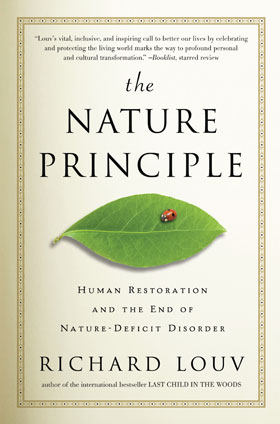
The Nature Principle

07/09/2011

Louv's second book

“The future will belong to the nature-smart—those individuals, families, businesses, and political leaders who develop a deeper understanding of the transformative power of the natural world and who balance the virtual with the real. The more high-tech we become, the more nature we need.”
—Richard Louv

The immediacy of Richard Louv’s message in Last Child in the Woods: Saving Our Children from Nature-Deficit Disorder galvanized an international movement to reconnect children with nature. We’ve touched base about his first book here on MSI’s blog.

Now, in The Nature Principle, Louv reaches even further with a powerful call to action for the rest of us.

Our society, says Louv, has developed such an outsized faith in technology that we have yet to fully realize or even adequately study how human capacities are enhanced through the power of nature. Supported by groundbreaking research, anecdotal evidence, and compelling personal stories, Louv shows us how tapping into the restorative powers of the natural world can boost mental acuity and creativity; promote health and wellness; build smarter and more sustainable businesses, communities, and economies; and ultimately strengthen human bonds. As he says in his introduction, The Nature Principle is “about the power of living in nature—not with it, but in it. We are entering the most creative period in history. The twenty-first century will be the century of human restoration in the natural world.”

Richard Louv makes a convincing case that through a nature-balanced existence—driven by sound economic, social, and environmental solutions—the human race can and will thrive. This timely, inspiring, and important work will give readers renewed hope while challenging them to rethink the way we live.

Editor’s note: I saw Mr. Louv speak in Park City about three years ago. He was a down-to-earth, (one would hope with a subject such as he covers) and passionate speaker. If you get a chance, go hear him speak, you can see his schedule on his website’s Appearances Page and  if you can hear him speak, do so.  Better yet, read his three books.

We’re honored to see that Mr. Louv has started to follow Mountain Spirit Institute‘s Twitter account. We’ve been at it since 1998, and started this blog in 2008 with 64,000 views since. We feel a kindred spirit with Louv, with our mission “to facilitate one’s connection to the natural environment, to each other and a deeper connection to one’s self”.  Mr. Louv has had great success in spreading the word about getting kids of all ages outside, and we’re effectively joining him in that cause.

A Few Scenes from this Week

26/08/2011

Early Morning Ridgetop Cloud

Lake Wakatipu with snows from the record-breaking storm

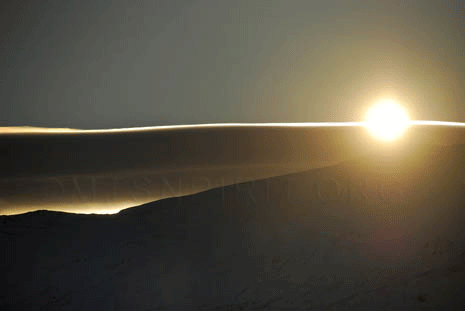
Yesterday's Sunrise in Kingston, NZ

A NZ Earthquake’s Lightshow

11/07/2011

Fishermen See Flashes of Light as Quake Hits Port
Lyttleton,  New Zealand,
From: The Press*
By Paul Gorman

Gary Vallance, Photo: Stacy Squires

Light show: While fishing on Lyttelton Harbour on June 13 Gary Vallance saw blue lights flashing in the water at the precise time the magnitude 6.3 earthquake struck.

Flashes of blue light in the deep waters of Lyttelton Harbour mystified the four occupants of a fishing boat on June 13.
Heading back to port after a largely unsuccessful trip in search of groper, Christchurch engineer Gary Vallance and three friends experienced the 2.20pm magnitude-6.3 earthquake from a different perspective in their seven-metre boat.
They did not feel the magnitude-5.6 quake at 1pm, when they were in deeper water near Pigeon Bay.
However, Vallance put their lack of fishing success down to the shake and unexpected swells.
“We were about halfway up the harbour between the heads and Lyttelton when the second one hit,” he said.
“I was looking out the front of the boat and I saw a couple of blue
flashes down in the water
was definitely a flash, a dim blue flash.
“Almost immediately, the boat shuddered and the guy driving it wondered what the bell it was. He thought he’d run into something.
“Then we saw all  rocks coming down the hillsides.
“The blue flashes were about 100 metres to the side of the vessel and shot from left to right in a straight line across us. Then the next minute it was like the boat hit something.”

He wondered if the flickering blue light was the result of friction from rocks on the harbour bottom grinding together as the quake struck.
Canterbury University geological sciences professor Jarg Pettinga said what they saw was possibly the effects of the energy of the P-wave (primary wave) moving through the water.
“The shockwave may have released some bubbles of gas from sediment or it may be something to do with the way the light was interfering wiht the water as the seismic wave was coming through.”

* The Press is an excellent newspaper, and their coverage of the earthquake through it all, has been fantastic. If you’d like to keep up on the latest earthquake news please visit their website, or if you’re on the South Island, purchase a copy.

Taking Time for the View

15/06/2011

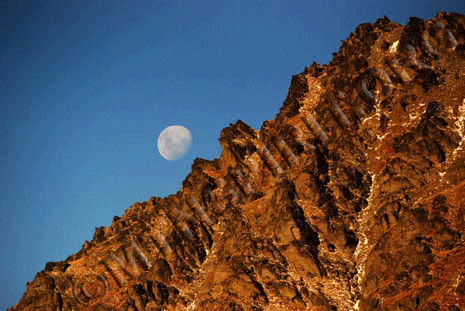
Remarkable Moonrise

I had an hour available on my way home after running some errands in nearby Queenstown, and thought I’d take a quick drive up the access road to the Remarkables Ski Area.  Although there’s no snow on the slopes, I thought I’d have a pretty good chance of getting some evening shots. I had missed out on the night before with an incredible red sky on the waters

Alta Basin, The Remarkables, Queenstown, NZ

of Lake Wakatipu, a hue created from the Chile volcano, so thought see what I could find tonight. It doesn’t take much to make a good photo here. Just show up and point the camera, the land and light do the rest.

You might have a busy day, but take the time to get out, bring your camera or better yet, a sketch book or some water colours, or go for a climb, and take a break.

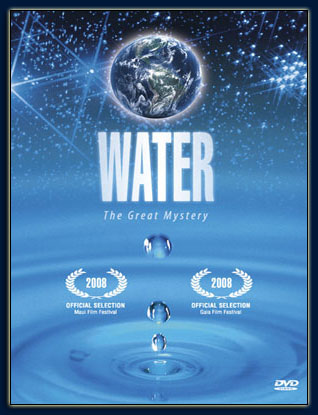
Water, The Great Mystery

04/06/2011

Water, Check it out.

Austrian Researcher Alois Gruber states in the movie, Water – The Great Mystery, by Hopscotch Films, “At the level of thought, a person who thinks negative thoughts is polluting his own water of which his body is 75-90% composed, and giving it a negative charge.”  The movie had my attention.
The film’s narrator continues, “As it records new information, water acquires new properties yet its chemical composition remains unchanged. The structure of the water is much more important than the chemical composition.

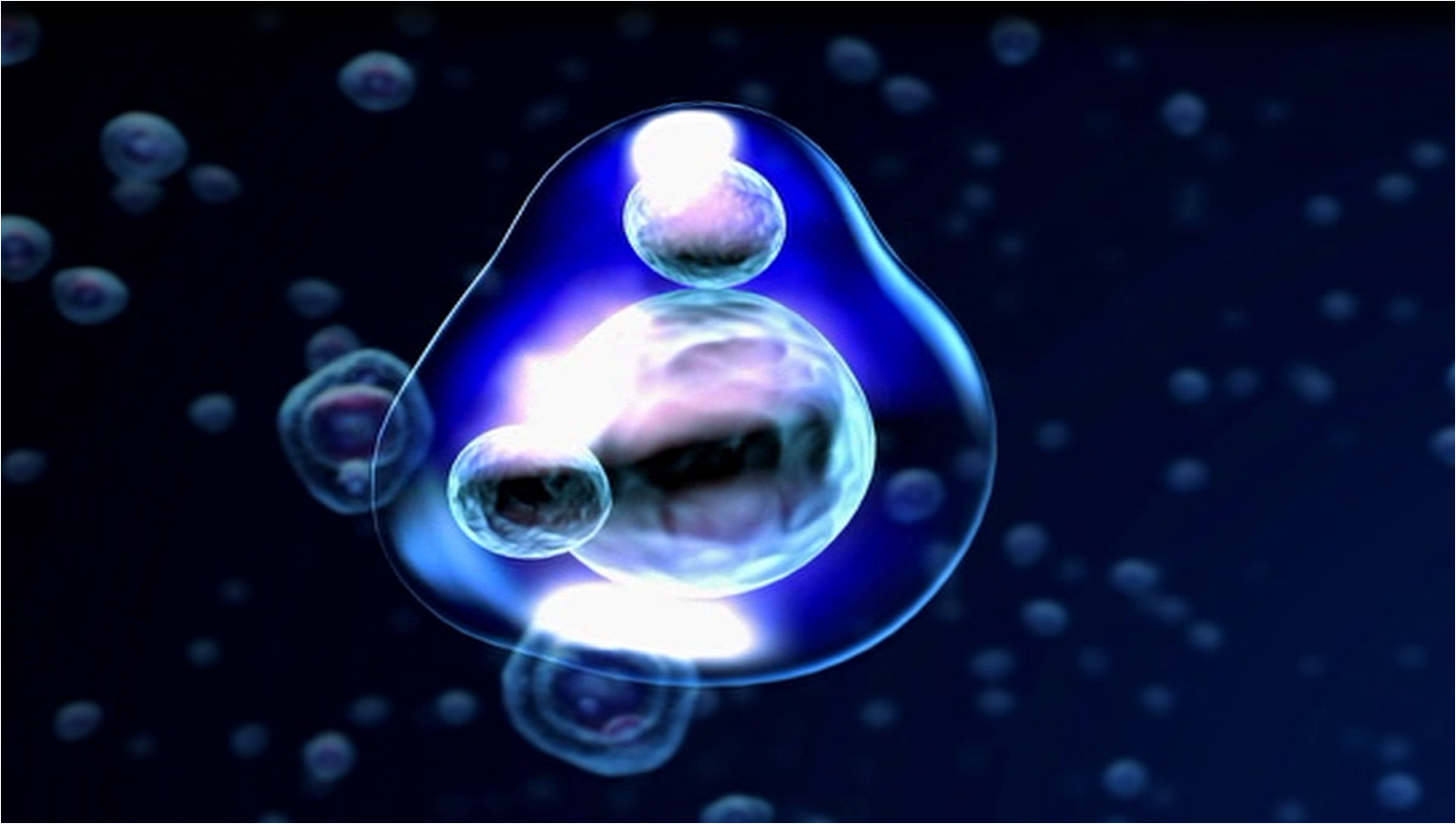
H2O

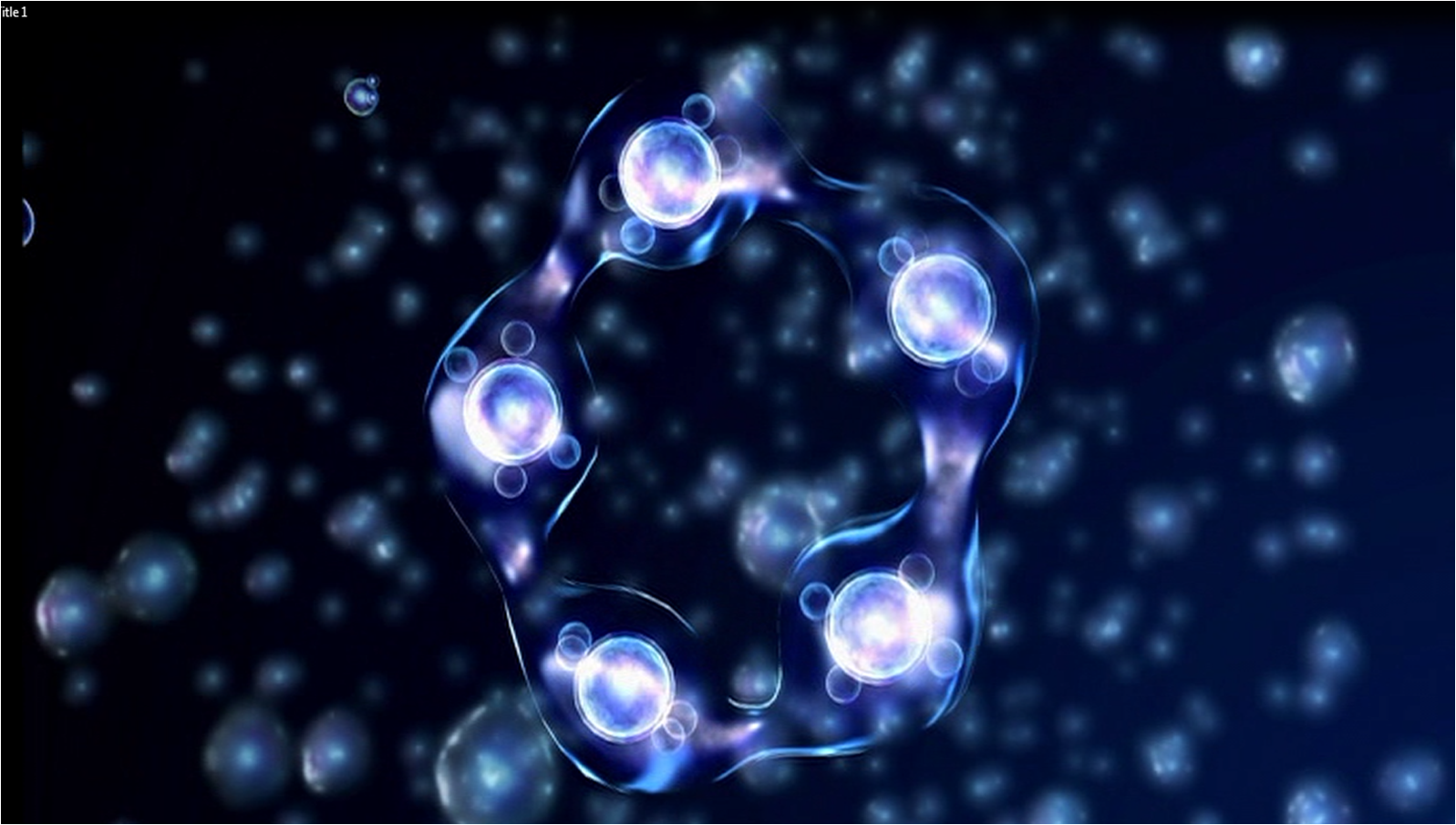
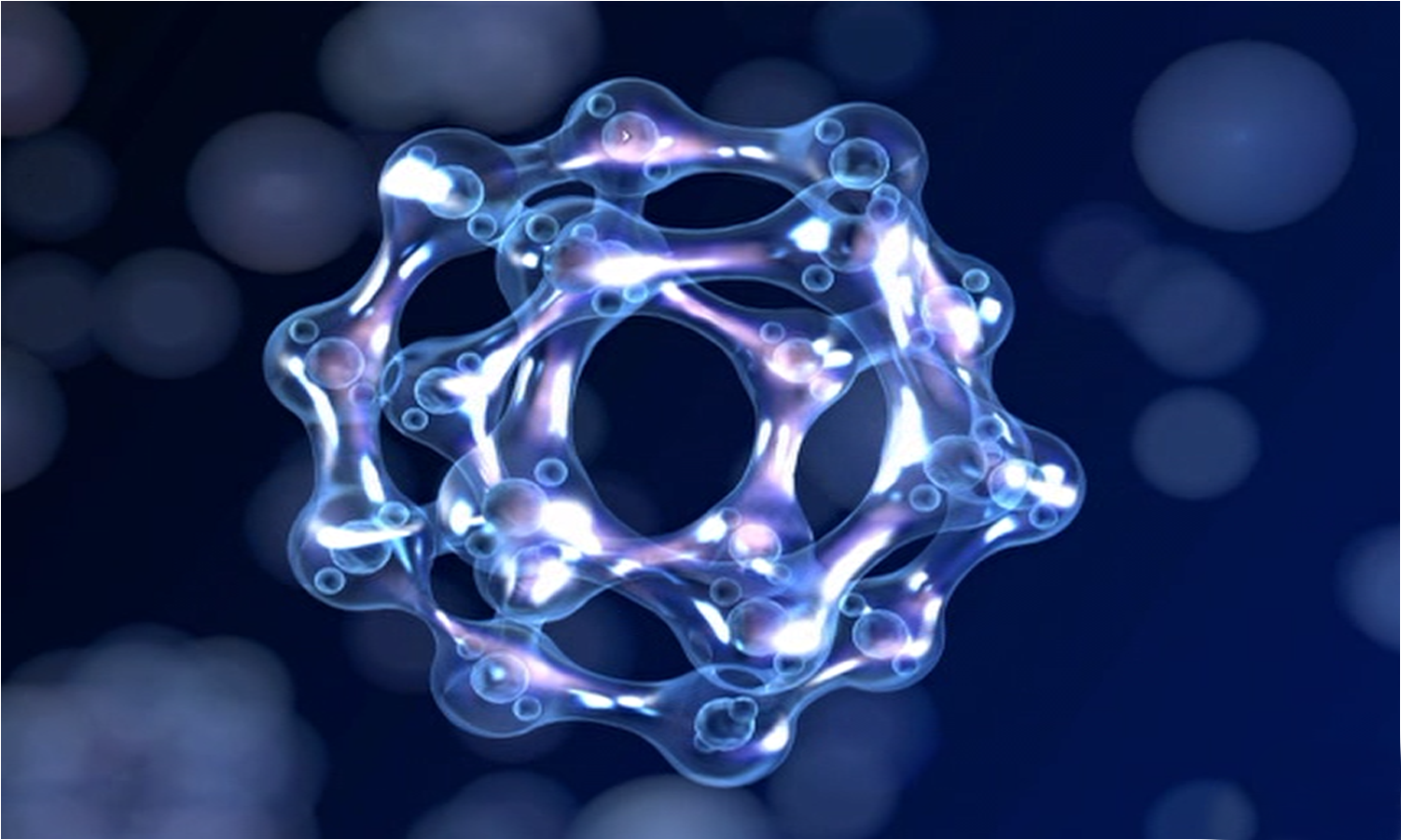
The structure of water means how its molecules are organized. Water molecules join together into groups which are called clusters. Scientists *theorize that these clusters work as memory cells of a

certain sort in which water records the whole history of its relationship with the world as if on magnetic tape.”

Water's structure in clusters

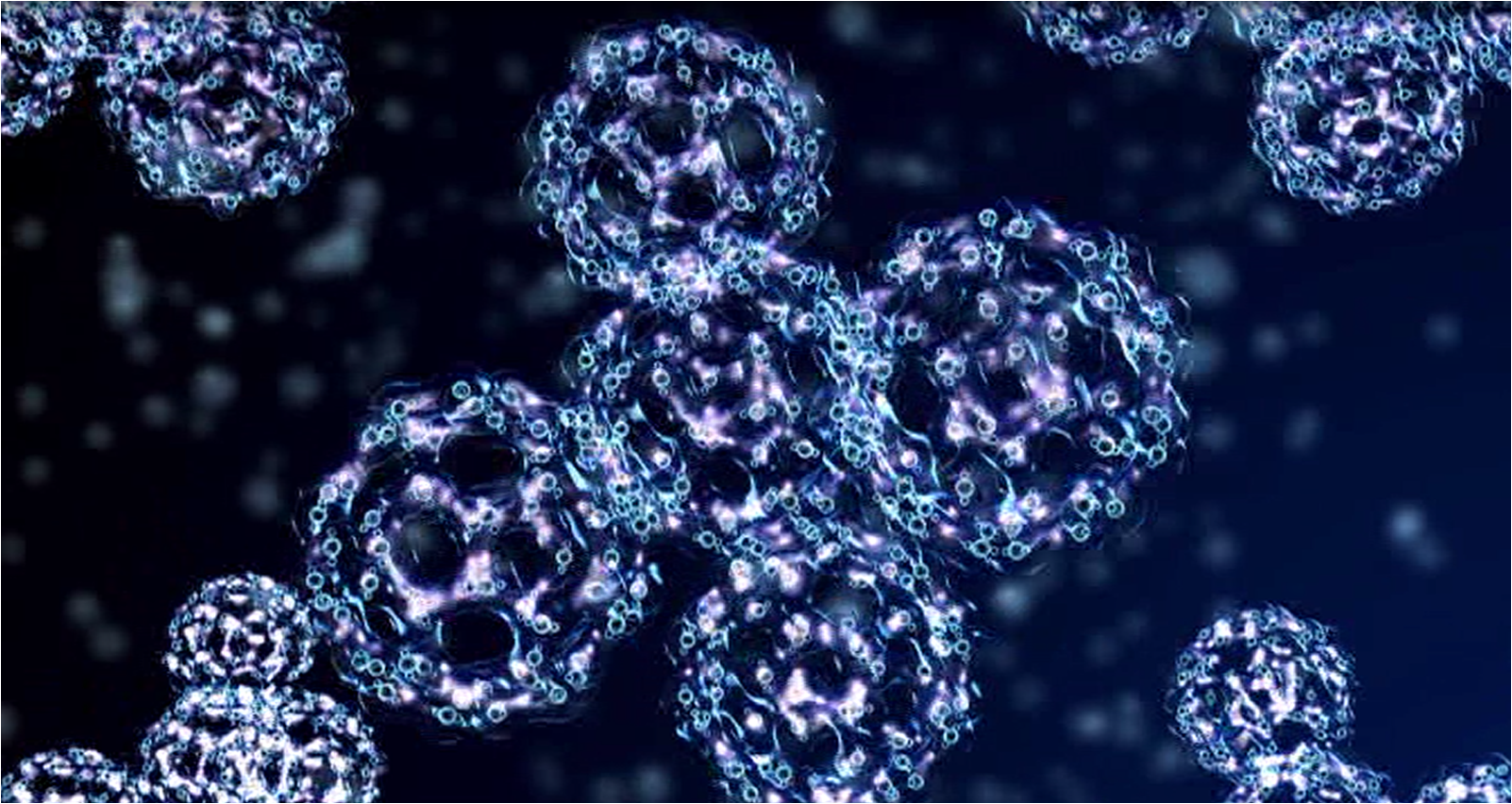
“Of course remains water, but its structure, like a nervous system reacts to any irritation. Modern instruments have made it possible to record the fact that within each of the water’s memory cells there are 440,000 information panels each of which is responsible for its own type of interaction with the environment. “

Molecules coming and going

Marc Chaplin, Professor and Laboratory Chief of London University says, “If you consider a cluster as a specific group of molecules, then it can only survive a short amount of time,  but if you consider it as a structure, whereby molecules can leave and other molecules come in, the  cluster will survive in effect, for a very long time. Water can record and store information, like a computer memory.”

H2O has "memory panels"

“Basically water has photographic memory and you can imprint it with very subtle energies, even from 10,000 km away”  says Professor Rustum Roy, of Penn State University, and Member of the International Academy of Science.  “Does that mean remote communication can happen between human beings who are structures essentially composed of water?” asks the film.
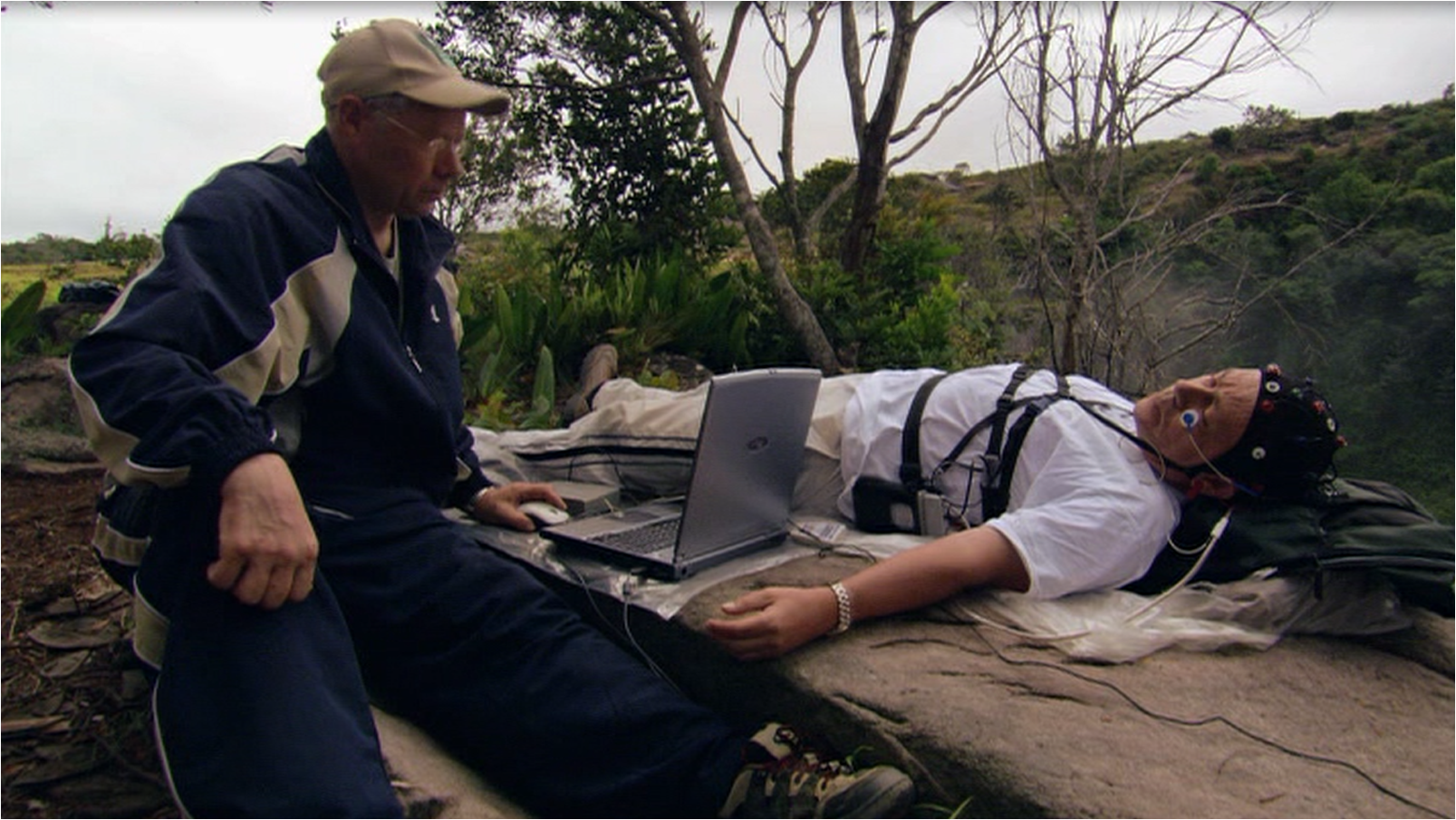
Subject A in Russia

“In Februrary 2005 a professor and colleagues conducted an experiment  to confirm or disconfirm the hypothesis that remote communication between people is possible.  Two people were 10,000 miles apart, one in Moscow, the other in South America. The “virtual brain” of the experiment’s participants showed with EEG’s and EKG’s as well as other systems being monitored.
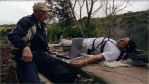
Subject B in S. America

Suddenly the two people had tuned themselves to the same wave, synchronization of areas of their brain, breathing patterns, and pulses. The theory is, liquids in the body carry out an information transmission system.”
The book the Secret Life of Plants was one of the first early works exploring and describing the reactions and relationships of plants to external stimuli in their world.  The author hooked up house plants in his office to a lie detector machine and to his surprise saw the plants react to his thoughts, regardless of whether he was in the same room or not, or the same city for that matter.
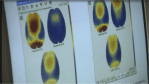
Subject A & B's synchronized scans

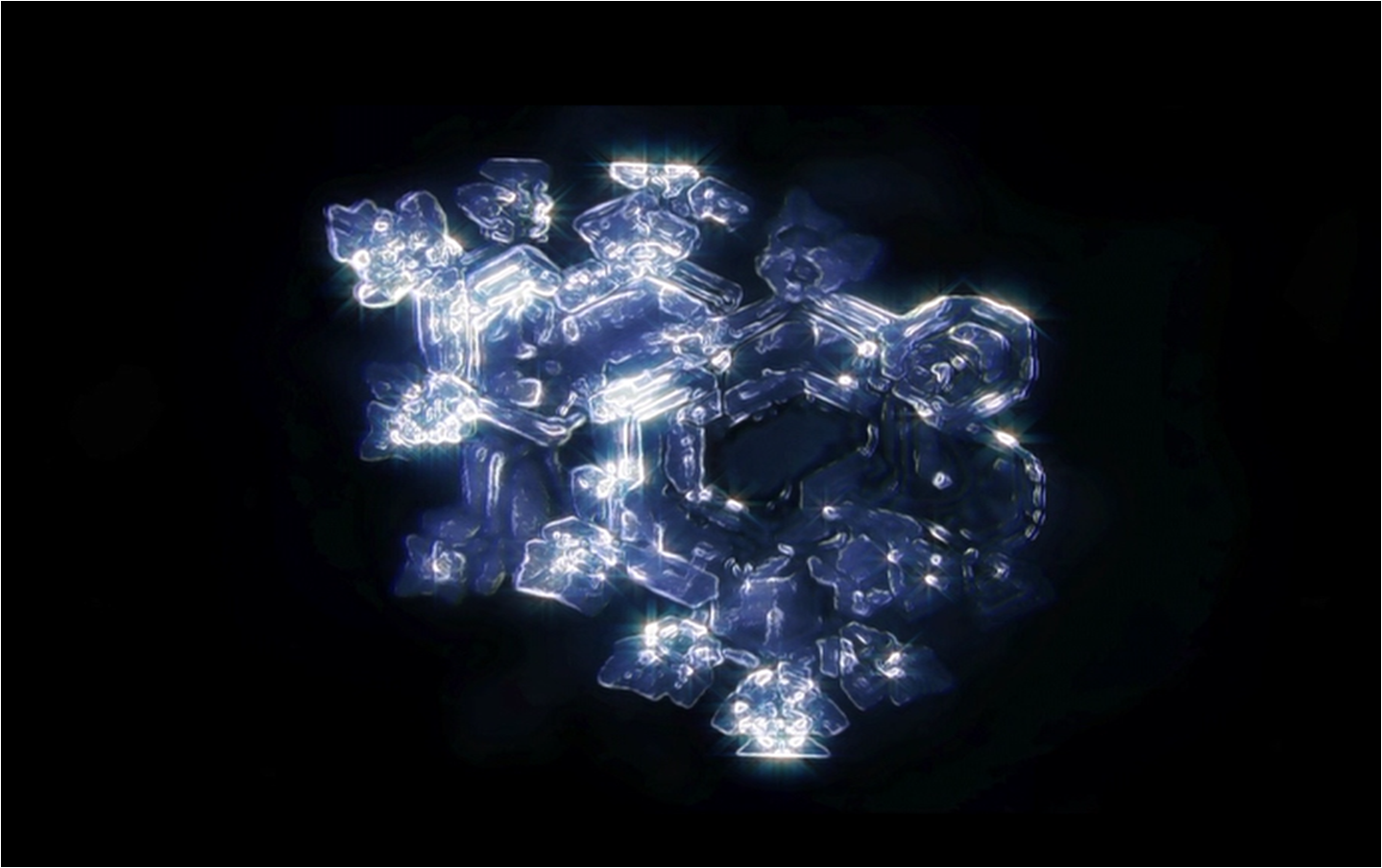
Dr. Masaru Emoto, author of “The Secret Life of Water”  was also interviewed in the film. Emoto, in his experiments, exposed different water droplets  to different thoughts, words  and intentions.

Water Crystals presented with Bach

These words and thoughts were directed at droplets before they were frozen, then images of the resulting water crystals were captured on film. The stunning results, such as  “beautiful” or “ugly” depended upon whether the words or thoughts were positive or negative. Emoto claims this can be achieved through prayer, music or by attaching written words to a container of water.    If you ‘re not familiar with his book or images, one of which is included here, check it out.

This led me to a logical conclusion from my shamanic studies in Peru, where the Inca and Quechua concept of Ayni, (reciprocity) runs throughout the mountain cultures in the Andes.

Q'ero Priests in the Andes

I learned to give words and form to what I had intuitively, (and most likely all of us have) had  known all my life from growing up in woods of New Hampshire, and later, mountain guiding in the mountains of the world –  that the mountains, streams and rivers, and other natural features give off a certain energy, and that we can interact with them as we would a person.  We can exchange energy, ask for support from the mountain, or lake,  and give back that support through emotional prayer, conservation protection and simple acknowledgement of the mountain’s energy and presence.
This might sound silly to the western logical mind, but the indigenous cultures who lived closer to the land knew and lived this life, and many still do, on a daily basis.  The western mind  is too busy, the channels are too clogged with data, to recognize the subtle signals that come from the old oak tree or the master mountain on the horizon.
The people of Cusco have twelve main “Apu’s “ or Mountain Spirits around their city, two of which are named Ausangate, Salkantay, Each main mountain or other geographic feature has its own characteristic such as male or female, strength,  allowance, introspection etc.. and the spirit of Ayni pervades all interactions with these mountain spirits.  As a side note, when I named our organization Mountain Spirit Institute in 1996, I had no awareness of the Andean “Apu’s”.
I took what I had learned, and melded it with my own intuition and experiences. When back in the U.S., I started to give more form to my relationships with the surrounding mountains and water features in my hometown of Sunapee, NH.  I started to see Mt. Sunapee in a different light, and in fact, took a job as a ski patroller mostly because I wanted to interact with the mountain energy on a daily basis. I wanted to, protect it, be in on the mountain, feel its power, and ask for strength from it as well.  Now that I think about it, maybe when Catherine Busheuff and I decided to move forward with those early meetings at the library, that later turned into the Friends of Mount Sunapee, maybe part of the seed that led to the mountain’s protection that exists today, came from those early interactions.  Many individuals have since carried forward  with their own passion to protect the mountain from abuse and over-development. I hope to think I may have had a small part in that.
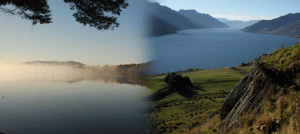
Communication w/Lake Sunapee from NZ's Lakes District

I also started relating to Lake Sunapee in a different way as well. While I always felt the water was in my bones, this film, and Emoto’s book, gives me some credence that the water memory from where we come is actually part of us.  So after seeing the movie, I spontanisouly  meditated on the waters of Sunapee from here in New Zealand. I started feeling the healing power of the waters of Lake Sunapee, even though I’m down here on New Zealand’s south island,  very long way away. I could feel the exchange of energy, of love and gratitude.
So what’s this all mean – from the shamanic studies in Peru, to experiments in Russia to meditation and communication with a body of water in New Hampshire from New Zealand,  from one water body to another body of water? It means, at least to me, that we can interact more with trees,  mountains, rivers, lakes and each other on a level far deeper than conventional society believes. Traditional societies know about this connection, and its knowledge may just mean we learn to survive as a species.
I started Mountain Spirit Institute because I feel I can contribute to helping people reconnect to the natural environment, each other and a deeper connection to themselves by setting the stage for powerful transformative experiences. This film is an affirmation that I, and our board of directors are on the right track. Visit our website for more information on our core values, and our mission, and do see the movie!

Water's structure as important as chemical make-up

Chapters of the movie Water, The Great Mystery, include:
The Structure of Water
The importance of water,
Dead and Heavy Water
Natural and Artificial Water
The Effect of Water on the Body
Water as the Medium
The Power of Faith
A Water Crisis
Nature Disasters
Love and Gratitude

* While I didn’t look for footnotes to the research mentioned in the movie, nor check into the science, I decided to write this post to share my personal experience of the movie, and in life.

There was much more fascinating information in the movie than I was able to include here. Do see it to learn more about agriculture, hydro power, our public water supply and one of the world’s most pristine water supplies in Brazil.  All images are screen shots from the movie and are intended and used for review purposes only.