Archive for the ‘Archeology’ Category

A Look into Inca Astronomy

12/11/2009

The Qorikancha was at the physical center of the Inca empire, their most revered ceremonial temple which also housed the golden sun disc and was considered where the four quarters of the empire came together.  It is located on Avenida del Sol, in Cusco, Peru.
The image below is of  beautiful painting by the Cusco artist Miguel Cartagena, which hangs in the Qorikancha, showing the important points of the Milky Way in the southern hemisphere and how the Inka related to them. Below is a description which is also hangs in the Qorikancha next to this painting:

Peru'09-Inka-Astronomy

Milky Way & llama - Southern Hemisphere

“The deities venerated in the Qorikancha were personified celestial bodies and meteorological phenomenon. In order to understand these beliefs, it is necessary to make reference to Inca astronomy, which is known to us through some brief mentions in colonial chronicles and through the folk astronomy of the Quechua communities of today. (more…)
‘Rebuilding’ the ruins of Machu Picchu

26/08/2009
Inca ruins get 'The Treatment'

Inca ruins get 'The Treatment'

By Amanda Richards

Peruvian authorities in charge of archaeological sites seem to have a voracious appetite to ‘rebuild’ the Inca ruins. They seem to think that the ruins need to be ‘reconstructed’ in order for them to become worth something more – ‘puesta en valor’ as the signs tell us.  The ruins in themselves are just not enough.

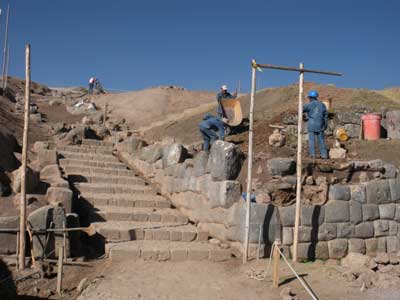
As we explored the ruins,we realized just how much had been ‘reconstructed’ and continues to be.  At Macchu Pichu for example, you can’t even see the ‘most beautiful wall in the world’ (as described by Hiram Bingham) as it is currently under ‘reconstruction’ and the area is only open to workers carrying bags of cement. It felt strange to watch the ‘ruins’ being rebuilt and made to look ‘tidy and new’.

Building a 'new' Inca wall

Building a 'new' Inca wall

Peter Frost raises this issue in his book ‘ Exploring Cusco’ hoping to ignite some discussion as he argues that there has never been a debate in Peru about this.  No one has ever questioned the authorities. And so the rebuilding of the old ruins – ‘The Treatment’ as Frost describes it, continues unimpeded.

I have to admit that on one hand there is something nice about seeing the ruins ‘new and rebuilt’ like the beautiful, big terraces at Moray for example.  However, I agree with Frost that this theme park approach takes away the ‘mystery, allure and enchantment’ that only our own imaginations can add to the experience of being there at these intriguing and mystical ruins.

Peru by Bike

17/08/2009

By Amanda Richards
Eva and I met while we were both  studying at Copenhagen University about 5 years ago. We were both  sad when we said our good-byes because  neither of us had any idea when we would  see each other again as she was heading home to Germany and I was returning to Australia.  Yet, now here we are in South America!

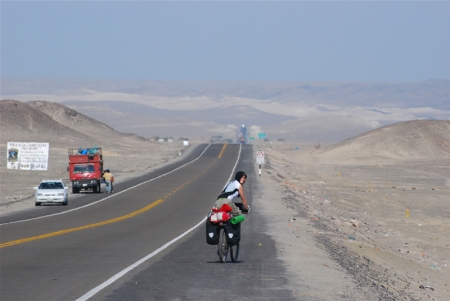
Eva is traveling with Sebastien and they  arrived here in Peru intent on cycling  and  hoping to explore `a strange new world, its countryside, people, cultures and languages for 2.5 months…´ Their adventures began in Lima  and they first  headed down  south to Nazca (a desert area) and then up to Cusco.

On the way to Nazca

On the way to Nazca

They have both been surprised at just how many other cyclists there are on the road – their expectation was that they would be almost the only ones on this big adventure!

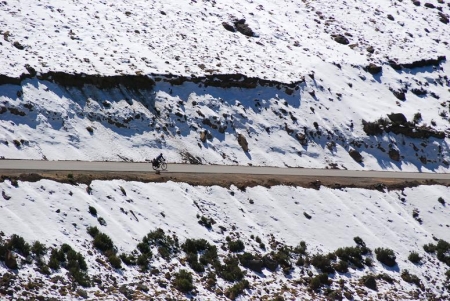
After the chaos of Cairo (where they are both currently working) they are particularly enjoying the times when they are higher  up in the mountains (sometimes above 4,000m) where there are fewer people.

Up up up and down down down

Up up up and down down down

Eva and Sebastien are at Machu Picchu today and will continue with their cycle tour when they return to Cusco tomorrow. Once again Eva and I  will sadly say our good-byes and who knows when or where we will meet again. Somewhere fun!

Peru’09- Sacsayhuaman

03/08/2009

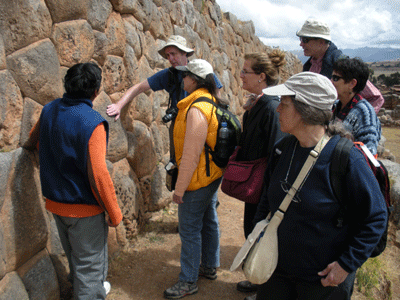
Participants check out the stonework of Sacsayhuaman

Participants check out the stonework of Sacsayhuaman

The citadel ruins overlooking the town of Cuzco called Sacsayhuaman, about a 20 minute hike from the San Blas area is the site of one of the last stands of the Inka Empire. It’s here where the last emperor fought off the Spaniards, but finally lost. Many were lost on the grounds surrounding the battlements. The stonework and size of the stones themselves is legendary.

There are few places that rival the massive 130 ton blocks that are fitted together so well, it’s difficult to wedge a knife between the cracks. Although there’s specualation, they’re still not sure how the stones were fitted together.
This was a good place to start our program.

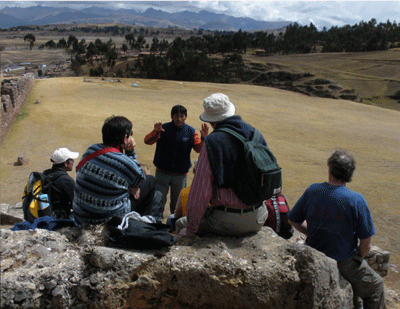
Local Guide tells of the Inti Raymi held annually

Local Guide tells of the Inti Raymi held annually

Participants were shown the area by a local guide who shared information about the  Inti Raymi festival held every year in June, about the stonework and the storehouses of grain and water, and the fact that most of the ruins were taken apart, block by block and used for Spanish buildings and churches in the Cusco center.

Sacsayhuaman is a beautiful place for an early morning walk, which Amanda and I did a few days ago. If you’re there before 7am, they usually don’t charge, plus that’s the best time to be there anyway.

Missing Link Fossil Found

21/05/2009
Ida, The Missing Link

Ida, The Missing Link

May 19, 2009—Meet “Ida,” the small “missing link” found in Germany that’s created a big media splash and will likely continue to make waves among those who study human origins.

In a new book, documentary, and promotional Web site, paleontologist Jorn Hurum, who led the team that analyzed the 47-million-year-old fossil seen above, suggests Ida is a critical missing-link species in primate evolution.
Read the rest of this story at National Geographic’s website.

37,000 Year Old Baby Mammoth

06/05/2009

Secrets of 37,000 year old baby mammoth revealed
By Paul RinconBBC

Baby Mammoth

Baby Mammoth

Perfectly preserved, the baby mammoth looks like she has been asleep only for a moment – not for the 37,000 years she has spent locked in the rock hard permafrost of the Arctic tundra.

Clumps of brown hair still cling to the three foot tall body, hinting at the coarse coat that would have once covered the infant. Even her eylasahes are intact.
These extraordinary images show why scientists are so excited by the discovery of Lyuba – the most complete body of a woolly mammoth ever found

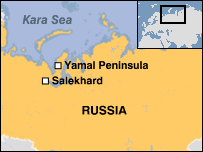
Area where Mammoth was Found

Area where Mammoth was Found

Discovered at the side of a river by reindeer herders on the Yamal Peninsula in northwest Siberia, the bone month old female is helping scientists to unravel how the extinct ice age giants once lived.

The contents of her stomach have provided scientists with valuable clues about what she and her fellow mammoths ate.

The baby’s layers of fat and minerals in her teeth have provided an unprecedented insight into her health and the health of her herd.

Palaeontologists now believe the information they have gleaned from the remains can help them understand what led to the woolly mammoths’ ultimate extinction around 10,000 years ago.

Mammoth Mummy

Mammoth Mummy

It is thought that mammoths died out as they were unable to adapt to the changing world around them as temperatures soared at the end of the last ice age, although some experts believe they may have been hunted to extinction by humans.

The findings have shown that the baby mammoth was in good health and well fed before its death, suggesting that its herd was able to find plenty of food at the time it was alive.

(more…)