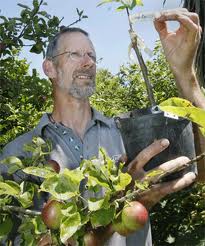
Robert and Robyn Guyton were determined to start a food forest instead of mowing a front lawn. And a forest did they grow, when in the mid-’90’s, they purchased some land and a house in the small coastal town of Riverton, New Zealand. Riverton along with its neighbor, Invercargill rank as one of the southernmost towns in the world, and back then Riverton was an affordable place to buy land. It still is compared to the northern resort towns of Wanaka and Queenstown, the latter which graces its runway with private jets, rivaling Aspen Colorado.
The Guytons worked in earnest on their two lots planting trees and plants based on permaculture practices. When they first started, they received some odd looks from the neighbors, as their front yard started to take on the forest look. There were no other like-minded people in Riverton when they arrived, but undeterred, they started a cooperative learning center called the South Coast Environment Society.
YOUR FOOD SUPPLY #30: Build it & They Will Come Note: (This video series started in 2010, while listening to the audio version of the book, “The Omnivore’s Dilemma”, when Amanda and I were driving across the U.S. and were seeing the effects of industrial farming in real time while listening to the book.Here’s that first entry Your Food Supply #1To see the whole series, click on the category “Your Food Supply” in the category section of this blog on the right of your screen.
Today the organization modestly states on its website it is an umbrella group for a “several” local environmental groups who have information,displays and meetings in the centre. Those several groups include:
Groups working for protection and enhancement of local ecosystems:
Riverton Estuary Care Society
Aparima Pest Busters
Aparima Nursery Enterprise
Seed Balls for Restoration projects
Groups working to promote sustainable lifestyles:
Riverton Natural Health Group
South Coast Permaculture
Sustainable Lifestyles project
Riverton Organic Food Co-op
Groups promoting sustainable growing methods
Riverton Organic Growers Gardeners Group
Southland Seed Savers
Riverton Organic Farmers Market
Riverton Community Orchard
Rivertonians for Alternatives to Toxic Substances (RATS)
Robert Guyton
My wife and I met the Guytons when they were giving a presentation on sustainability to the ultra small Garston School, (which deserves its own blog post), New Zealand. We were intrigued with their presentation, which included a movie (to be posted on this blog) called “Welcome to the Food Forest”. We decided to take our chances and take the hour and half drive from our place and show up unannounced. Even though we had a standing invitation, we happened to miss them, when we stopped by to say hi. Nevertheless, I decided to interview Mark Baily while visiting the centre. You can see the video on my adjacent post. We’ll have to get down there again when Robert and Robyn are home, so we can get the proper tour of their food forest!
YOUR FOOD SUPPLY #30: Build it & They Will Come Note: (This video series started 13 years ago, while listening to the audio version of the book, The Omnivore’s Dilemma, when Amanda and I were driving across the U.S. and were seeing the effects of industrial farming in real time while listening to the book.Here’s that first entry Your Food Supply #1To see the whole series, click on the category “Your Food Supply” in the category section of this blog on the right of your screen.
A New Zealand Farmer Does Good by Following His Passion
Tom O'Brien of High Country Walks
Tom O’Brien, owner of Blackmore Farm and founder of High Country Walks has followed his passion by offering up a little hut on the back side of his 5000 acre farm. Called the Chinaman’s Hut, it was restored some years ago, by local volunteers, Tom and his father. The hut is situated on the rolling mountains of the Slate Range, just south of the Remarkables Mountains, on the border of Otago and Southland. Tom took the afternoon to show me his farm, the backcountry and the Chinaman’s Hut. below is a short piece on the hut, and a chat with Tom about his philosophy and passion of sharing this part of the world with others.We’re in hopes, here at Mountain Spirit Institute of collaborating with Tom by running some programs on the Slate Range and Blackmore Farm. We chatted about providing Solo’s and other types of programs.
Thanks for the time you took to show me around Tom!
Note: I’ve met one of the volunteers who helped restore the Chinaman’s Hut, a neighbor of ours here in Kingston named Dusty, who I’ll see if I can get on tape in the next few days. He has an interesting story to tell of not only this restoration project by many others.
I’m in the middle of a book called “A Man’s Country? The image of the Pakeha Male“ by Jock Phillips. It’s a well-known fact that the New Zealand male, and Aussie as well, has a “She’ll be right” attitude. All is well and good, but what happens when things go wrong, or life events happen that one didn’t plan for, doesn’t want and has no intention of participating in. Is “opening up” an idea who’s time has come?
A Man’s Country? From the back cover:
” A rugged practical bloke – fixes anything, strong and touch, keeps his emotions to himself, usually scornful of women. Yet at heart a decent bloke, loyal to his mates, provides well for the wife and kids…
Few Pakeha (white) men grow up in New Zealand without a strong sense of the Kiwi bloke they are expected to become. Jock Phillips’ book is a penetrating, provocative history of that stereotype.
Where did that stereotype come from? How has it changed? What truths does it hide? At what costs? The book begins with the Pakeha colonial society of the nineteenth century – the absence of women, the harsh physical conditions, the growth of an exclusively male ethic. It then examines in detail the image of the Pakeha male, as booze, as rugby player, as soldier, as family man, in the 1980’s, says Phillips, the stereotype has been well and truly exposed as a role model. We now know the costs we have paid as both men and women. After reading this book, no New Zealand man will quite be the same.
Published by Penguin
For another take, see my post on the movie The Men’s Group
Graeme Dingle is fast becoming one of my role models, and I’ve never met the man. I intend to though. Maybe if I’m fortunate, we may collaborate on a co-venture project helping to connect people to the mountains, who knows. The more I learn about Mr. Dingle, the more I like and respect who he is, what he stands for, and what he’s accomplished in outdoor education.
Here’s an article from the Directions Magazine By Laura Crooks
Inspiring New Zealand teenagers to reach their potential was a plan born during a trip to the Arctic by adventurer Graeme Dingle and partner Jo-anne Wilkinson in the early ’90s.
Why did you think New Zealand needed a specific programme to help the country’s youth?
I set up the Sir Edmund Hillary Outdoor Pursuits Centre (OPC) in 1972 and I thought that was my contribution to New Zealand in terms of young people. But it was really just the start, because I learnt so much about youth development through it and I got to thinking about the business of dealing with harder kids than those we met at OPC. I felt that for kids who had low confidence and low self-esteem, a one week experience in the wilderness wasn’t enough – it needed to be a continuum of things that really built on what had been learnt in that first period. I then set out to do the first continuous circumnavigation of the Arctic and in the Arctic you get a lot of very unusual communities – they’re very isolated and they live in such extraordinary circumstances where it’s light half the year, then continuously dark the other half of the year. They have very high rates of suicide, the kids don’t have too much to look forward to, and that started us thinking. But it didn’t really hit home until we got back to New Zealand – that here we lived in paradise and yet we had one of the highest rates of youth suicide, youth incarceration, dropouts from school unplanned teenage pregnancy – the works. The main catalyst was going to see Once Were Warriors – that was the thing that finally made us say: “Let’s do something about this”. So, Jo-anne and I invented Project K. basically. The Project K Trust grew into the Foundation for Youth Development (FYD) with nearly 20,000 young people in programmes each year. The FYD runs programmes for kids aged 5 – 18, and Project K is one of these. (more…)
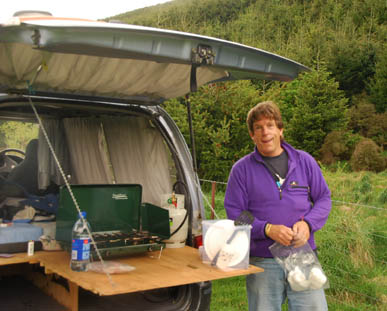
We had 11/11 a bit earlier than most of the planet (if you’re going by clock-time). We decided to kick ours off with a picnic, a short sage ceremony, and finished it off with an evening rainbow. Welcome – The Age of Aquarius.
11 min after 11AM on 11/11
The Author, another tailgate picnic in Roberts Canyon, NZ
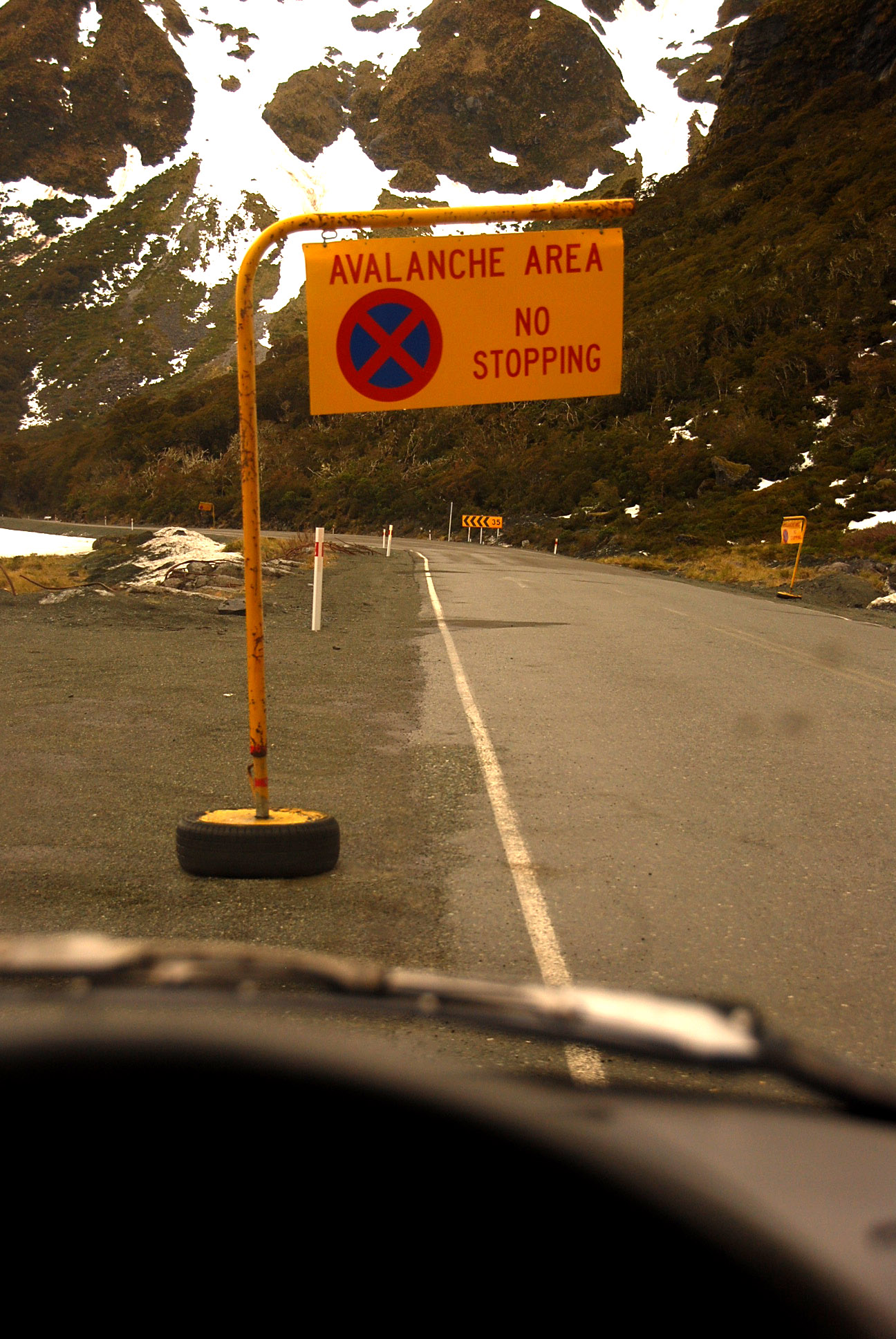
Milford Sound is renowned for its world class beauty, its fjords, hikes, and waterfalls, wildlife and dramatic alpine terrain. It’s something to put on your “must do” list, despite its popularity with so many that come to New Zealand. However, the drive through (and under) the mountains, on NZ Highway 97 and its the 1270 meter Homer Tunnel also got my attention. I’m looking forward to getting out into the Darran Mountains soon, where there’s granite and lots alpine adventure to be had.
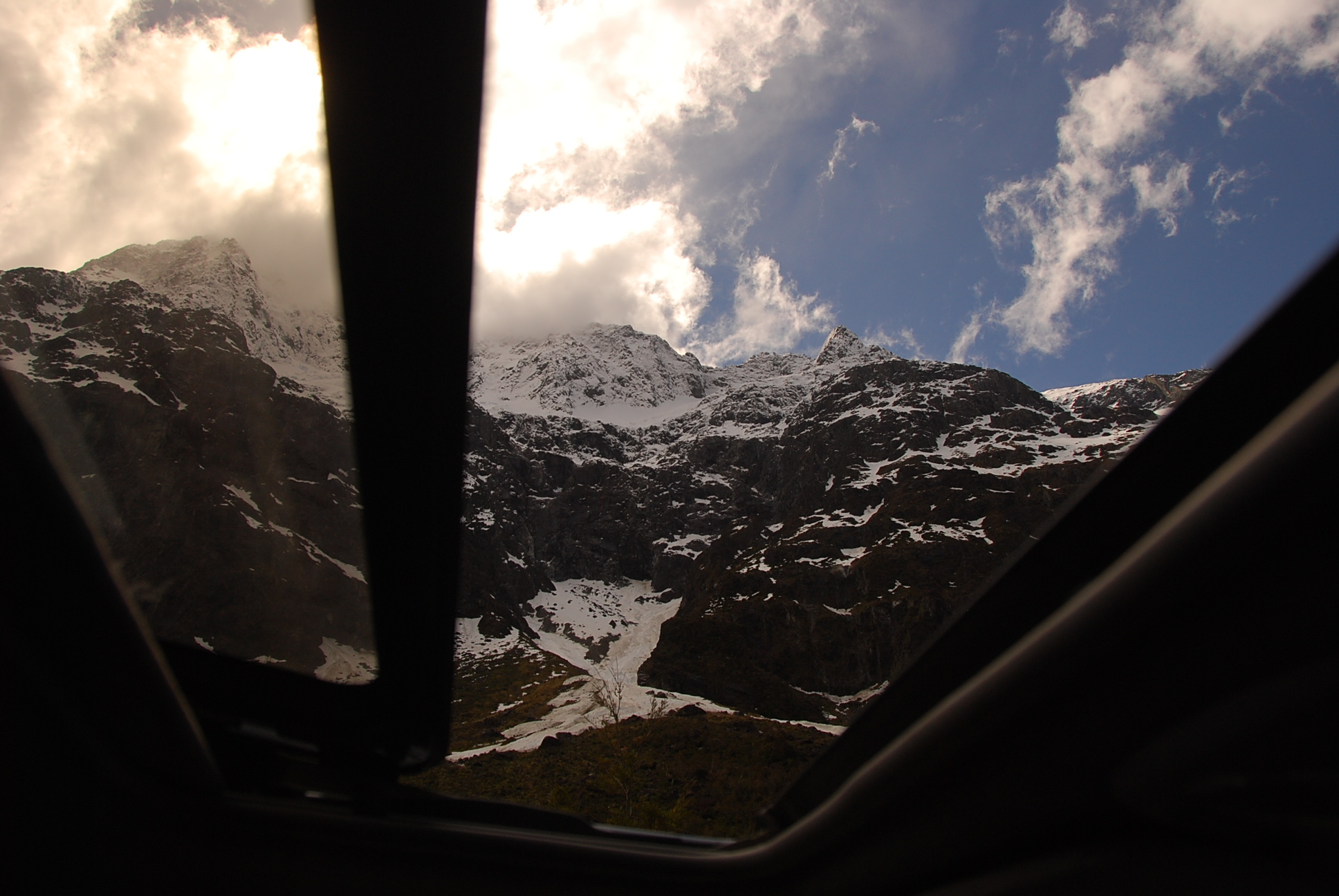
A sense of perspective and vertical relief from our sunroof
We took a day off, and drove over to Milford last month, and thought we’d share a few images.
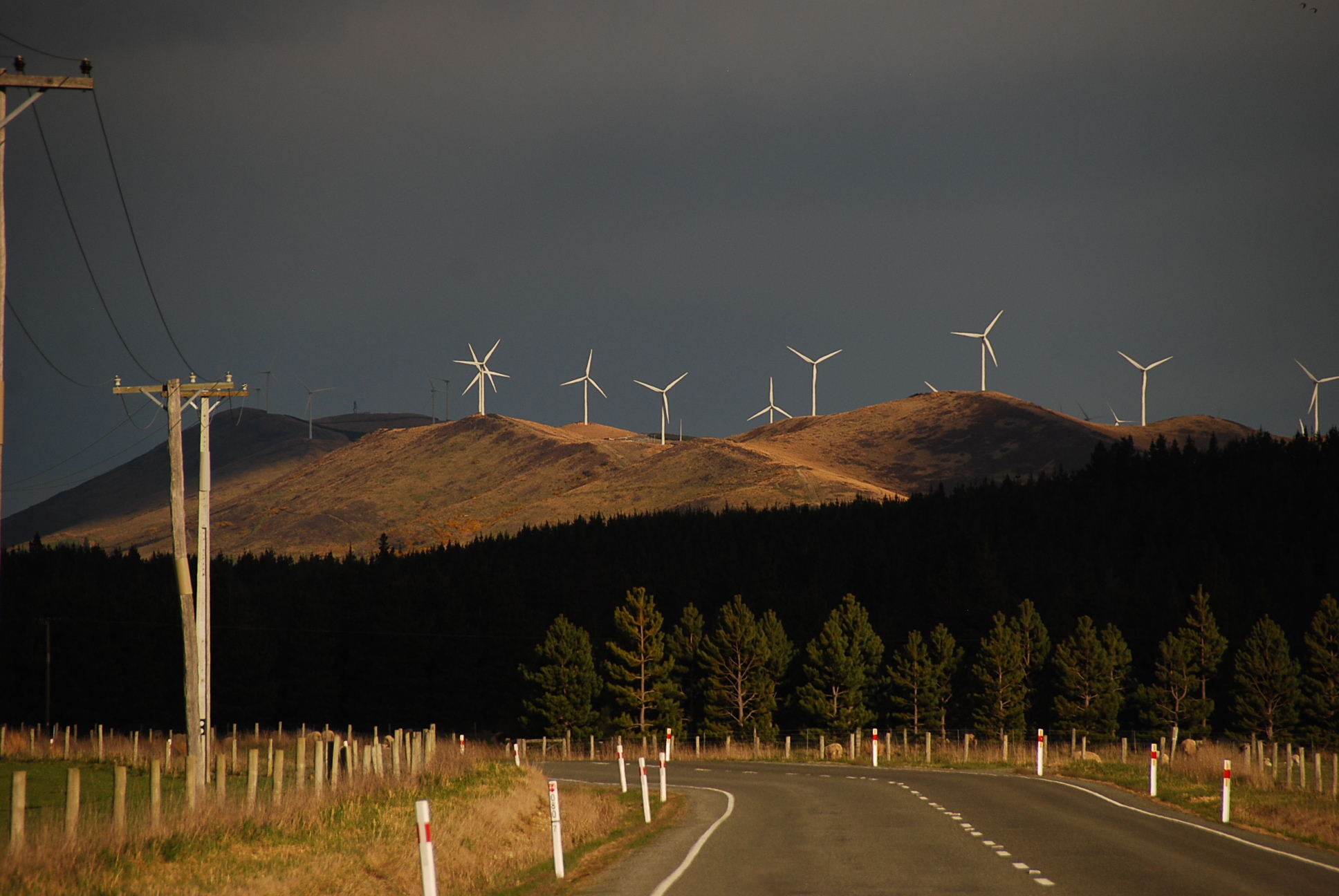
Heading back to Kingston, we caught a glimpse of the wind farm, which is somewhat controversial in this area, and stopped to take an image of the huge blades above the fields of sheep.
Yep, we did get out of the car, these are just some images taken along the road. More on the backcountry and Milford Sound in another post.
“Now I see the secret of making the best person: it is to grow in the open air and to eat and sleep with the earth.” Walt Whitman
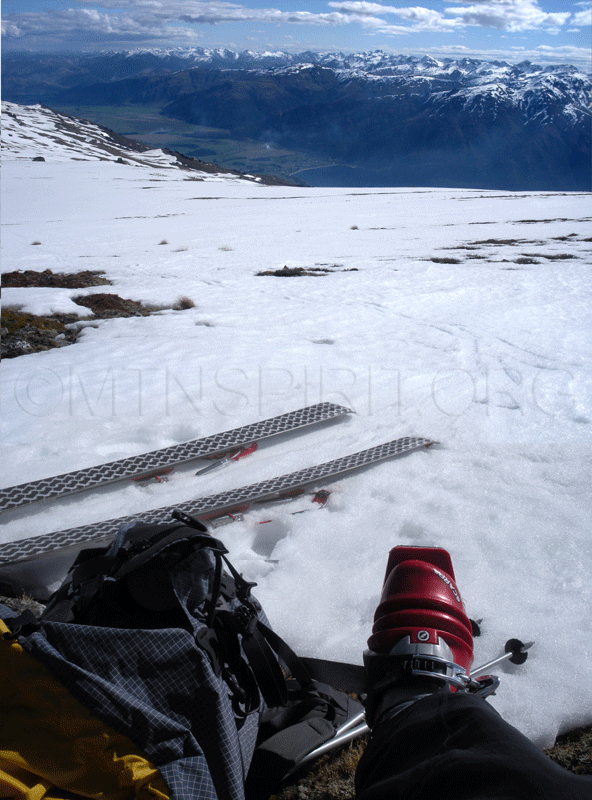
The other day, as the spring corn was coming onto the scene, I finally decided to investigate the moderate ridgetops of our valley here in the Wakatipu Basin in Kingston, New Zealand. The skiing wasn’t the steepest, and the “peaks” aren’t the sharpest in the Southern Alps, but the snow was damn perfect. After all, the first ski hut in New Zealand was just down the road on the Nevis Road. There must have been a reason for that being the first NZ ski field.
What I found after a two hour hike to snowline, were broad snowfields of cornsnow with some minor peaks along the ridge. Evidently this is where a snowmobile/heli-ski operation brought people up last season. I could see them lifting off, just across the road, and thought, “If they’re headed up there, must be something to it.” We live in Kingston, a sleepy little town, home of spectacular scenery, rock climbing, dramatic walks, a long pebble beach at the south end of the second largest lake in New Zealand, and home to an eclectic community that hasn’t been discovered by Queenstown yet. Oh I almost forgot to I mention the Kingston Flyer steam train, which is now up and running, after a number of years in receivership. Look closely at the image on right, the clouds of smoke are from the steam train’s maiden test run, and from the fires it started along side the tracks.
A long, fun day. Rising at 4:40 I hit the DOC trailhead by 5:30, and got back to the car around 18:30 I was a little tired, but jazzed. Fortunately there were freezing temperature up high, so by 10am, there was perfect corn on the northern aspects. I took some pix and video, so decided just to blend them into a movie for the day…Enjoy.
The Shweeb: Where's the passing lane? Aside from that, sign us up!
Shweeb’s bike-powered 200 meter monorail, pitched as an adrenalin-fueled sky cycling adventure in Rotorua, New Zealand, may be headed for bigger tracks. Google, who found out about it a few years ago, has been so enamored with the system, in which users are suspended form the track in transparent pods to cycle around the landscape a t speeds of up to 45 km per hour, they’ve invested 1.05 million in developing the technology. I t could be the future for alternative transportation, so Google claims. What one would do about traffic jams is something to ponder, but that’s a minor speed-bump compared to running fossil fuels till we’re extinct.
Marco Wells, Coronet Peak, NZ - Image: R. Richards
Last Friday, I had one of the strangest, (but good) experiences of my outdoor career – I took a 14-year old friend snowboarding for the first time in the mountains. However, it wasn’t his first time snowboarding . He had learned at one of forty indoor ski facilities in the world, Snow Planet in Auckland, New Zealand. He learned to board over of a number of years, but had never been outside on natural snow on a mountain. At Snow Planet they have a Poma style tow-lift. He had been on a chairlift once with his family, but that was in the summer without a snowboard on his feet. So combining his indoor boarding skills and one-time on a chair lift ride, gave him a collection of skills to head outside. Taking him up Coronet Peak’s chair for the first run, was like watching someone who was putting all the pieces together. He kept saying, “Look at all this snow!” and, “We’re high up on this chair”. His skills were solid and it was quite an amazing experience to see someone come out of their shell or out of their building. The next days were filled with a trip in the backcountry, and an afternoon at the Remarkables Ski Area, where he was exposed to all sorts of terrain and conditions and handled them admirably. It reminded some obscure fact of how many indoor rock climbers never climb on real rock, or never end up placing a piece of rock gear for protection on a climb, (what they quaintly call “trad”, I call climbing)
Anyway, congrats to Marco for coming out of the indoors ski gym and joining me in the mountains. Come out again soon! We’ll be waiting.
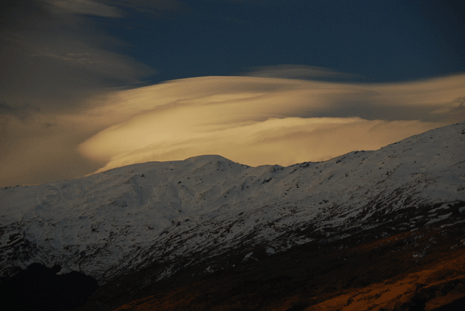
It’s been quite windy the last few days, but warming up here in Southern Otago, New Zealand. Spring skiing and ski-touring season. Lenticular clouds (Altocumulus lenticularis) are classic indicators of high winds aloft. As you can see, as the sun set last night, the winds were howling up on the ridgetops just north of the house. This view taken from our balcony.