Archive for the ‘Sustainable Living/Communities’ Category

Hugo Chavez at Copenhagen Conference

17/03/2010

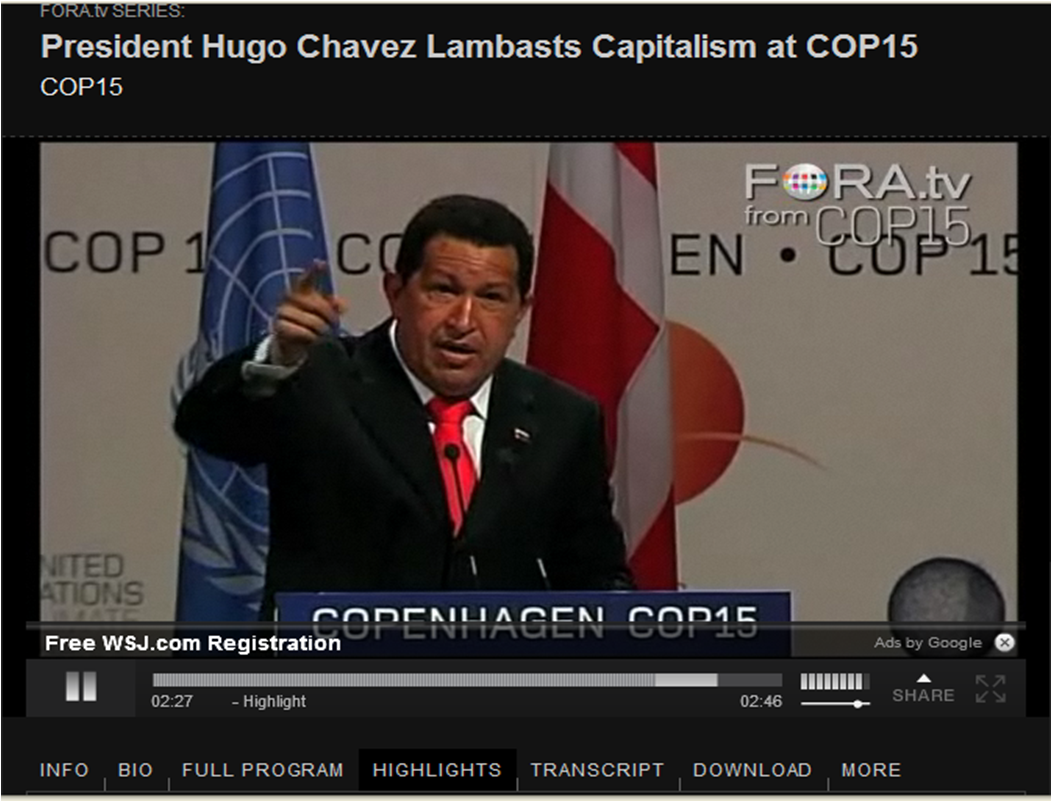
Chavez, calling it like he sees it

Venezuelan President Hugo Chavez links capitalism to the current state of global environmental degradation during an address on FORA.TV at the COP15 Climate Conference in Copenhagen.”A ghost is stalking the streets of Copenhagen…it’s capitalism, capitalism is that ghost,” says Chavez. He mentions in his address, a placard that demonstrators were holding up outside the conference building, which stated “Don’t change the climate, change the system”. He also stated, “If climate change were the banks, they would have saved it.”

Raw Milk as Food Rights Catalyst

17/03/2010

By: D.R. Richards

"Where's the Food?"*

We just attended a talk, sponsored by the Weston A. Price Foundation, given by author David Gumpert, who wrote The Raw Milk Revolution. The main point we took away from this informative talk was that raw milk is at the center of an issue about Americans loosing their right to choose what they eat and drink.
Says Gumpert, “The framers of the U.S. Constitution did not include the right to eat and drink what you wished. It wasn’t placed along the right to bear arms or to assemble  becuase growing your own food or purchasing it from your neighbors was a given”.  Gumpert also stated that international agencies such as the World Bank and others were trumping national laws via agreements and treaties that were eliminating U.S. sovereignty on such issues. This seems a bit hard to believe but true, at least on the food front.  To learn more or purchase The Raw Milk Revolution, see the publisher’s website. The book comes highly recommended from audience members who had read it. * Title of another interesting book written years ago on the subject of food supply rights.

Ghost Towns, Above and Below Water

12/03/2010

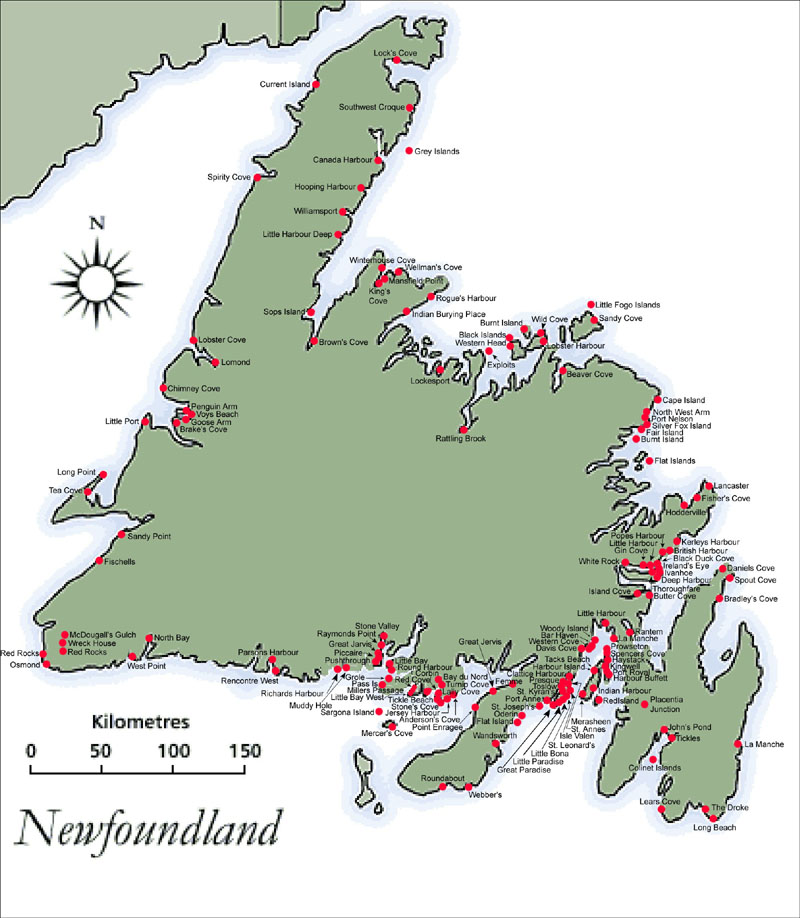
Newfoundlanders Abandon Villages, Cod Fisheries Gone

Child with Cod, circa 1895, from Greenpeace

After more than 400 years as the foundation of one of Earth’s great fisheries, cod are not coming back to Canada. The costs are more than environmental.

In the mid-20th century, cod supported more than 40,000 eastern Canadian fishermen. That’s when industrial catch techniques nearly tripled annual harvests. By the early 1970s, cod numbers plummeted.

Fishing stopped for a while. Cod came back. Fishing started again. Cod disappeared. In the early 1990s, the government halted fishing again, expecting the fish to return, just like before — but this time, they didn’t. They’ll likely vanish before mid-century.

Scientists can’t say for sure what’s going on under those cold gray waters, but they can speculate.

Newfoundland communities abandoned since 1960

There were likely too few cod to revive a population: individuals simply couldn’t find each other to reproduce. Some other species might have taken their spot in the web of life. The web itself has changed shape, and may no longer have room for them.

“You see this very rapid, drastic collapse of large predatory fishes that used to dominate, particularly cod,” said Boris Worm, a marine biologist at Dalhousie University in Nova Scotia. “You see a rapid collapse of those, and a shift of the ecosystem towards invertebrates and small pelagic fishes.”

Read the rest of this post

Politicians Will Not Change the World

01/03/2010

An Open Letter from a “Former Economic Hit Man”
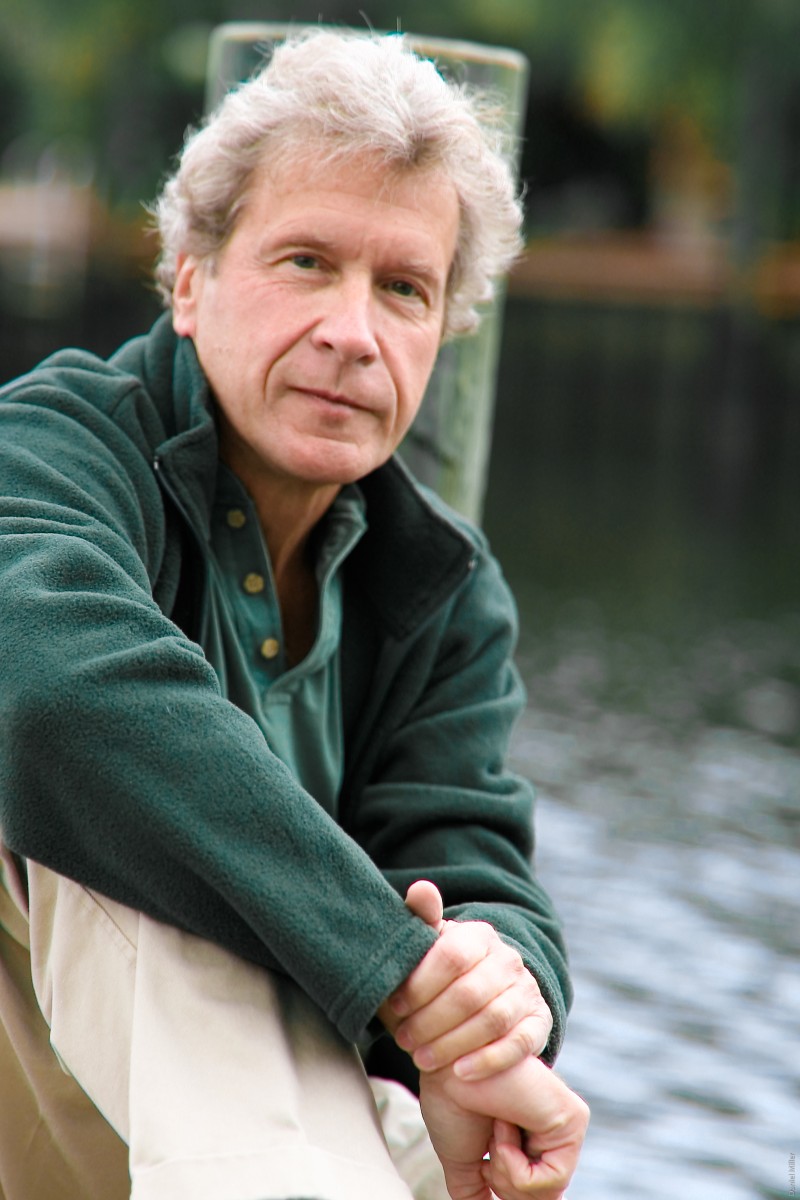
By John Perkins

Former "E.H.M.", John Perkins

[Editor’s Note: I have long been a fan of  New York Times Bestselling author John Perkins, after reading Confessions of an Economic Hit Man, which should be read by every citizen of the world – by Americans to see how our lifestyle impacts “third world” countries, and by those citizens in countries that have been taken advantage of by the “corporatracy”. Please Read on….]

“Many of you have asked how I feel about the Obama administration . . .

In short: the fact that we moved from a conservative Republican oilman from Texas to a liberal Democratic African American from Illinois, and yet change plods along at a snail’s pace – if at all – is a confirmation of what I discuss in detail in my “HOODWINKED.”

Our president has little real power. (more…)

Crop Mob Gathers

26/02/2010

By Christine Muhlke
New York Times Sunday Magazine

Image: David La Spina, NY Times

“Who brought their own wheelbarrow?” Rob Jones asked the group of 20-somethings gathered on a muddy North Carolina farm on a chilly January Sunday. Hands shot up and wheelbarrows were pulled from pickups sporting Led Zeppelin and biodiesel bumper stickers, then parked next to a mountain of soil. “We need to get that dirt into those beds over there in the greenhouse,” he said, nodding toward a plastic-roofed structure a few hundred feet away. “The rest of you can come with me to move trees and clear brush to make room for more pasture. Watch out for poison ivy.”

Bobby Tucker, the 28-year-old co-owner of Okfuskee Farm in rural Silk Hope, looked eagerly at the 50-plus volunteers bundled in all manner of flannel and hand-knits. In five hours, these pop-up farmers would do more on his fledgling farm than he and his three interns could accomplish in months. “It’s immeasurable,” he said of the gift of same-day infrastructure.  It’s the beauty of being Crop Mobbed.  Read the rest of this story
IMAGE:
The Crop Mob gathers mulch and finishes the greenhouse – just two of the day’s tasks at Okfuskee Farm in Silk Hope, N.C.
IMAGE CREDIT: David La Spina for The New York Times

Quebec vs. American Anxiety

26/02/2010

By D. R. Richards

Telltale signs of "joie de vive"

What is it, that makes Quebec, Canada a breath of fresh air for those of us who often escape there from the northeastern U.S.? It’s interesting to experience this question through the eyes of my wife, who’s from New Zealand, Australia and South Africa. She’s new to the U.S, and to New England, and is not afraid to share her observations. I always felt more comfortable when I lived in Europe, South America and New Zealand,  but, honestly, still struggle to put into words exactly why an ex-pat life could still be my destiny. I had my “Euro-epiphany” at 21, after having a chance meeting with Erga Rehns in Portugal. It took two years to sink in, and I almost didn’t return stateside. I still have that ex-pat perspective. I still look at the U.S. with the eyes of an foreigner.
My wife just got her Green Card a few days ago, on the 22nd, and the next day we were outa here, off to Magog, Canada. Partly because my birthday was on the 23rd, and partly because she was on the wait list for a Vipassana course for which she was accepted and started the following day.

Mt. Orford with "Visitor's Center"*

As we walked the streets of the little Quebec towns, and went for a walk at Mt. Orford Provincial Park, we discussed what exactly is it that makes us feel more relaxed away from the U.S.? Here’s what our conversation yielded: For one, the people take care, and pay attention of their food and time. They are not as stressed. Immediately it’s obvious that there isn’t an anxiety in the air –  in fact, there’s a calmness. Kids are smiling, people are quietly enjoying their week-day afternoon. We also concluded it takes a lot more effort in the U.S. to relax because of the nervousness of the collective consciousness. Today’s Health Care Summit in Washington illustrates the deep crisis Americans are experiencing about such basics as going to the doctor. In other countries, people are incredulous that there’s even a debate in the U.S. about profit over people. The idea that someone could lose their house should they become sick is a foriegn concept.  It would simply not happen in France or New Zealand, or in Canada. (See the movie Sicko)

Meditation: The Ripple Effect

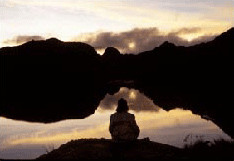
As I write this, my wife is sitting peacefully in the mountains of Quebec at a Vipassna retreat center. I feel the ripple effect, and I hope you do as well. Janice Vien, in her Iyengar yoga classes always closes with the phrase, “May the benefits of this practice be extended to others”. It’s clear Americans face difficult roads ahead because of the greed of the “corporatracy”. And yes, of course, one can keep their center no matter where one is, as put forth by Eckhart Tolle. But for those that are sensitive, the difference in  energy between the U.S. and Quebec is striking.
Maison Verte's B&B = Quality and Care

*The reason I put quotes around the Mt. Orford Visitor’s Center is the sense of scale in Quebec, and other countries is more realistic than in the U.S.  When one thinks of  “Visitor’s Centers”  in the U.S., usually the image of the Denali National Park, Arches National Park, or the Smithsonian most likely comes to mine. The Center is Quebec however, is a small lodge, (with fireplace, bathrooms and picnic tables), despite it being a popular national park.
When is Enough, Enough?

13/02/2010

Keeping Land Developers in Their Box
By D.R. Richards,
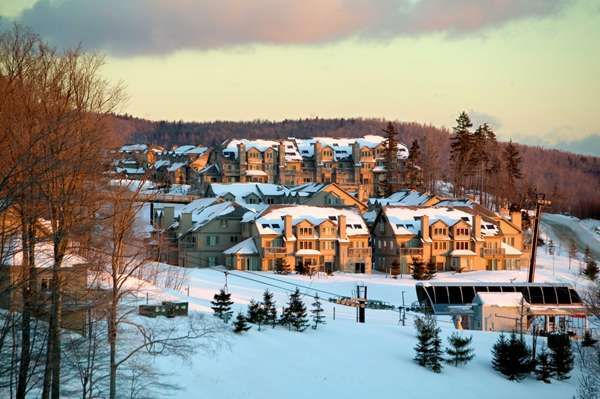
I remember that particular afternoon, when a friend and I talked about trying to do something to help save Mount Sunapee from the dread of slope-side condo development. Sullivan county, New Hampshire had no history* of activism, none, zero, zip. Being a native, of a conventional, conservative county, I had to really watch my thoughts of not wanting to make waves in my home town.  I didn’t want to stand out. Besides, people I talked to said there was “nothing that could be done”, “it was already a done deal”, or they were “going to develop the mountain and what could anyone do anyway”.  That particular afternoon, the friend and I decided to call a few people, and set up a meeting at the Abbott Library in Sunapee to see what could be done. That first meeting eventually led to the formation of Friends of Mount Sunapee.  (*Current FOMS Vice President Linda Dennis was a founding member of a previous Mt. Sunapee land protection group, but  at the time we convened, it was not active).

Mt. Sunapee has Friends

Never underestimate what the efforts of a few committed people can do in the face of deep pockets and driven land developers.  Thanks to many, (too many to mention here) the word spread about the threat to our State Park, and eventually it spread to the candidate for New Hampshire governor,  John Lynch.  Lynch has been the most popular Governor New Hampshire has seen, and because of his courageous stance to defend the state lands of Mount Sunapee, the developers decided to sue him, and the state of NH, because their imaginary back-door deal wasn’t honored.  Now I read the owners  are threatening to sue again. This time they’re stomping their feet at  the U.S. Forest Service in Colorado,  for again, not getting their desires met to expand their ski area. (For more info click here)

Overdevelopment is not pretty, Okemo, VT

It makes  one wonder how some can be so incredibly out of touch with reality, out of touch with the wishes of the locals and the natural environment.  I just watched the movie Avatar, (I still have a headache from the Imax 3-D version three days later) and the Muellers’  insatiable appetite for land and profit remind me of the miners in Avatar and their lust for the precious “unobtainium” mineral at all costs.
My dad was a developer. He built one of the first “funnel developments” on Lake Sunapee called Fisher’s Bay. (more…)

The ‘Fat Map’

04/01/2010

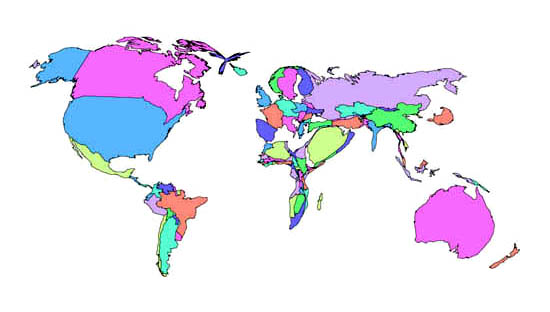
Putting World Hunger Into Perspective
From: The Huffington Post
By Princess Haya Bint Al Hussein
Hunger now scars the lives of over 1 billion people — a new record. Today, Monday the 16th, world leaders will gather at a UN food summit in Rome to debate what to do about it. As a former Goodwill Ambassador for the World Food Program, I sense how the meeting may go.

Per capita calorie consumption, nation by nation. By: World Food Program

There will be more media attention on the politicians than on the issues, an abundance of speeches, and a series of oddly fancy luncheons — with more speeches. At a similar luncheon, I remember wondering:  Read the rest of this article

Bottled Water: The Real Story

04/01/2010

The Real Story

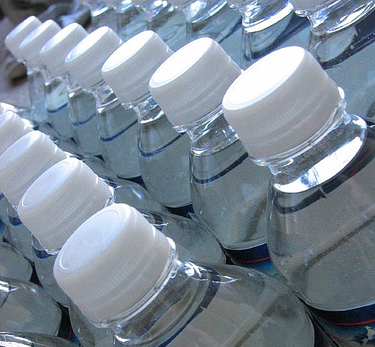
Too many bottles, The new faux pas

I recently received a flyer in the mail from Food and Water Watch, with the title: “America’s water should belong to each of us, not the companies that bottle and sell it. Not the corporations that want to privatize is. Take the pledge to protect your right to clean safe drinking water. Here’s what I’ve learned.

American consumers drink more bottled water every year, in part because they think it is somehow safer or better than tap water. They collectively spend hundreds or thousands of dollars more per gallon for water in a plastic bottle than they would for the H20 flowing from their taps.

Rather than buying into this myth of purity in a bottle, consumers should drink from the tap. Bottled water generally is no cleaner, or safer, or healthier than tap water. In fact, the federal government requires far more rigorous and frequent safety testing and monitoring of municipal drinking water. Read more

Bottled Water: Illusions of Purity : Not safer than tap water
Bottled water manufacturers are good at implying things. With glossy ads and labels depicting quiet mountain streams, a consumer is led to believe what they’re drinking is healthier than what comes from the tap. But chances are it’s not. In fact, municipal water is more tightly regulated than bottled water. (more…)

Plant Hope & Grow Happiness

27/12/2009

By Amanda Richards

An Eco-fable about planting trees

I picked up an excellent book on the week-end – one that I hope you will read. It’s an oldie but a goodie. This book is a magical and inspiring tale about a man who planted trees. It is also known as  The Story of Elzéard Bouffier, The Most Extraordinary Character I Ever Met.

It was first published in 1953 and is a timeless eco-fable about what one person can do to restore the earth. The hero of the story, Elzéard Bouffier, spent his life planting one hundred acorns a day in a desolate, barren section of Provence in the south of France. The result was a total transformation of the landscape-from one devoid of life, with miserable, contentious inhabitants, to one filled with the scent of flowers, the songs of birds, and fresh, flowing water.