Obama Legalizes Horse Slaughter for Human Consumption By Madeline Bernstein
Horse slaughter plants are legal again in the United States. Restrictions on horse meat processing for human consumption have been lifted. courtesy of Google Images
In a bipartisan effort, the House of Representatives and the United States Senate approved the Conference Committee report on spending bill H2112, which among other things, funds the United States Department of Agriculture. On November 18th, as the country was celebrating Thanksgiving, President Obama signed a law, allowing Americans to kill and eat horses. Essentially, one turkey was pardoned in the presence of worldwide media while in the shadows, buried under pages of fiscal regulation, millions of horses were sentenced to death.
Horse slaughter has been prohibited in the United States as funding for inspections of horses in transit and at slaughter.. Read the rest of this story..
If We End Corporate Personhood We Can Define the Terms of a New Economy by: Thom Hartmann, Berrett-Koehler Publishers | Book Excerpt
The prevalence of the corporation in America has led men of this generation to act, at times, as if the privilege of doing business in corporate form were inherent in the citizen; and has led them to accept the evils attendant upon the free and unrestricted use of the corporate mechanism as if these evils were the inescapable price of civilized life, and, hence, to be borne with resignation.
Throughout the greater part of our history a different view prevailed. (more…)
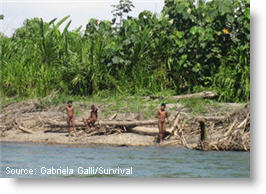
Peru’s government has said they are taking measures to protect an uncontacted tribe located in the south-east Amazon rainforest, nonprofit organization Survival International said in a press release.
“Government authorities in Peru have responded to Survival’s call to protect uncontacted Indians who have recently appeared on riverbanks near a popular tourist destination,” the organization said Wednesday.
The Indians are believed to be from the Mashco-Piro tribe in the Manu area. Tourists who visit the nearby national park have recently been leaving clothes on the riverbanks to “entice the Indians out of the forest,” Survival said.
The group has sent warnings to outsiders to stay out of their area. They recently hit a park ranger with an arrow with the tip removed as a warning sign, Survival said. “Uncontacted Indians lack immunity, Read the rest of this story..
Life has such an ebb and flow. One minute you can be riding the wave, the next minute you are under the wave. One minute you can feel safe and secure in your life, and the next minute you can feel totally threatened by something.
I find that when I meditate it helps me to separate myself from the sting of something to realize that it is all coming from God’s Divine Will. Usually the most emotionally charged things aren’t really that big of a deal anyway. (more…)
The Shweeb: Where's the passing lane? Aside from that, sign us up!
Shweeb’s bike-powered 200 meter monorail, pitched as an adrenalin-fueled sky cycling adventure in Rotorua, New Zealand, may be headed for bigger tracks. Google, who found out about it a few years ago, has been so enamored with the system, in which users are suspended form the track in transparent pods to cycle around the landscape a t speeds of up to 45 km per hour, they’ve invested 1.05 million in developing the technology. I t could be the future for alternative transportation, so Google claims. What one would do about traffic jams is something to ponder, but that’s a minor speed-bump compared to running fossil fuels till we’re extinct.
The Media Education Foundation does it again with another solid documentary, although this one, The Bro Code, is a bit hard to watch. The sad fact, that we all know, is that men are indoctrinated from day one to act and behave a certain way, especially towards women. This film lays bare the ways in which men get trapped into the tunnel vision of how they fit into the world.
In MEF’s powerful new release, The Bro Code, filmmaker Thomas Keith takes aim at the forces in male culture that condition boys and men to dehumanize and disrespect women. Keith breaks down a range of contemporary media forms that are saturated with sexism — movies and music videos that glamorize misogyny; pornography that trades in the brutalization of women; comedy routines that make fun of sexual assault; and a slate of men’s magazines and cable TV shows whose sole purpose is to revel in reactionary myths of American manhood. The message he uncovers in virtually every corner of our entertainment culture is clear: It’s not only normal — but cool — for boys and men to control and humiliate women. By showing how there’s nothing natural or inevitable about this mentality, and by setting it against the terrible reality of men’s violence against women in the real world, The Bro Code challenges young people to step up and fight back against the idea that being a real man means disrespecting women. Featuring interviews with Michael Kimmel, Robert Jensen, Shira Tarrant, J.W. Wiley, Douglas Rushkoff, Eric Anderson, and Neal King. To see the trailer click here..
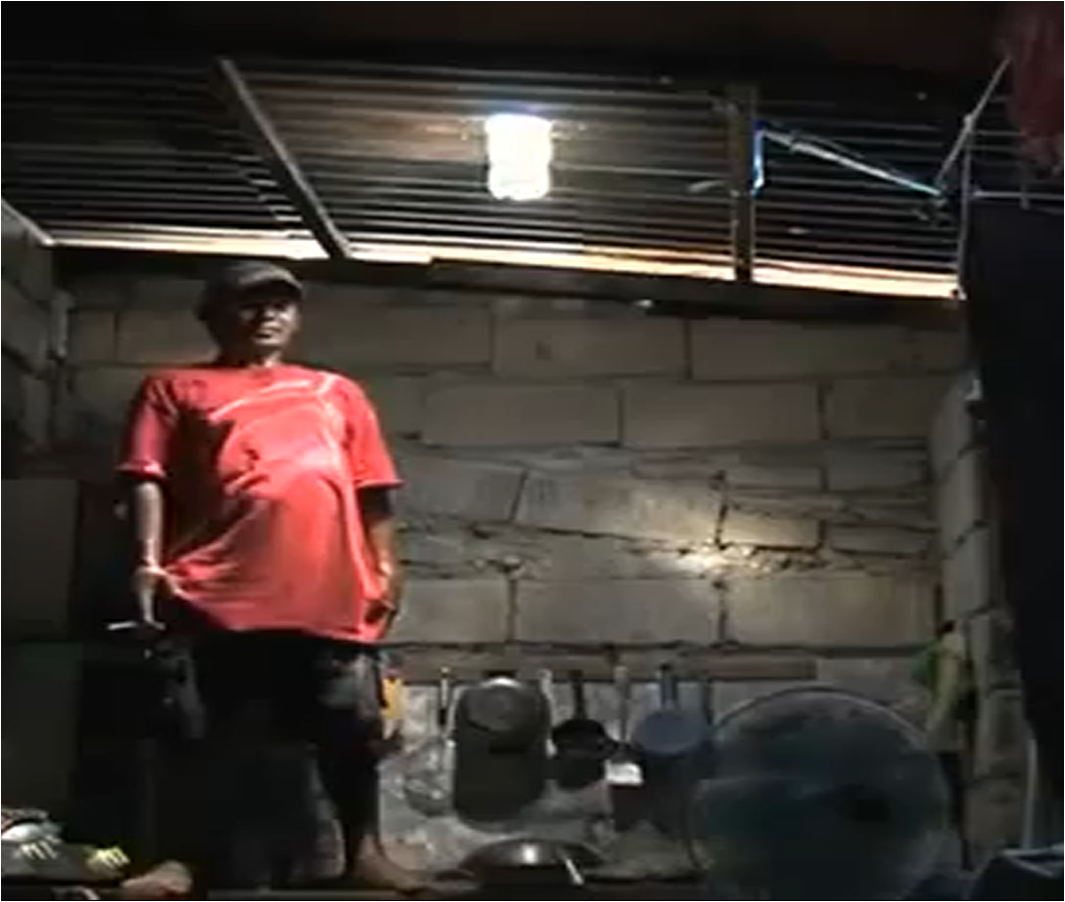
In the slums of Manila, an innovative project is shedding light on the city’s dim and dreary shanties. Plastic bottles jut from the roofs, bringing light to the dark dwellings below. The technology is as simple as it could be. Each bottle contains water and bleach. When placed snugly into a purpose-built hole in the roof, the home-made bulb refracts and spreads sunlight, illuminating the room beneath. Eco-entrepreneur Illac Diaz is behind the project. “What happens is, the light goes through the bottle, basically a window on the roof, and then goes inside the water. Unlike a hole which the light will travel in a straight line, the water will refract it to go vertical, horizontal, 360 degrees of 55 watts to 60 watts of clear light, almost 10 months of the year.” The initiative, known as “A liter of light”, aims to bring sustainable energy practices to poor communities, an idea originally developed by students at Massachusetts Institute of Technology. The bottles are designed to emit clear light for about five years, as the bleach prevents algae from building up in the water. For Erlinda Densing, a mother of eight, the technology has made a big difference to her small home.
“‘That’s only water?!’ my neighbors were asking. ‘That’s only water!’ I said to them. Basically, the sun’s rays are really bright. A lot of neighbours came and got curious. They were like, ‘can we see? can we see?’. Maybe they also wanted to have lights installed. ‘It’s really bright,’ I said.” The device can be built and installed in less than an hour. A sheet of corrugated iron serves as a support structure to hold the bottle in place, and prevent any leakage. “Liter of Light, lights up the house, saves a lot, but at the same time improves the standard of living across the board, of the bottom 90 per cent of this country.” Working with low-income communities, local governments and private partners, the project has installed more than 10,000 bottle lights across Manila and the nearby province of Laguna. Rey del Mundo is a volunteer.
“This is very important. Because at present, we’re too dependent on fuel that we don’t produce. Although we have some local production, it’s not sufficient for our needs. So if we strive to develop alternative sources of energy, which are the energy sources, this will help our country a lot.” For residents, it means less money spent on electricity to power lights during the daytime, and more money on food. While for Diaz and his volunteers it’s quite simply a bright idea.
Humala Signs Prior Consultation Law During Jungle Ceremony by Andean Air Mail & PERUVIAN TIMES
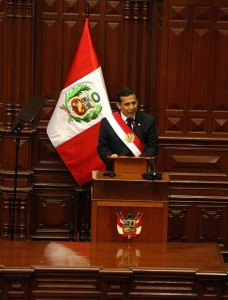
President Ollanta Humala enacted the prior consultation law on Tuesday during a ceremony in the north jungle town of Bagua.
The bill was unanimously approved by Congress and has been strongly supported by international and national rights organizations. It is intended to ensure that Peru’s local laws are in compliance with the International Labour Organization’s Convention 169.
The convention requires the State to consult indigenous people prior to adopting administrative and legislative measures, as well as investment projects and development plans, that could affect their communities.
“This law has the objective of [promoting] development for native peoples, of the Amazonian communities and the entire region,” Humala said. “That is the spirit of this law.”
“Today we have taken an important step in the construction of a nation, the construction of a republic,” Humala added.
Ex-President Alan Garcia rejected a similar prior consultation bill during his recent term, expressing worries that the legislation would provide veto powers to indigenous communities that could deter mining and energy projects.
Humala and members of his Gana Peru party have said the new law will help address the more than 200 social conflicts in Peru that have impacted projects in the extractive industries.
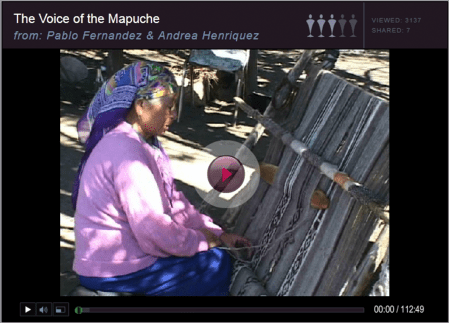
The Mapuche are an indigenous people living in central Chile. Their cultural center is the town of Temuco. This film was voted the People’s Choice on Culture Unplugged. To view the
South America Unites Against “Irresponsible Debtors” in the North By: Mario Osava, Inter Press Service
North American Funny Money
Default, insolvency, fiscal irresponsibility, debt crisis and similar terms form part of the vocabulary used to describe countries in the developing South in the 1980s and 1990s. A decade later, the world seems to have turned upside down.
The “irresponsible debtors” are now in the industrialized North, and the countries of South America, victims of the “lost decade” of the 1980s and the subsequent financial crises, are now working hard to protect themselves against contagion from the crisis in the United States and Europe.






 Mountain Spirit's Blog