Archive for the ‘Sustainable Living/Communities’ Category
07/06/2010

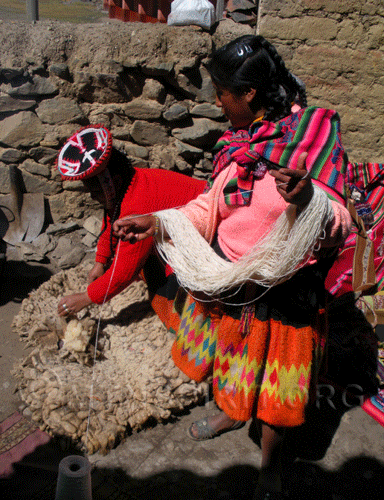
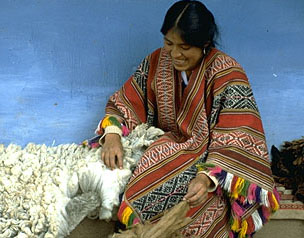
Weavers: Willoc, Peru
Dr. Andrea Heckman an expert on Quechua weavings, will show a documentary film at the South American Explorers Club in Cusco, Peru on Thursday June 10th at 7 p.m. The film tells the story of Quechua villagers near the sacred peak of Ausangate.
Set against a backdrop of high Andean lakes and mountains, it shows a harsh existence but also a deep interconnectedness with the natural forces and their ritual relationships to the mountain, revealed in various festivals, weaving and other traditions.
If you’re in Cusco, and want see the film, contact the SAE in Cusco.
Tags:Ausangate, Cusco, Dr. Andrea Heckman, Peru, Quechua weavings, South American Explorers Club
Posted in Fair Trade, Film/DVD, Mountain People, Peru, South America, Sustainable Living/Communities, Sustainable Travel | Leave a Comment »
07/06/2010

Guevara's Granddaugther for PETA
In the last few years, interesting graffiti has been popping up through out South America. “Vegan Straightedge” and “Vegan Revolution” can be found on street corners if one searches. It’s a fascinating movement and even more intriguing that it is spreading through South America.
“Meatless Mondays” have caught on in the United States and may be making a jump down south. Che Guevara’s granddaughter (left) showed her support for the cause last year by posing for a PETA, People for the Ethical Treatment of Animals, ad.
Image: The granddaughter of Cuban revolutionary leader Ernesto “Che” Guevara is at the forefront of another revolution — for vegetarianism. Read more..
Tags:Che Guevara, Lydia Guevara, PETA, South America, Vegan Revolution
Posted in Conservation, Fair Trade, Holistic Living, Peru, Sustainable Living/Communities | Leave a Comment »
21/05/2010

Chevron's Logo?
Please sign this petition to Chevron’s CEO, Mr. Watson asking that Chevron finally do the right thing in Ecuador. (En español aquí)
Dear Mr. Watson:
As the new CEO of Chevron, climate change and the environmental and human rights impacts of Chevron’s operations are the two issues that will define your tenure at the helm of one of the world’s largest oil companies. Chevron has fallen behind other businesses and many political leaders already taking a leadership position on climate change. Furthermore, your company is drawing increasing criticism for failing to rectify its massive human rights and environmental disaster in Ecuador. Taking the following steps will demonstrate a true commitment to environmental responsibility and respect for human rights – which will only strengthen your company’s future.
We the undersigned call on Chevron CEO John Watson to:
* Clean up Chevron’s toxic legacy in Ecuador, compensate affected communities for health and environmental impacts, and provide affected people real access to health care and potable water.
* Develop a global environment and human rights policy that will prevent similar tragedies in the future.
* Adopt aggressive strategies to provide clean energy to a carbon-constrained world.
Tags:Chevron Petition, civil and environmential rights, Climate Change, Ecuador, Environment, John Perkins
Posted in Conservation, Environment, Room For Improvement, Sustainable Living/Communities | 1 Comment »
21/05/2010
By John Perkins
Sent by email, also published in the Huffington Post

John Perkins
While countries around the world continue to watch their economies collapse, and Goldman-Sachs leaders testify to Congress about how they manipulated both their shareholders and the American public, we are also faced with a tragic oil spill on our most fragile coastlines.
The sad truth is that oil, greed and fake accounting work hand in hand to empower those who have — and significantly disempower those who do not.
In my book, Hoodwinked I talk about the 30,000 Ecuadorians who filed a lawsuit against Texaco (since purchased by Chevron). The company destroyed vast sections of rain forest and the toxic wastes from its operations allegedly killed many people and made many more chronically sick. (more…)
Tags:Greed, Gulf Oil Accident, Hoodwinked, John Perkins, Oil Spill
Posted in Books, Climate Change, Conservation, Environment, Fair Trade, Room For Improvement, Sustainable Living/Communities, This Just In Department | 1 Comment »
18/05/2010
Book Describes How to Transition
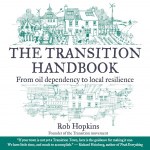
Adapt or Die
“If your town is not yet a Transition Town, here is guidance for making it one. We have little time, and much to accomplish.”
Richard Heinberg, Post Carbon Institute, Santa Rosa, California, author of ‘Power Down’ and ‘Peak Everything’
We live in an oil-dependent world, and have got to this level of dependency in a very short space of time, using vast reserves of oil in the process – without planning for when the supply is not so plentiful. Most of us avoid thinking about what happens when oil runs out (or becomes prohibitively expensive), but The Transition Handbook shows how the inevitable and profound changes ahead can have a positive outcome. These changes can lead to the rebirth of local communities, which will grow more of their own food, generate their own power, and build their own houses using local materials. They can also encourage the development of local currencies, to keep money in the local area.
The book has three sections, Read more
Tags:Peak Oil, Post Carbon Institute, Richard Heinberg, The Transition Handbook, Transition Towns
Posted in Books, Climate Change, Conservation, Environment, Holistic Living, Leadership, Sustainable Living/Communities | Leave a Comment »
07/05/2010
If Group Meditation reduced violent crime in Washington DC, what could a massive healing meditation do for the world’s waters?
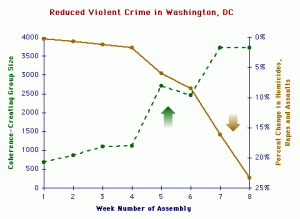
Startling & Postive Results
Below is a writeup on the now-oft quoted meditation event in Washington DC. Then read further, about a worldwide meditation event scheduled for May 18th at 15:38 EST to send healing prayers to the world’s waters.
From alltm.org
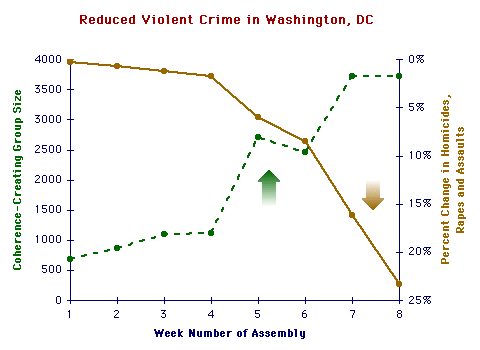
A study published in the peer-reviewed journal Social Indicators Research reports on one of the most dramatic sociological experiments ever undertaken. Researchers predicted in advance that the calming influence of group meditation practice could reduce violent crime by over 20 percent in Washington, D.C., during an 8-week period in the summer of 1993.
In fact, the findings later showed that the rate of violent crime–which included assaults, murders, and rapes–decreased by 23 percent during the June 7 to July 30 experimental period. The odds of this result occurring by chance are less than 2 in 1 billion. Rigorous statistical analyses ruled out an extensive list of alternative explanations, according to John Hagelin, (more…)
Tags:Arizona, Council Meeting of the International Council of 13 Indigenous Grandmothers, Crime, Fairfield, Group Meditation, Healing Waters Meditation, Institute of Science, Iowa, John Hagelin, Social Indicators Research, Technology and Public Policy, Transcendental Meditation, Washington DC
Posted in Climate Change, Environment, Holistic Living, Inner Work, Service, Spiritual, Sustainable Living/Communities | 2 Comments »
03/05/2010

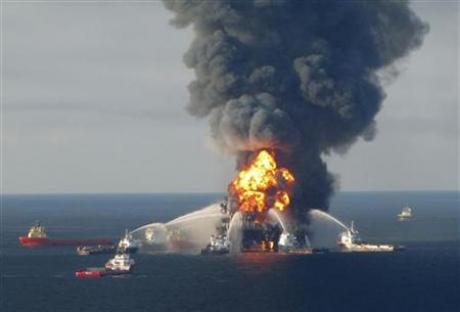
Gulf Oil Spill 2010, Image: Reuters, UK
I can’t help but think, with the Gulf oil spill, that we’re simply fleas on the back of a living organism that’s about to shake us off. The spill is big. A retired expert mentioned this morning on The Power Hour internet radio show with Joyce Riley said there is not an easy way to stop such a huge oil spout, which is under such high pressure. It’s escaping the man-made hole created thousands of feet under the ocean’s surface. The expert actually said the only way he knew of containment, was to use an atomic blast, placed just in the right way, to seal the hole.
In any event, Chief Sealth from the Pacific Northwest was right, “We do not own the earth.” This latest mishap by us, seems to really be screwing things up. To be more informed on a culmination of “the perfect storm” read Richard Heinberg’s Peak Everything which addresses a number of issues which are peaking on our planet today.
Below if from Amazon’s page on Peak Everything.

Heinberg is Brilliant
From Publishers Weekly
In his latest, “Peak Oil” expert Heinberg (Oil, War and the Fate of Industrial Societies) puts that theory in place alongside corresponding peaks in population, food production, climate stability and fresh water availability to paint a grim future of overlapping and accelerating global crises. For an introduction to Peak Oil, the idea that coming fossil fuel shortages will be sudden and drastic, readers should seek Heinberg’s earlier works; this volume assumes familiarity and addresses the challenges a post-carbon world poses for a global community “as reliant on hydrocarbons as it is on water, sunlight, and soil.” The worst-case scenario, “global economic meltdown” read more
Description of Peak Everything
The twentieth century saw unprecedented growth in population, energy consumption, and food production. As the population shifted from rural to urban, the impact of humans on the environment increased dramatically.
The twenty-first century ushered in an era of declines, in a number of crucial parameters:
* Global oil, natural gas, and coal extraction
* Yearly grain harvests (more…)
Tags:Bill MicKibben, Environmental Damage, Gulf Oil Spill, Lester R Brown, Peak Everything, Plan B, Richard Heinberg, Worldwatch Institute
Posted in Climate Change, Conservation, Environment, Sustainable Living/Communities | 2 Comments »
11/04/2010

Weaving in the Peruvian Highlands
Handwoven Fabrics: Living History
Handwoven fabrics are the living history and cultural treasure of the Peruvian Highlands. The weavers who create these extraordinary textiles are the keepers of the culture and sustainers of a noble but difficult lifestyle in tune with the earth. This book, Weaving in the Peruvian Andes celebrates their authentic, well-crafted work by showing varied and distinctive styles of traditional clothing, the basics of how fabric is created from spinning to dyeing to weaving, the way traditional crafts are passed from one generation to another, the names and meaning of the myriad textile designs that reflect the culture and history of the people, and the rituals and celebrations in which woven fabrics play such an important role.

N.C. Alvarez
Author Nilda Callañaupa Alverez is founder and director of the Center for Traditional Textiles of Cusco. She has established weaving associations through the Andean highlands to preserve a tradition of handmade textiles and to promote economic development. She lives in Cusco and in her native community of Chinchereo, Peru.
All proceeds from the sale of the book benefit the Center of Traditional Textiles of Cusco.
Mountain Spirit Institute focuses on weaving during our educational programs in Peru. Learn more at www.mtnspirit.org
Tags:Center for Traditional Textiles of Cusco, Chinchereo, Cusco, Mountain Spirit, Nilda Callañaupa Alverez, Peru, textile designs, Weaving in the Peruvian Andes
Posted in Archeology, Books, Fair Trade, Holistic Living, Peru, South America, Sustainable Living/Communities, Sustainable Travel, Traveling | Leave a Comment »
07/04/2010
Another Tear-Down
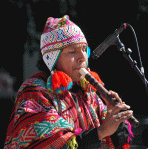
Seminario, performing in Keene, NH
Guillermo Seminario, the director of Chimu Inka, the Peruvian band came to the U.S under invitation from Mountain Spirit Institute to run a program to perform and teach about Peruvian folklore music in 2008. In one Vermont town, we were being housed in a very nice old residence in one of the more ritzy parts of town. At one point during the evening, Guillermo turned to me, shaking his head, saying, “In Peru, there are children without food, and a place to sleep.” He queried, “It confusing me, seeing such wealth in your country when Peru is so poor in many parts of my country.”
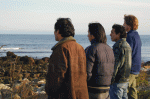
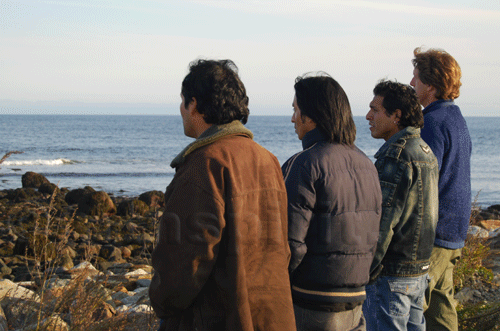
Our Peruvian Guests on the Coast, NH
We have thought and discussed this much since that day. Tearing down a perfectly good house just doesn’t seem right.
It’s more than, “Finish your broccoli, there are people starving in other countries,” but it stems from the same disconnect. It’s true the U.S and other 1st world country’s inhabitants are happily oblivious to our role in contributing to The Empire’s excesses. It’s time to think small, and stop the waste. I have a gut feeling this level of living will not continue, mostly due to peak oil. It’s actually quite obvious.
Tags:Confessions of an Economic Hitman, Guillermo Seminario, Imperialism, Lake Sunapee, NH, Peru, Rebuilding, Sunapee, Sustainability, Teardowns, Tearing down homes, Waste
Posted in 1- Video Posts, Conservation, Environment, Peru, Room For Improvement, Sustainable Living/Communities | Leave a Comment »
29/03/2010
An interesting account of the fate of Atlantic Salmon caught off the coast of Norway

Salmon, after a long trip
By Sarah Murray
Orion Magazine
For ordinary humans, the extraordinary migration of salmon is difficult to imagine. Take Chinook salmon. Some of these fish swim from the Columbia River up to Canada and beyond, covering up to sixteen miles a day. Calculated as body lengths per second, that would be the equivalent of a human swimming more than 160 miles a day—fast enough to circumnavigate the equator in 150 days. Migrating fish also cover vast distances. In its trans-Pacific migration, a tagged bluefin tuna was found to have covered an amazing twenty-five thousand miles—a distance greater than the Earth’s circumference.
If the mileage clocked by these fish sounds impressive, it is nothing compared to the journeys some of them take after their death. Read the rest of this article.
Tags:Atlantic Salmon, Chinook Salmon, Columbia River, Fish Processing, Norway, Sarah Murray
Posted in Animals, Conservation, Environment, Sustainable Living/Communities | Leave a Comment »






 Mountain Spirit's Blog