Posts Tagged ‘history’

Music as Protest, US, Vietnam & New Zealand

29/09/2024

By Randall Richards
Performing Music to Protest & Educate: Past, Present, & Where to From Here?

When I started a couple of volunteer music venues as listening rooms which I named “Coffeehouses”, one in Leavenworth, Washington and a second, in Sunapee New Hampshire (which is still going strong), Little did I know the history of the term CoffeeHouse.

I recently happened to stumble upon this interesting definition of the term, but never realized its origin when I had created those coffeehouses in the states. Interesting how things turn out: “GI Coffeehouses” were a consequential part of the anti-war movement during the Vietnam War era, particularly the resistance to the war within the U.S. military. They were mainly organized by civilian anti-war activists as a method of supporting anti-war and anti-military sentiment

. The FTA Roadshow was explicitly created in the ’70’s as a counter to Bob Hope’s pro-war USO tour. Original cast, from left: Gary Goodrow, Jane Fonda, Donald Sutherland, Peter Boyle, Dick Gregory, and Barbara Dane at the Haymarket GI Coffeehouse near Fort Bragg.

We started the first venue in Washington State because I had been a professional pianoplayer for years, and budding singer/songwriter on the guitar. I wanted to perform in a supportive listening room environment. 

I had taken note of one such venue in a Sedona, AZ bookstore.  Since I could only find bars and pubs, where venues treated the artists as background musicians, I wanted no part of that.So I decided to give it a shot by approaching a local hotel owner who was willing to let me set up on Friday nights in his unused conference space and stage in Leavenworth, WA. More on that winning formula in another piece.

Here’s the East Coast’s Sunapee Community Coffeehouse, still going strong after many years!


New Zealand:
Fast forward to New Zealand, 2021 in the thick of mandates, and other general draconian measures pushed upon the population, based on a injection that was neither safe nor effective. We started having occasional bonfire music jams, and a like-minded Saturday Market, primarily for our freedom loving community (but all were welcome) in the Upper Clutha region of the South Island.

  About six months ago I decided to apply to be one of the 16 international chapters of Jam For Freedom, backed by Eric Clapton. We were welcomed with open arms.

We have yet to hold our inaugural event. I’m still in the process of reaching out to additional musicians in the country who have been part of either the Wellington Protests, were featured in The River of Freedom and We Came Here for Freedom documentaries. Once we have a critical mass of freedom loving musicians, we’ll create an event,

We’ll also create traveling Jam For Freedom (Coffeehouse type roadshow), starting with the South Island based on the Coffeehouse formula I had started in the U.S., but simply a mobile version. That means a featured performer, followed by an open mic, a “trained” listening room audience, and passing the hat for the musicians, venue hire, and roadshow expenses,). I have a van, a waterproof trailer for the music gear, and just need some JFF branding for the vehicle and a stage backdrop.

Vietnam:
My family and I just toured of Vietnam, and I’m now writing a few pieces, not about the tourist side, but the impact of the war museums, the wonderful people we met, the stories I was told, and most recently, a book I’m reading called Understanding Vietnam explaining not only the war, but the deep seated psyche of the Vietnamese.
During a visit to the War Remnants Museum in Ho Chi Min City, I found these images on display:

Yo koi Kumiko sings to solders in the artillery battleground in Quang Binh Provence, 10 December, 1973
“A rally against US aggression in Vietnam from Japan’s Beheiren, Tokyo, 1972

This might be the time to premise some the articles I’m working on about Vietnam’s view of the US Occupation of Vietnam. They call it the “American War”, by the way. I went to Vietnam with some ingrained knee-jerk conditioning, courtesy of our government’s controlled media in the states. That paradigm quickly dissolved. Of course I could see Vietnam’s plugging their side of the story as well. But I do have discernment, and will talk about that in later posts.

Although there is a history of protest music from the US side I assume there’s more about Vietnam’s side, protesting war. However, this was the first time I it was on my radar.
The historians will write about such protest songs being written now, not only about anti-war, but about various nefarious agendas that aim to curb our freedoms, hurt our children and enslave the world’s population. Music is one of the best ways to call out the troublesome behaviors of those powerful people in charge who obviously don’t have our best interests in mind.

Comedy is a another avenue to opening the dialogue where direct debate and conversation often fail to bridge the gap between different paradigms. Jim Breuer’s Somebody Had to Say It, is a case in point.


So wish us luck with our Jam For Freedom adventure here in New Zealand! If you’re a musician get in touch! If you’re a friend of mine, who happens to be living stateside, or elsewhere, I also invite you to join in the conversation on our Jam For Freedom Telegram chat or the International Telegram group. Even though the NZ chat is focused for us here in New Zealand, I feel, the more the merrier. We could use the moral support! Did you guys hear that… Kirtana, Neal Fox,  Scot Bergeron, Conspiracy Music Guru?

THANKS TO:
A special thanks goes to those New Zealand musicians who performed at our protest on Parliament grounds and were featured in those documentaries mentioned above, and to those who have joined our Jam For Freedom NZ Telegram Group. Also thanks to all the steering committee and volunteer members of the West and East Coffeehouses who have worked hard to deliver live music in a listening room for so many years.

A special acknowledgement again to Neal Fox for being ahead of the curve, and for his unflinching creative stance in music compositions and film-making productions, and sticking it to the “all powerful”. You can see his work here.

Learn more about the Coffeehouse concept here. Start one in your community! You learn more about Randall’s music here. Our music studio is open for musicians-in-residence who would like to be pampered and be free to write and record in our small studio set in the mountains of the Southern Alps of NZ.
Vietnam: Hunting Down The Heli-Pad

24/09/2024

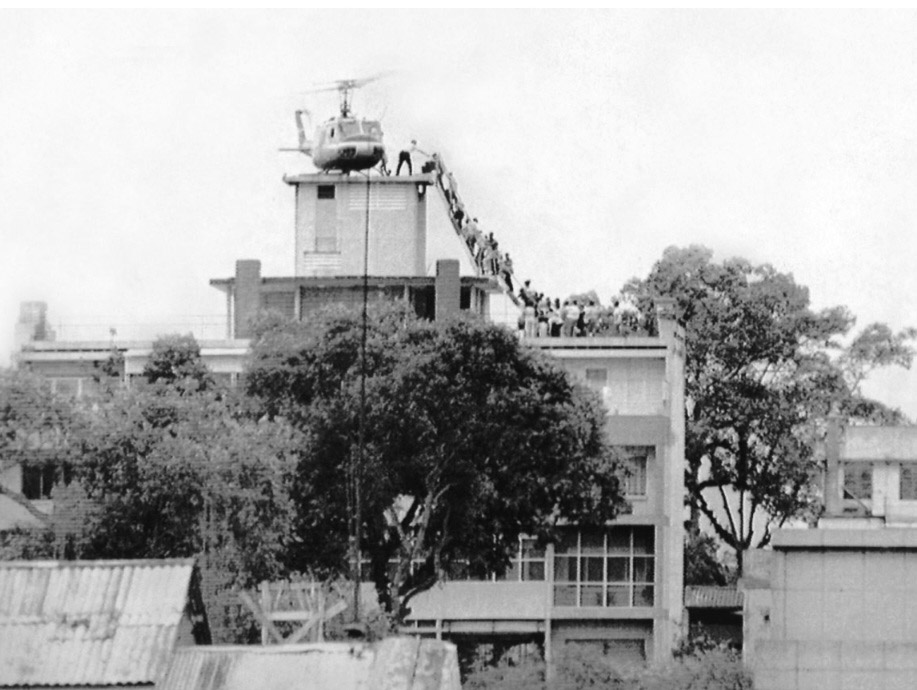
If you grew up in the Televised Vietnam War Era as I did, one photograph stands out among many. That is the image of the helicopter airlifting people off the top of a building during the last hours of the fall of Saigon.

Image Credit: Hubert Van Es

My family and I recently went to Vietnam for seven weeks, and frankly, I almost had a nervous twitch flying into Hanoi, which lies in the northern part of the country. It was something visceral, something in my programming from watching night after night of death tolls and visuals of bombs being dropped from B-52 planes. Those daily kill tolls was akin to a football tally – Bonkers in hindsight.
I’ve already posted a couple of entries when we were traveling. But now I’m going to tick off a few articles I have in the hopper. And where to start? Well, not at the beginning this time. I’ll start at the end with the Fall of Hanoi and this image above.
My main thrust of the pieces I’ll post, are not touristy, rather, to show what I learned while there, and how it pertains to the ol’ “People and countries who don’t learn from the past, are doomed to repeat it.” mantra. So the themes and points I’ll be writing about, pertain just as much about today’s political shenanigans as they did during the “Vietnam War,” which forthwith I’ll be calling “The American War”. Because, it’s all about perspective.

Vietnam was my first trip to Asia. A typical U.S. Citizen, I had traveled, but to South America and Europe. So I had my eyes opened by the wonderful proud people of Vietnam, the museums and history of this nation, and a glimpse of what makes Vietnamese people who they are and how they see the world and themselves in it. But more on that in later articles.
Back to this helicopter image: While in Ho Chi Min (Saigon), I kept wondering if the building featured in the image still stood, and if so, where might i find it.
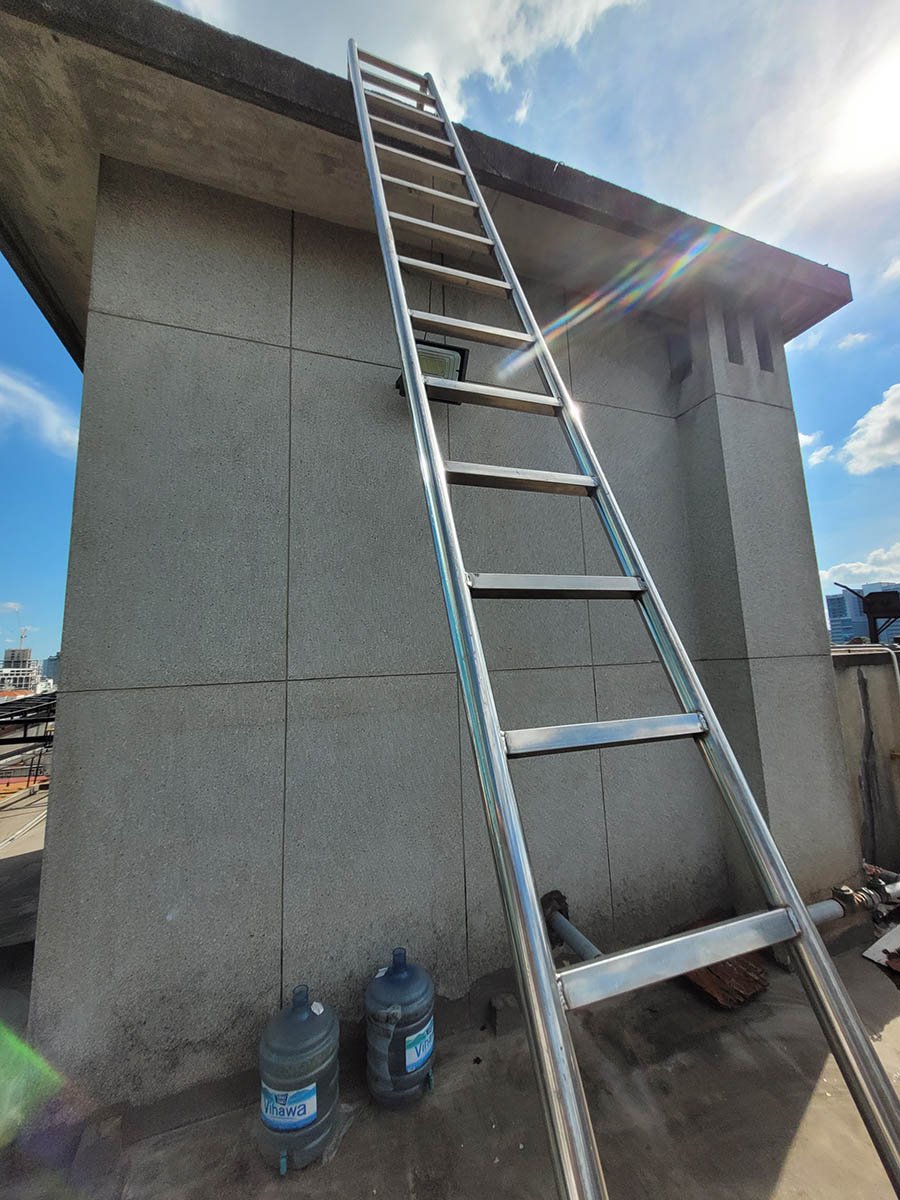
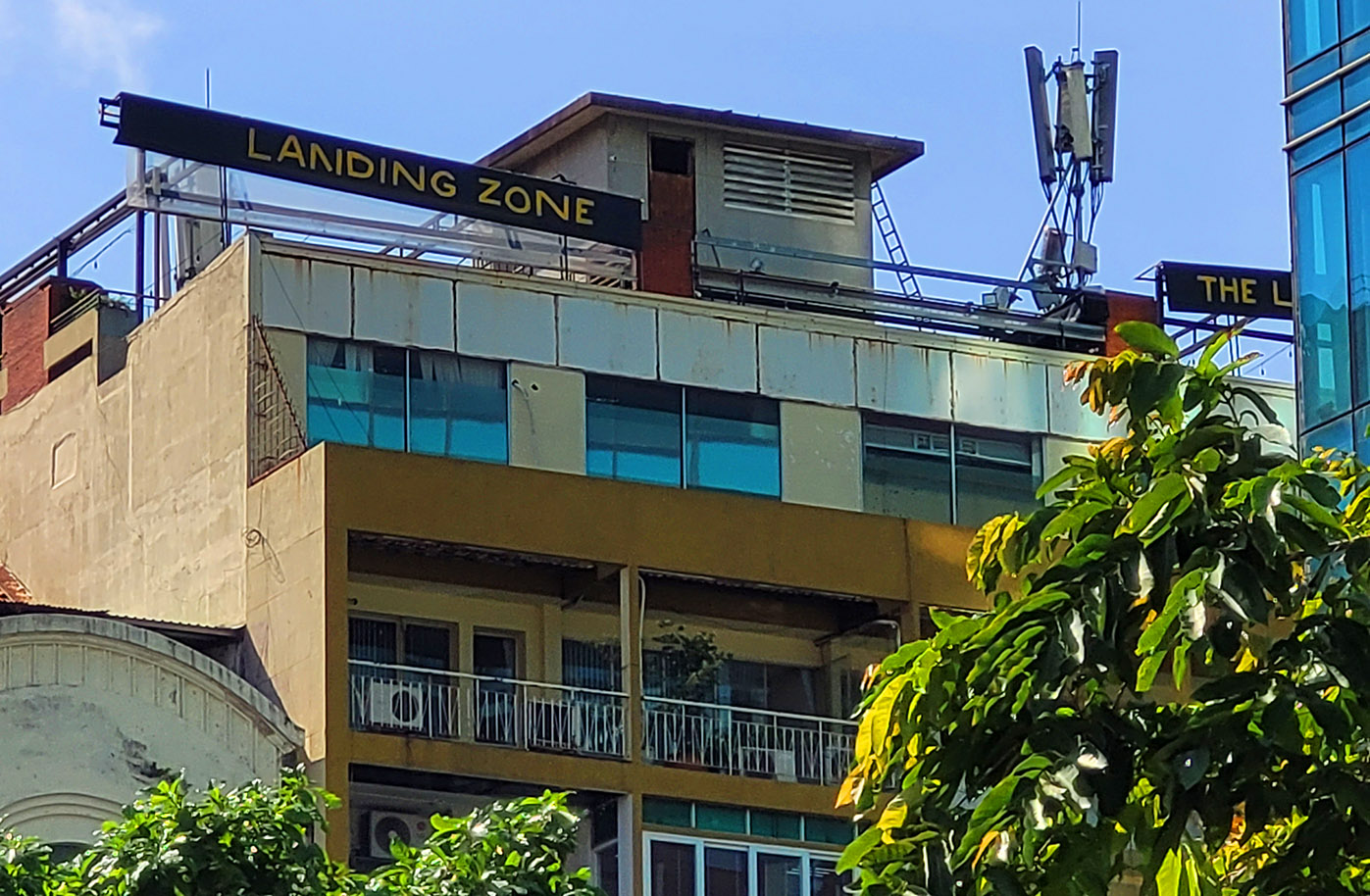
After doing a little research I was able to find an address. When the taxi dropped us off, the building looked like all the the others. Only when I stepped back into an adjacent park, could I see the recognizable elevator housing and even the sign that said “Landing Zone”.


So why write about this image and building in the first place? More on that in a minute.
Once I discovered this was indeed the right building, I ventured inside. Aside from the sign on the roof, there was nothing at street level to indicate anything special was here. In fact I had read on a post, the site has been intentionally left under the radar.
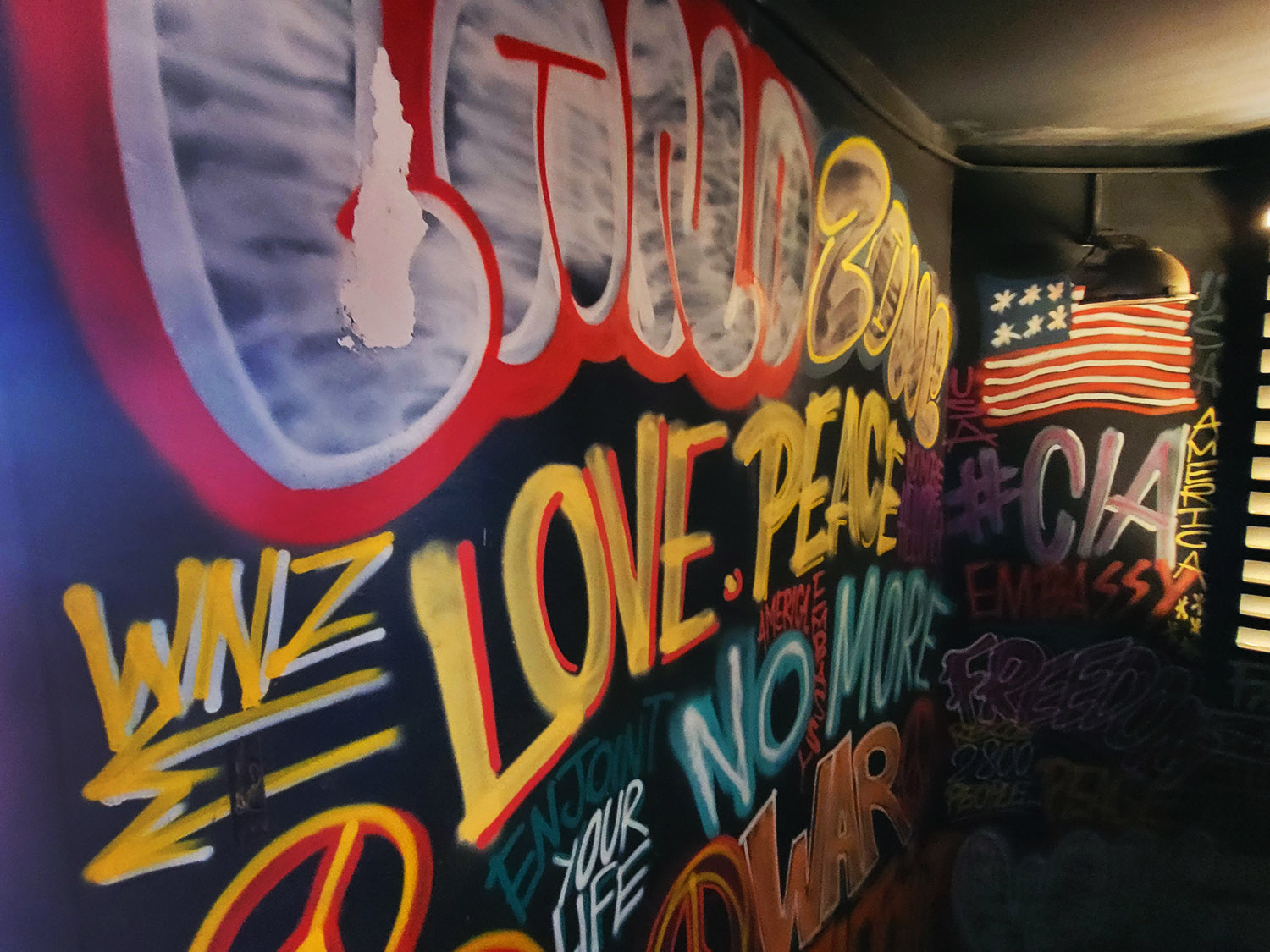
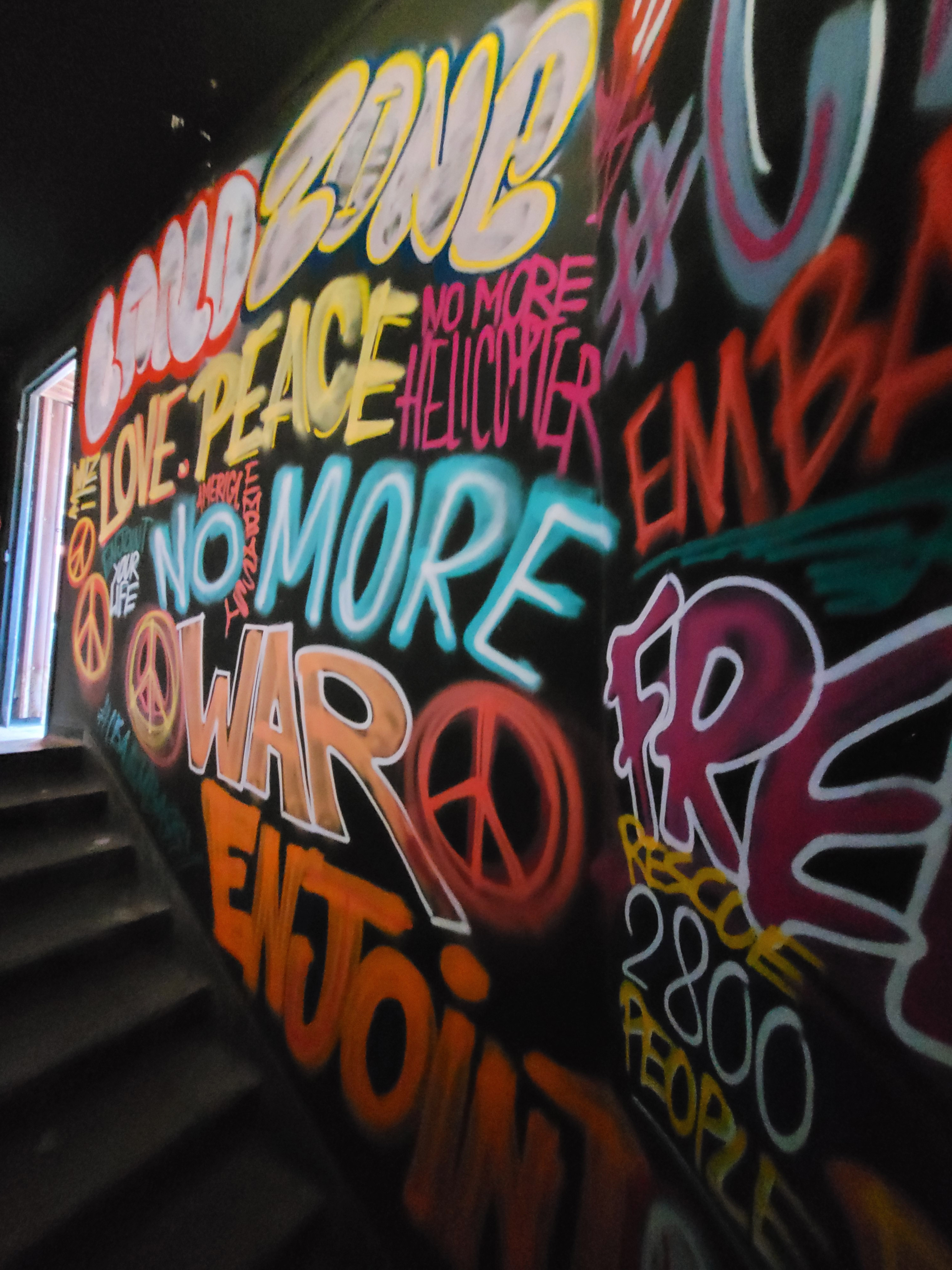
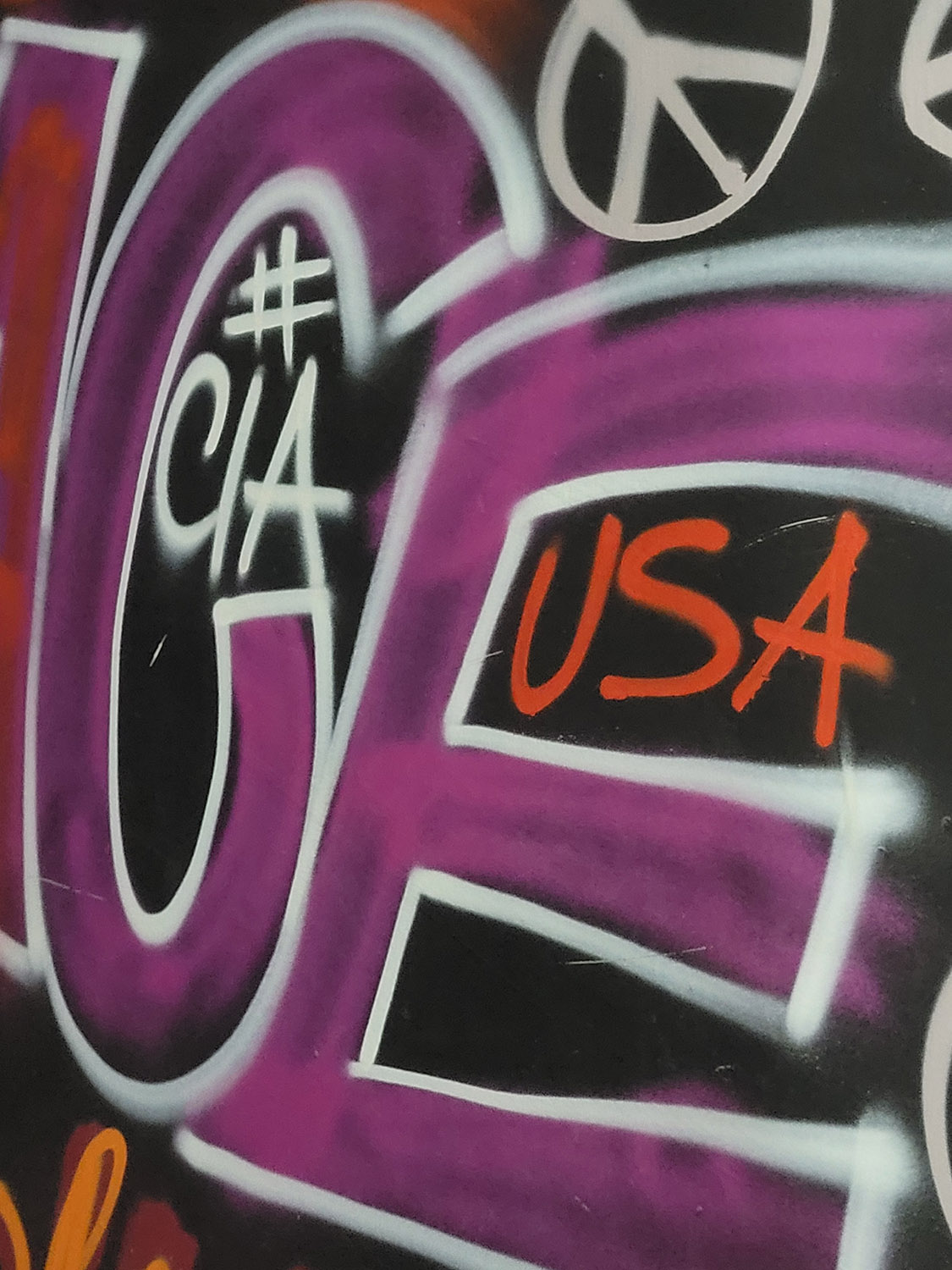
I approached a security guard behind a desk and asked if it were possible to get to the roof. “Sure” he said, “But you’ll have to give me $10 to gain access.” I’m not sure if he got the money, if it went to the building’s fund, or the tea chest. Anyway, I took the rickety elevator to the top floor, and was greeted by a narrow graffitied cement staircase But the artwork was well done, and there were some great messages in the artwork.

Up I went, and get to the top of the building, where a newer replacement ladder substitutes, (I assume) for the original. I may be wrong, but it looked new to me.


At the time the original image was taken by Dutch photographer, Hubert Van Es, the caption which accompanied the image, that went “over the wire services” at the time said the landing zone was that of the US Embassy, but in fact was that of the CIA Station Chief, Thomas Polgar’s apartment on the top floor. You can read more here on that. What was his apartment, is now an empty office.

The roof had been reinforced with steel and concrete before the fall of the city, to support a helicopter in the event it were needed for an evacuation. That, it turns out, was a good call.

My main takeaway from tracking down this heli-pad site was the story behind the image. It appears that those boarding the helicopter were South Vietnamese, that had been on the U.S.’s side of the war. Not all made it out, and others only made it by luck, which I’ll cover in another post. Another takeaway was that artwork. It posed more questions than it answered. Who made it? The messages are almost cryptic in the words they chose. But no doubt, the message of peace and ‘no more war’ prevails. Haunting, especially for a kid that grew up watching the war on television.

Author’s Pop Quiz: Are there any undeclared US wars in the last 20 years that you can recall where the U.S. left suddenly, in some cases leaving millions of dollars worth of military equipment behind.
Bonus Question: Besides needing a quick evac, can you think of any other reasons equipment might be left behind? Stay tuned for more on these questions in future posts.
Image credits: Randall Richards, except for the one by Hubert Van Es

Check out www.mtnspirit.nz/msm for more on Randall’s bio.

The “Live Free or Die” State: Man Tells FBI to Go Away

18/09/2024

By Randall Richards
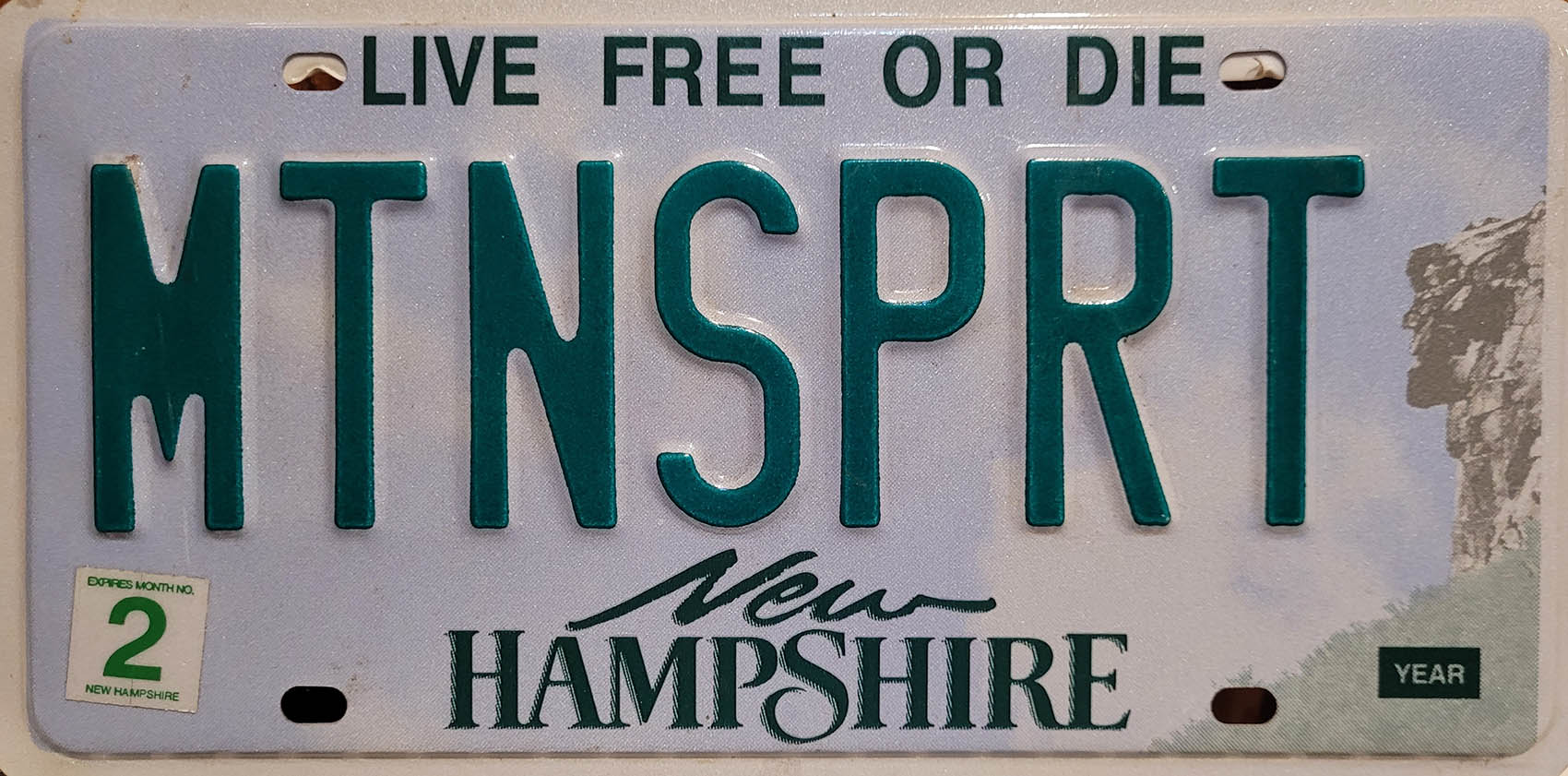
I’m from a state in the US which has “Live Free or Die” as the state motto on the license plate. When I legally transferred registration of a van I’d purchased in The Netherlands to New Hampshire, I still drove that van throughout the European Alpine countries, ski touring, climbing, and playing music. The talk on the street was this formation a new European Union currency. Some of the locals were jittery, for good reason.
So complete with the US license plates I’d drive into small villages and cities alike. I raised a few eyebrows, and almost got in a few problems because of the reactions I received with the motto displayed on the back of the van.

Since those days, until today, I’ve felt that New Hampshire residents probably don’t really live by that motto, much less understand it. Today this story surfaced of a New Hampshire man standing by his right to free speech. The interaction is being praised as a model for how citizens can assert their rights when confronted by federal agents, especially in cases of potential entrapment. Here’s the the story:

Watch: FBI Agents Called Out During Visit to Law-Abiding Citizen Regarding a Meme Post

Intel agency foot soldiers regret approaching man over First Amendment-protected activity.
A man filmed two U.S. federal agents as they approached him to ask about posts he’d made on social media, leading to them being publicly shamed for targeting a First Amendment-protected activity.

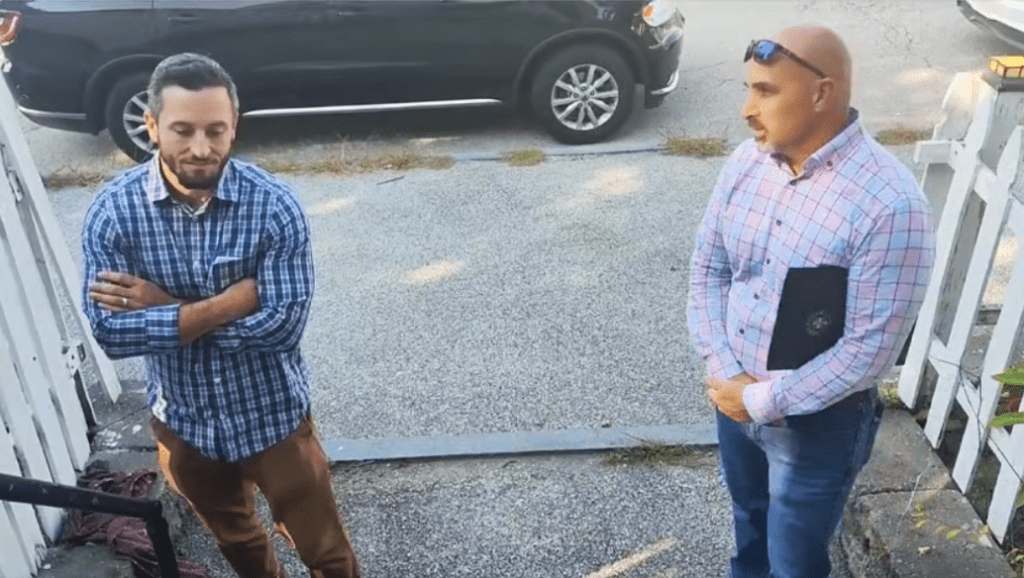
In a viral video, X user Jeremy Kauffman filmed as two plain-clothes agents approached his front porch requesting he not film them, as the citizen asked for their full names while notifying them he intended to post the interaction online.

“The FBI visited my house today for free speech acts they knew were not crimes.
You can see the shame on their faces. This is the Democratic regime manifest.”

Jeremy Kauffman (@jeremykauffman) September 16, 2024
“All I want to do is talk to you about a post that was made,” one of the unidentified agents told Kaufman after showing a badge alongside a holstered sidearm.

Kaufman went on to speculate the agents’ yearly average salary was likely over $100K, before telling them it was a waste of taxpayer money.
“Talking about burning a couple hundred dollars an hour just here, let alone all the time you guys are spending…to investigate something that you know is not against the law, right?” the man told the agents, who repeatedly requested the man stop filming them.

After appearing thoroughly embarrassed, the agents eventually departed while the man chided them, saying, “You know Americans that believe in the Constitution think you’re laughable. You go home and you think about what you did today. Go home and think about it. You coward.”
It’s unclear what social media post prompted the visit.|
The interaction is being praised as a model for how citizens can assert their rights when confronted by federal agents, especially in cases of potential entrapment. Story and lead, courtesy of Infowars

SOLO, After All These Years

03/02/2012

Dr. Frank Hubbell started SOLO, (Stonehearth Open Learning Opportunities) in the mid-’70’s and is still going strong. I was recently at SOLO’s base in New Hampshire, renewing my Wilderness Emergency Medical Technician qualifications and thought I’d share some footage of the place that many outdoor professionals know so well. SOLO offers a wide variety of programs.  I met some interesting folks attending this re-cert, and will post an interview or two here in the coming days.

From their website: SOLO took root in the early 1970s and grew out of the vision of its founders Frank Hubbell and Lee Frizzell (husband and wife). As Frank recalls, pre-hospital care was in its infancy, and an organized EMS system didn’t exist yet in New Hampshire. The concept of providing emergency care to the sick and injured revolved around what is today referred to as the “Golden Hour.” “As skiers, climbers, and EMTs in the White Mountains of New Hampshire, we would respond to the call for injured hikers and climbers,” Frank remembers. “It very quickly became apparent that the skills that we had learned as “street EMTs” did not work in the wilderness environment. We had to learn how to provide care outside the golden hour. But, that information was not available—we had to learn it through experience.” Frank’s frustration with the lack of an appropriate “wilderness” standard led to the creation of one of the first, if not the first, wilderness emergency medicine courses in the country. By 1975, a basic “Mountain/Woods First Aid” course was taken on the road by Frank, and taught to the few folks who could see its value.. Read more..

In addition to SOLO, there are also a number of organizations offering Wilderness First Responder and EMT trainings. I’ll probably cover a few of them in this blog at some point

A Restored Mountain Hut Getaway with Good Energy

11/01/2012

A New Zealand Farmer Does Good by Following His Passion

Tom O'Brien of High Country Walks

Tom O’Brien, owner of Blackmore Farm and founder of High Country Walks has followed his passion by offering up a little hut on the back side of his 5000 acre farm. Called the Chinaman’s Hut, it was restored some years ago, by local volunteers, Tom and his father. The hut is situated on the rolling mountains of the Slate Range,  just south of the Remarkables Mountains, on the border of Otago and Southland. Tom took the afternoon to show me his farm, the backcountry and the Chinaman’s Hut. below is a short piece on the hut, and a chat with Tom about his philosophy and passion of sharing this part of the world with others.We’re in hopes, here at Mountain Spirit Institute of collaborating with Tom by running some programs on the Slate Range and Blackmore Farm. We chatted about providing Solo’s and other types of programs.
Thanks for the time you took to show me around Tom!
Note: I’ve met one of the volunteers who helped restore the Chinaman’s Hut, a neighbor of ours here in Kingston named Dusty, who I’ll see if I can get on tape in the next few days. He has an interesting story to tell of not only this restoration project by many others.

The Stoic Male – Is it Time to Move On?

06/01/2012

Cultural shackles?

I’m in the middle of a book called A Man’s Country? The image of the Pakeha Male by Jock Phillips. It’s a well-known fact that the New Zealand male, and Aussie as well, has a “She’ll be right” attitude. All is well and good, but what happens when things go wrong, or life events happen that one didn’t plan for, doesn’t want and has no intention of participating in. Is “opening up” an idea who’s time has come?

A Man’s Country? From the back cover:
” A rugged practical bloke – fixes anything, strong and touch, keeps his emotions to himself, usually scornful of women. Yet at heart a decent bloke, loyal to his mates, provides well for the wife and kids…
Few Pakeha (white) men grow up in New Zealand without a strong sense of the Kiwi bloke they are expected to become. Jock Phillips’ book is a penetrating, provocative history of that stereotype.
Where did that stereotype come from? How has it changed? What truths does it hide? At what costs? The book begins with the Pakeha colonial society of the nineteenth century – the absence of women, the harsh physical conditions, the growth of an exclusively male ethic. It then examines in detail the image of the Pakeha male, as booze, as rugby player, as soldier, as family man, in the 1980’s, says Phillips, the stereotype has been well and truly exposed as a role model. We now know the costs we have paid as both men and women.  After reading this book, no New Zealand man will quite be the same.
Published by Penguin
For another take, see my post on the movie The Men’s Group