Posts Tagged ‘Washington State’

Music as Protest, US, Vietnam & New Zealand

29/09/2024

By Randall Richards
Performing Music to Protest & Educate: Past, Present, & Where to From Here?

When I started a couple of volunteer music venues as listening rooms which I named “Coffeehouses”, one in Leavenworth, Washington and a second, in Sunapee New Hampshire (which is still going strong), Little did I know the history of the term CoffeeHouse.

I recently happened to stumble upon this interesting definition of the term, but never realized its origin when I had created those coffeehouses in the states. Interesting how things turn out: “GI Coffeehouses” were a consequential part of the anti-war movement during the Vietnam War era, particularly the resistance to the war within the U.S. military. They were mainly organized by civilian anti-war activists as a method of supporting anti-war and anti-military sentiment

. The FTA Roadshow was explicitly created in the ’70’s as a counter to Bob Hope’s pro-war USO tour. Original cast, from left: Gary Goodrow, Jane Fonda, Donald Sutherland, Peter Boyle, Dick Gregory, and Barbara Dane at the Haymarket GI Coffeehouse near Fort Bragg.

We started the first venue in Washington State because I had been a professional pianoplayer for years, and budding singer/songwriter on the guitar. I wanted to perform in a supportive listening room environment. 

I had taken note of one such venue in a Sedona, AZ bookstore.  Since I could only find bars and pubs, where venues treated the artists as background musicians, I wanted no part of that.So I decided to give it a shot by approaching a local hotel owner who was willing to let me set up on Friday nights in his unused conference space and stage in Leavenworth, WA. More on that winning formula in another piece.

Here’s the East Coast’s Sunapee Community Coffeehouse, still going strong after many years!


New Zealand:
Fast forward to New Zealand, 2021 in the thick of mandates, and other general draconian measures pushed upon the population, based on a injection that was neither safe nor effective. We started having occasional bonfire music jams, and a like-minded Saturday Market, primarily for our freedom loving community (but all were welcome) in the Upper Clutha region of the South Island.

  About six months ago I decided to apply to be one of the 16 international chapters of Jam For Freedom, backed by Eric Clapton. We were welcomed with open arms.

We have yet to hold our inaugural event. I’m still in the process of reaching out to additional musicians in the country who have been part of either the Wellington Protests, were featured in The River of Freedom and We Came Here for Freedom documentaries. Once we have a critical mass of freedom loving musicians, we’ll create an event,

We’ll also create traveling Jam For Freedom (Coffeehouse type roadshow), starting with the South Island based on the Coffeehouse formula I had started in the U.S., but simply a mobile version. That means a featured performer, followed by an open mic, a “trained” listening room audience, and passing the hat for the musicians, venue hire, and roadshow expenses,). I have a van, a waterproof trailer for the music gear, and just need some JFF branding for the vehicle and a stage backdrop.

Vietnam:
My family and I just toured of Vietnam, and I’m now writing a few pieces, not about the tourist side, but the impact of the war museums, the wonderful people we met, the stories I was told, and most recently, a book I’m reading called Understanding Vietnam explaining not only the war, but the deep seated psyche of the Vietnamese.
During a visit to the War Remnants Museum in Ho Chi Min City, I found these images on display:

Yo koi Kumiko sings to solders in the artillery battleground in Quang Binh Provence, 10 December, 1973
“A rally against US aggression in Vietnam from Japan’s Beheiren, Tokyo, 1972

This might be the time to premise some the articles I’m working on about Vietnam’s view of the US Occupation of Vietnam. They call it the “American War”, by the way. I went to Vietnam with some ingrained knee-jerk conditioning, courtesy of our government’s controlled media in the states. That paradigm quickly dissolved. Of course I could see Vietnam’s plugging their side of the story as well. But I do have discernment, and will talk about that in later posts.

Although there is a history of protest music from the US side I assume there’s more about Vietnam’s side, protesting war. However, this was the first time I it was on my radar.
The historians will write about such protest songs being written now, not only about anti-war, but about various nefarious agendas that aim to curb our freedoms, hurt our children and enslave the world’s population. Music is one of the best ways to call out the troublesome behaviors of those powerful people in charge who obviously don’t have our best interests in mind.

Comedy is a another avenue to opening the dialogue where direct debate and conversation often fail to bridge the gap between different paradigms. Jim Breuer’s Somebody Had to Say It, is a case in point.


So wish us luck with our Jam For Freedom adventure here in New Zealand! If you’re a musician get in touch! If you’re a friend of mine, who happens to be living stateside, or elsewhere, I also invite you to join in the conversation on our Jam For Freedom Telegram chat or the International Telegram group. Even though the NZ chat is focused for us here in New Zealand, I feel, the more the merrier. We could use the moral support! Did you guys hear that… Kirtana, Neal Fox,  Scot Bergeron, Conspiracy Music Guru?

THANKS TO:
A special thanks goes to those New Zealand musicians who performed at our protest on Parliament grounds and were featured in those documentaries mentioned above, and to those who have joined our Jam For Freedom NZ Telegram Group. Also thanks to all the steering committee and volunteer members of the West and East Coffeehouses who have worked hard to deliver live music in a listening room for so many years.

A special acknowledgement again to Neal Fox for being ahead of the curve, and for his unflinching creative stance in music compositions and film-making productions, and sticking it to the “all powerful”. You can see his work here.

Learn more about the Coffeehouse concept here. Start one in your community! You learn more about Randall’s music here. Our music studio is open for musicians-in-residence who would like to be pampered and be free to write and record in our small studio set in the mountains of the Southern Alps of NZ.
Sunapee/Outward Bound Program:New Webpage

23/04/2009

MSI's New Webpage on Sunapee's OB Program

MSI's New Webpage on Sunapee's OB Program

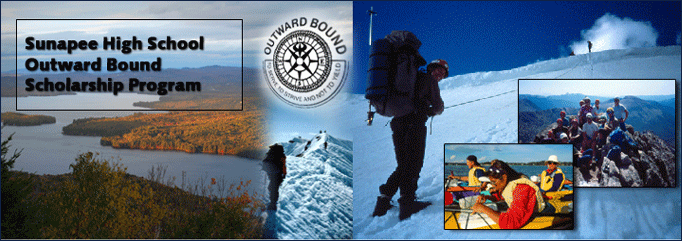
The MSI/Sunapee High School/Outward Bound Scholarship Program, now in it’s fourth year gets a new webpage. There is a host of information: past recipients, donors, an overview and goals of the the program and where to find out more. The program is gaining some traction both with students, the community and with Outward Bound’s scholarship department.  Thanks to former Recruiter and Scholarship coordinator Charlie Reade who helped MSI’s Executive Director R. Richards set up the program, a number of students have had a trip of a life time.

Image: Brian Baily-Mountain Yoga

Image: Brian Baily-Mountain Yoga

On the webpage are pics from Brian Baily’s Rock/Backpacking course in Colorado, and Hanna Baade’s sea kayaking program on the coast of Maine. Baade was the first recipient of the scholarship which was first supported by Sugar River Bank. More recently, Rotary International (New London, NH) and other organizations are aiding the effort.

The program is one of MSI’s first “service projects”, aimed at giving back to the community in which MSI is incorporated, and the director’s hometown. In all aspects of MSI, we incorporate a service component, whether it be a board meeting, a program to Peru or at the administration level. Again this inspiration comes from Outward Bound and Kurt Hahn in the first place.

On Rappel: North Cascades, WA, USA

On Rappel: North Cascades, WA, USA

You can check out the web page, and who knows, you may even be inclined to jump on the bandwagon and donate!

Donations can be sent to MSI’s office at:

Mountain Spirit Institute
POB 626
Sunapee, NH 03782
USA

Living Close to the Land, A Lost Art?

22/11/2008

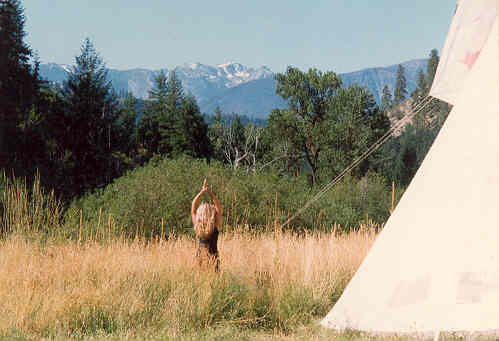
Yoga at the Tipi, North Cascades, Leavenworth, WA

Yoga at the Tipi, North Cascades, Leavenworth, WA

By Randy Richards, Founder
Executive Director
Mountain Spirit Institute
Images: R Richards

Alternative structures are getting more attention these days, especially with the spector of dwindling non-renewable petroleum products for building and heating materials. Simple living is more than an idealist notion. Cody Michaels, a longtime  friend and solo pianist extradonaire, just swung by my town for a performance at our local CoffeeHouse. His performance is a reminder that we actually need to live and  breath outdoors more. He and I went for a walk to the top of a hill overlooking Lake Sunapee just before his gig. We wer just in time to catch the sunset too. It seemed bitterly cold,  (read, There is no bad weather, just bad clothes), but it was worth it. Cody shared his appreciation of the wind whipping through the bare branches, and the artist’s light that cuts through the landscape at an obtuse angle this time of year.
Living outside has become a lost art for the majority of Americans. In my tipi days, I always enjoyed the circular living structure. Occasionally, when a visitor might bring a dog, often times, the a dog would go walk nerveously round and round along the inner walls of the tipi looking for a corner in which to sit. To no avail. Even our domestic pets are used to the square structures in which we all live. 

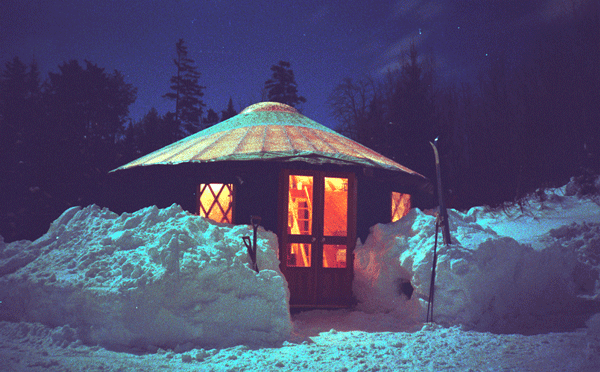
Home base, warm yurt, Sunapee, NH

Home base, warm yurt, Sunapee, NH

My tipi has been put up every year though,  for the Sunapee SunFest, but I don’t live in it any more. My yurt, now that is a cool structure. It’s toasty warm, and clean living off the grid with solar panels, gravity feed shower, composting toilet and a hand dug well. I’ll write more on yurt living in another post.  I had it up for 5 years in Sunapee, NH on Ryder Corner Road. The different reactions I received from different neighors was worth noting. The old time locals, who grew up on local farms thought it was the best thing, a great addition to the neighborhood.  Ohers were less clear about their feelings of the thing.

Yurt interior w/loft

Yurt interior w/loft

Reactions varied from polite disdain, a blank stare, or possibly a somewhat condescending chuckle. It’s only worth mentioning because as illustrated in the movie “Escape from Suburbia” we may be headed for voluntary simplicity whether we want to or not.  I’m not a Chicken Little thinker, however, watching the aformentioned movie made me sit up and take more notice. It might be worth your time.

A confession is due here. I’m not living as close to the land as I’d like. I’m not growing my own food, (although I do eat from friend’s gardens once in a while.) And I’m not in my yurt. However I forsee my partner and I taking action on this. I’m glad I have the background I do, having lived in my tipi and yurt. As Richard Louv says in his lecture and book “Last Child in the Woods”, my past experiences give me a touchstone, a reference point that helps me know my place in the natural world. My life is still more green than most, but I’ve still got goals to reach. I suggest you do the same. 

Living closely to the earth not only makes sense, it can be much more fun than being in the rut of spending all those non-renewables.

Guiding, The Mountain Life

22/11/2008

Randy Richards, Founder
Executive Director
Mountain Spirit Institute
Images: R Richards

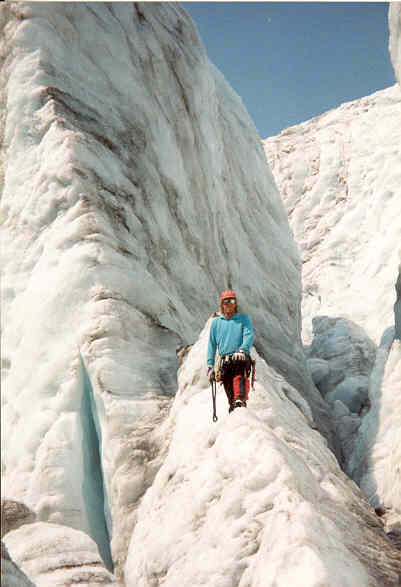
R Richards at ice climbing school site, Mt. Baker, WA

The author, ice climbing site, Mt. Baker, WA

I was rummaging through my images the other day, and came across some pictures of guiding on Mt. Baker and teaching mountaineering instructors on Mt. Hood. What’s the difference between guiding and experiential education in the mountains?  The main difference to me is, experiential ed encourages, or shows people a way to better walk their talk.  It allows them space to try new things, physically, mentally an spiritually, in a new environment. The mountains, and a group of people climbing them,  can provide a vehicle for huge growth. Guiding on Aconcagua, Argentina, and in other areas of South America,  I noticed that groups and individuals , whether facilitated or not, go through huge experiences while at high altitude. If the organization has processes in place that allow growth within the group, both positive and challenging experiences can happen. It’s not guaranteed it will happen but may happen. It’s whether or not they have the OK to express what goes for them is the key.  This determines whether it’s a positive learning experience or not. We all will learn as we go through our life, that’s mandatory, it just depends on how one chooses to receive them these learnings, by blessings or lessons. I prefer blessings at this point in my life. Some individuals, after having prepared for the summits in the high altitudes, still weren’t lucky enough to have made it to the top.  

The Guiding Life

The Guiding Life

They either had a bad summit day, weren’t hadn’t prepared physically, had an unfortunate bout of altitude sickness or some other ailment, or of course, the weather kicked in as it tends to do on high mountains. Guiding, at least through some of my expriences working with certain guide companies,  wasn’t really set up to allow the full range of emotions that can happen in the mountain environment.  Big stuff went down too. Just think  back to the events that surrounded the “summit teams” on Everest during “the big disaster”. I recall John Krakaur’s comment in his book about Everest, that stated, “we were a team in name only”. More about this in another post.
Guiding is a big fun, but for those wanting a bit more depth to their experience, I’ve got a notion. We can delve into more of  who we are, while being out there with others.

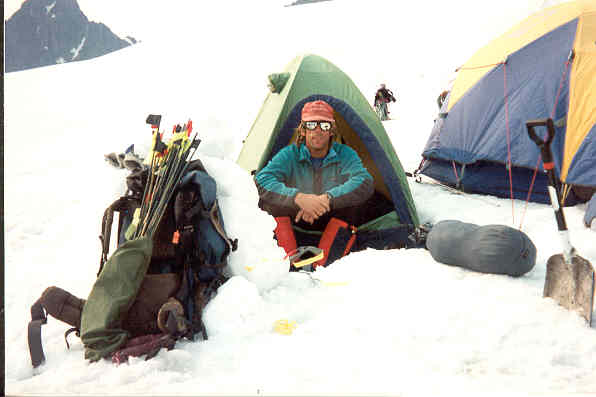
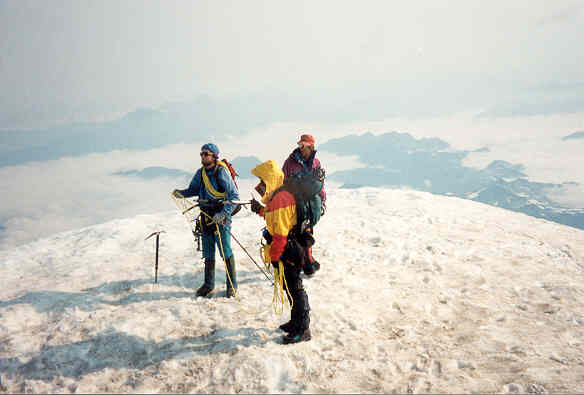
Richards and clients, Summit Mr. Baker

Richards and clients, Summit, Mt. Baker

That’s why I started Mountain Spirit. Learning to respect the mountains through knowledge of safe travel, and learn from an exchange with the mountains, the spirit of the place. Our mission at MSI is facilitating connecting to one’s self, with each other and the environment. We’re well past the time where we can simply be observers of our environment, let alone be adventurers for adventure sake. (See my entry on Willie Unsoeld below).
More and more colleges are offering Adventure Education in there Health Department offerings. I was an adjunct faculty for an adventure education department for a brief time. The current state of our world demands that we better use our time and energy wisely if we’re heading to the mountains. I’ve given up downhill ski lifts for this reason. It’s bad enough I drive to the mountains, but at least I’d better use my own human power for my day to reach the top of the mountain.

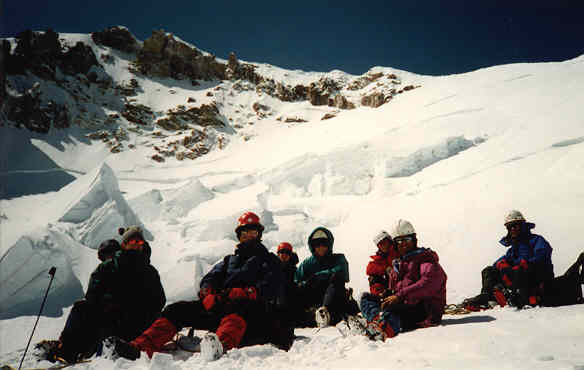
Training Instructors, Mt. Hood, OR

Training Instructors, Mt. Hood, OR

Willie Unsoeld had it right when he said that we need to  get out there for  “our metaphysical fix”, which does indeed make the world a better place. When we come back we can be better contributors to society. I know, I’m a healthier, more well rounded person for my years in the backcountry.
So what’s this about “walking our talk”? There are countless guided groups, who are well cared for in the mountains,  as are spiritual groups that do shamanic work high in the Andes. Do the latter go there mostly to say they worked with a shaman in the Peruvian Andes? Does their study and knowledge help them to better interact in their immediate day to day lives?  Do they chop wood and carry water. I often wonder.

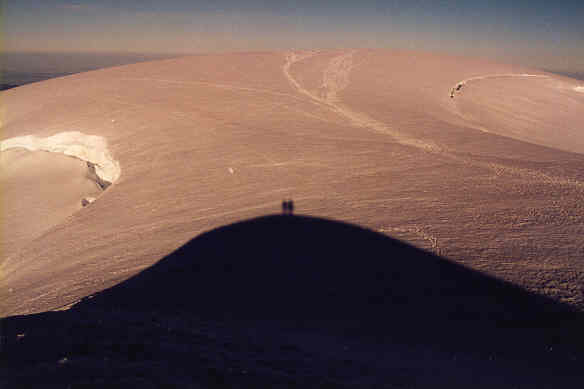
Summit Sunset Silhouette, Mt. Baker

Summit Sunset Silhouette, Mt. Baker

I’ll close with an oft quoted saying from Sun Bear, “If it doesn’t grow corn, I don’t want to hear about it.” Climbing mountains is certainly not growing corn in the literal sense, but if you approach it right, (read: right livelihood), than I believe you are indeed making the world a better place. Do the pilgrimage, just don’t use too much gas getting there.