Archive for November 22nd, 2008

Living Close to the Land, A Lost Art?

22/11/2008
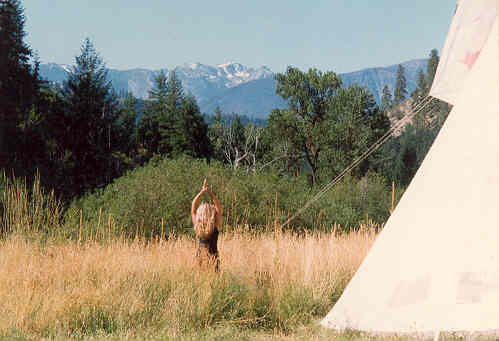
Yoga at the Tipi, North Cascades, Leavenworth, WA

Yoga at the Tipi, North Cascades, Leavenworth, WA

By Randy Richards, Founder
Executive Director
Mountain Spirit Institute
Images: R Richards

Alternative structures are getting more attention these days, especially with the spector of dwindling non-renewable petroleum products for building and heating materials. Simple living is more than an idealist notion. Cody Michaels, a longtime  friend and solo pianist extradonaire, just swung by my town for a performance at our local CoffeeHouse. His performance is a reminder that we actually need to live and  breath outdoors more. He and I went for a walk to the top of a hill overlooking Lake Sunapee just before his gig. We wer just in time to catch the sunset too. It seemed bitterly cold,  (read, There is no bad weather, just bad clothes), but it was worth it. Cody shared his appreciation of the wind whipping through the bare branches, and the artist’s light that cuts through the landscape at an obtuse angle this time of year.
Living outside has become a lost art for the majority of Americans. In my tipi days, I always enjoyed the circular living structure. Occasionally, when a visitor might bring a dog, often times, the a dog would go walk nerveously round and round along the inner walls of the tipi looking for a corner in which to sit. To no avail. Even our domestic pets are used to the square structures in which we all live. 
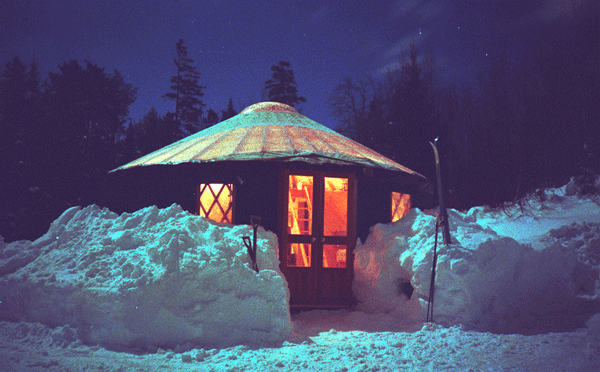
Home base, warm yurt, Sunapee, NH

Home base, warm yurt, Sunapee, NH

My tipi has been put up every year though,  for the Sunapee SunFest, but I don’t live in it any more. My yurt, now that is a cool structure. It’s toasty warm, and clean living off the grid with solar panels, gravity feed shower, composting toilet and a hand dug well. I’ll write more on yurt living in another post.  I had it up for 5 years in Sunapee, NH on Ryder Corner Road. The different reactions I received from different neighors was worth noting. The old time locals, who grew up on local farms thought it was the best thing, a great addition to the neighborhood.  Ohers were less clear about their feelings of the thing.

Yurt interior w/loft

Yurt interior w/loft

Reactions varied from polite disdain, a blank stare, or possibly a somewhat condescending chuckle. It’s only worth mentioning because as illustrated in the movie “Escape from Suburbia” we may be headed for voluntary simplicity whether we want to or not.  I’m not a Chicken Little thinker, however, watching the aformentioned movie made me sit up and take more notice. It might be worth your time.

A confession is due here. I’m not living as close to the land as I’d like. I’m not growing my own food, (although I do eat from friend’s gardens once in a while.) And I’m not in my yurt. However I forsee my partner and I taking action on this. I’m glad I have the background I do, having lived in my tipi and yurt. As Richard Louv says in his lecture and book “Last Child in the Woods”, my past experiences give me a touchstone, a reference point that helps me know my place in the natural world. My life is still more green than most, but I’ve still got goals to reach. I suggest you do the same. 

Living closely to the earth not only makes sense, it can be much more fun than being in the rut of spending all those non-renewables.
Guiding, The Mountain Life

22/11/2008

Randy Richards, Founder
Executive Director
Mountain Spirit Institute
Images: R Richards

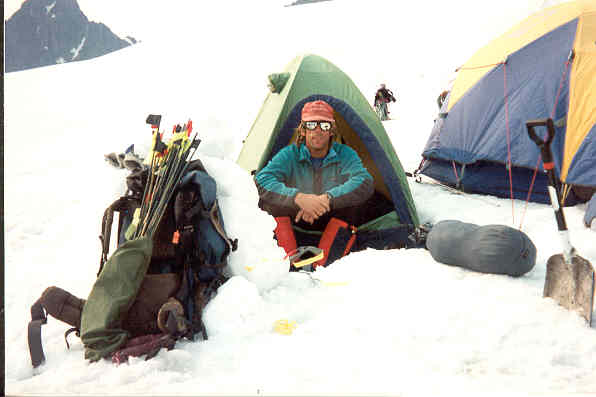
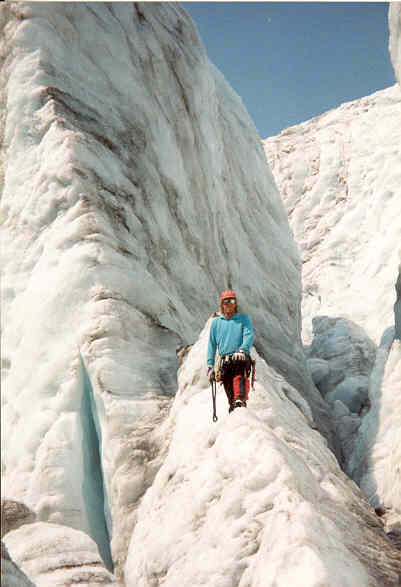
R Richards at ice climbing school site, Mt. Baker, WA

The author, ice climbing site, Mt. Baker, WA

I was rummaging through my images the other day, and came across some pictures of guiding on Mt. Baker and teaching mountaineering instructors on Mt. Hood. What’s the difference between guiding and experiential education in the mountains?  The main difference to me is, experiential ed encourages, or shows people a way to better walk their talk.  It allows them space to try new things, physically, mentally an spiritually, in a new environment. The mountains, and a group of people climbing them,  can provide a vehicle for huge growth. Guiding on Aconcagua, Argentina, and in other areas of South America,  I noticed that groups and individuals , whether facilitated or not, go through huge experiences while at high altitude. If the organization has processes in place that allow growth within the group, both positive and challenging experiences can happen. It’s not guaranteed it will happen but may happen. It’s whether or not they have the OK to express what goes for them is the key.  This determines whether it’s a positive learning experience or not. We all will learn as we go through our life, that’s mandatory, it just depends on how one chooses to receive them these learnings, by blessings or lessons. I prefer blessings at this point in my life. Some individuals, after having prepared for the summits in the high altitudes, still weren’t lucky enough to have made it to the top.  

The Guiding Life

The Guiding Life

They either had a bad summit day, weren’t hadn’t prepared physically, had an unfortunate bout of altitude sickness or some other ailment, or of course, the weather kicked in as it tends to do on high mountains. Guiding, at least through some of my expriences working with certain guide companies,  wasn’t really set up to allow the full range of emotions that can happen in the mountain environment.  Big stuff went down too. Just think  back to the events that surrounded the “summit teams” on Everest during “the big disaster”. I recall John Krakaur’s comment in his book about Everest, that stated, “we were a team in name only”. More about this in another post.
Guiding is a big fun, but for those wanting a bit more depth to their experience, I’ve got a notion. We can delve into more of  who we are, while being out there with others.

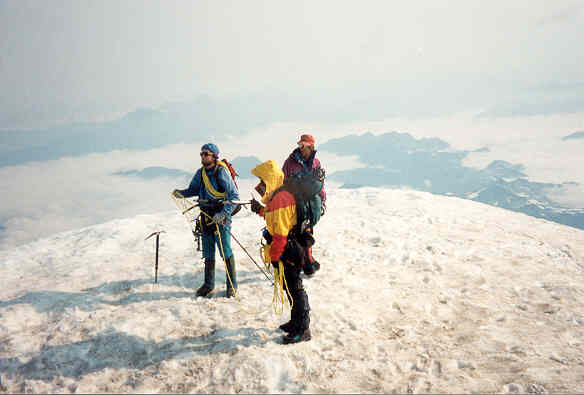
Richards and clients, Summit Mr. Baker

Richards and clients, Summit, Mt. Baker

That’s why I started Mountain Spirit. Learning to respect the mountains through knowledge of safe travel, and learn from an exchange with the mountains, the spirit of the place. Our mission at MSI is facilitating connecting to one’s self, with each other and the environment. We’re well past the time where we can simply be observers of our environment, let alone be adventurers for adventure sake. (See my entry on Willie Unsoeld below).
More and more colleges are offering Adventure Education in there Health Department offerings. I was an adjunct faculty for an adventure education department for a brief time. The current state of our world demands that we better use our time and energy wisely if we’re heading to the mountains. I’ve given up downhill ski lifts for this reason. It’s bad enough I drive to the mountains, but at least I’d better use my own human power for my day to reach the top of the mountain.

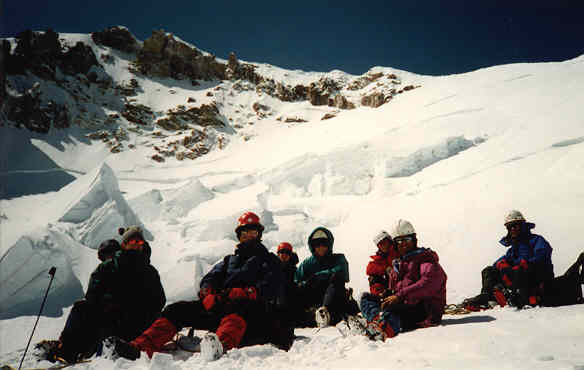
Training Instructors, Mt. Hood, OR

Training Instructors, Mt. Hood, OR

Willie Unsoeld had it right when he said that we need to  get out there for  “our metaphysical fix”, which does indeed make the world a better place. When we come back we can be better contributors to society. I know, I’m a healthier, more well rounded person for my years in the backcountry.
So what’s this about “walking our talk”? There are countless guided groups, who are well cared for in the mountains,  as are spiritual groups that do shamanic work high in the Andes. Do the latter go there mostly to say they worked with a shaman in the Peruvian Andes? Does their study and knowledge help them to better interact in their immediate day to day lives?  Do they chop wood and carry water. I often wonder.

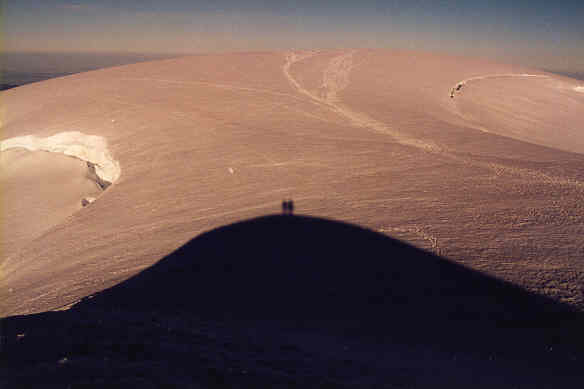
Summit Sunset Silhouette, Mt. Baker

Summit Sunset Silhouette, Mt. Baker

I’ll close with an oft quoted saying from Sun Bear, “If it doesn’t grow corn, I don’t want to hear about it.” Climbing mountains is certainly not growing corn in the literal sense, but if you approach it right, (read: right livelihood), than I believe you are indeed making the world a better place. Do the pilgrimage, just don’t use too much gas getting there.

Cell phone tower taken down in Piura for causing health problems

22/11/2008

by Jobana Soto, Living In Peru.com
Piura, Peru

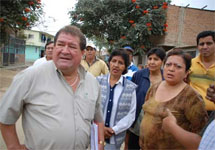
Citizens of Piura, Peru discuss a Cell Towerc creating health issues.

Citizens of Piura, Peru discuss a Cell Tower creating health issues.

After one year of protests and complaints, Telefónica Móviles began the dismantling yesterday of one of its antenna towers located illegally in the small town of AA.HH., a poor region in Piura.

The order of the dismantling came after countless complaints by locals citing health problems like migraines, believed to be caused by the metallic structure.

In September, locals met with Telefónica Móviles and the company’s contractor, Ametra, to assure the community that November 18 will begin the removal of the tower.

But November 18 came and went, with no signs of the tower being taken down, prompting a massive protest in the AA.HH. region. Mayor of the municipal of Piura, César Palacios Castro, assured locals on Tuesday that the tower will be “put to its knees.”

Locals expect the tower to be out of their town by the end of this month.
Article by Jobana Soto: http://www.livinginperu.com/news/7893

Prajna, The Best Knowledge – Great Minds Think Differently

22/11/2008

Just another day at the office, living history on election day.  Talk about “Being The Change”. 

For a look into some really great minds, I like to explore the TED talks, a rich source of inspiration into the areas that make our world go ’round of Technology, Entertainment and Design, recorded every year in sunny, brainy California.  Check out this one by Austrian artist, Stefan Sagmeister.  Just hearing the name of the country reminds me of a slower, more peaceful, more connected to each other way of life.

And a moving story from brain researcher Jill Bolte – her remarkable account of observing the process of watching her brain shut down while having a stroke, and how the brain works…not for the squeamish!

And one of my favorites, a charismatic delivery about the power of classical music, Benjamin Zander, with other messages thrown in to challenge our perceptions of music’s connection to our humanity.