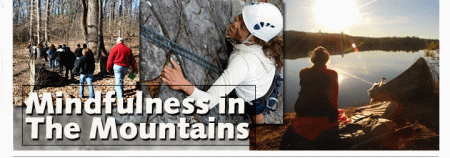
Led by a unique team of experienced world-class outdoor adventurers, guides, instructors, and experienced meditators, this weekend will provide room for exploring the layers of self-knowledge possible through adventuring in our natural environment. During the weekend, lovers of nature and those interested in hiking, rock climbing and kayaking will come together to adventure without and within.
To get an idea what see the interview of Lama Willa Miller by R. Richards below:
Read more on the program at our MSI and Wonderwell’s Webpages, and stay tuned for more details posted on this blog.
“The long day wanes: the slow moon climbs: the deep Moans round with many voices. Come, my friends, ‘Tis not too late to seek a newer world.
Alfred Lord Tennyson
I started Mountain Spirit Institute in 1998 when we led our first trip to Peru, with the basic mission “to facilitate a deeper connection to the natural environment, each other and ourselves.” Since then it has become ever more apparent how we need “nature time” more than ever. It’s good to see people out on the trail, and in kayaks these days, but National Park use is down in the U.S, and technology competes for the breath of fresh air. We just offered a presentation last night in a small town in New Hampshire called “Get Outside While You Still Can.” The piece below echoes a lot of what we covered in our presentation, and why we started MSI.
• Get Out into nature that is
• How do you view nature?
• Find it hard to get nature time?
• Technology Got ya?
How do you spend your time?……
Doing This?
Or Doing This?
Come and explore, with Mountain Spirit board members
Bob Stremba and Randy Richards, Nature Deficit Disorder
&
Why we need to get outside while we still can!
GETTING OUTSIDE!
WEDNESDAY, JULY 25th , 7:00PM
Cost: Free
Lake Sunapee Bank Community Room
116 Newport Road
New London, NH, USA
For more information call 603-763-2668 or http://www.mtnspirit.org
Mountain Spirit Institute Offers Upcoming Programs and Special Events
Mountain Spirit Institute of the Dartmouth Lake Sunapee Region and Queenstown New Zealand area, is offering programs this summer and fall in New Hampshire, based on its mission to “help people reconnect with the environment, each other and a deeper connection to one’s self”.
The first program, on July 22nd , is an Adventure Educator’s Sharing Symposium open to teachers, students and outdoor educators who would like to share, learn and apply best practices of group processing and facilitation, especially with a holistic approach. There is no charge, as MSI is offering this as a public service.
Mountain Spirit will also be offering a Reconnection with Nature Hike on July 24th where there will be hiking to a local mountaintop, and participants will have a chance to relax with a short meditation and powerful nature reading. Again, there is no charge, as MSI is offering this as a public service.
On July 28th there will be a one-day Solo retreat starting at eight in the morning with a basic orientation and safety talk. Participants will then be shown their own “solo spot” where they will spend the day with minimal gear and distractions. There is a nominal program fee for this event. There will also be an Overnight Solo on August 24th and 25th where participants spend the night under a tarp in a beautiful local setting. The goal for Solo’s are to reconnect, unplug, contemplate and be present in nature with few distractions with the safety net of experienced facilitators and guides. Solos will also be offered as an on-demand basis.
Lama Miller
Mountain Spirit Institute is collaborating with Lama Willa Miller of the Wonderwell Refuge, in Springfield NH on an outdoor adventure program called Mindfulness in the Mountains. The Natural Dharma Fellowship has a retreat center, where the program will be based for the weekend of Oct 12-14th.
MSI will offer again its MSI Film Series, one of which will be Fat, Sick, and Nearly Dead. This remarkable film follows two men, one an Australian and other an American truck driver, on their amazing path to recovering their health through juicing and healthy lifestyle choices . There will be some testimonials and discussion after the film. They do what their website calls a “reboot of your body”.
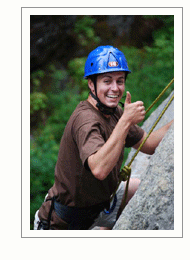
Rock Climbing will be offered to parent/children pairs, as well as families up to four, on the local crags in the region by appointment.
Mountain Spirit Institute is an insured non-profit educational organization started in 1998. Their first program was a cultural immersion trip to Peru. All of the summer and fall programs will be facilitated and managed by internationally recognized guides and facilitators. For more information on any of these programs or on Mountain Spirit Institute, visit their website at www.mtnspirit.org or call 603-763-2668
Expedition 2012: From Vermont to James Bay by Canoe Paddling Forward, Giving Back
Expedition 2012's Route
By R.Richards
Family friend, Tom Bloch is one of ten crew members of Expedition 2012, an epic 1,200 mile canoe trip from Lake Dunmore Vermont to James Bay in Northern Canada, which is underway as we post this.
The expedition is an effort to support the Keewaydin Foundation in its ongoing mission to preserve “the Keewaydin Way”, and extend its benefits to an ever-greater range of today’s youth. The Foundation has three summer camps: Keewaydin Temagami (Ontario, Canada), Keewaydin Dunmore (Salisbury, Vermont), and Songadeewin of Keewaydin (Salisbury, Vermont).
To accomplish their goal, Expedition 2012 is committed to establish a new scholarship endowment for the Foundation. Expedition 2012 is using the extended wilderness canoe trip, which is a tradition at Keewaydin’s as a fundraising platform, . They are paddling the long route over the course of 65 days in wood and canvas boats hand-crafted by the expedition members. During the course of this project, expedition members are additionally dedicated to environmental advocacy towards the preservation of the wilderness we hold dear. To learn more about the progress of the expedition, and to follow the the paddlers go here, or head over to their blog
Keewaydin states on their website, “To live for a summer in a world largely unstructured and shaped only by nature itself… this is an adventure few are privileged to know.” and adds, “Through these programs, Keewaydin builds strong, independent character while exposing young men and women to a bygone lifestyle. Since 1893, Keewaydin has withstood the temptation of change, holding firm to what is dear of the past and leaving it untouched. Keewaydin’s simplicity and special link to the undisturbed wilderness set our programs apart from traditional camp experiences. This is the Keewaydin Way.” To learn more about the camp, visit their website.
The map, drawn up by Johnny Clore, shows the full itinerary of Expedition 2012 from Lake Dunmore down Otter Creek to Lake Champlain, then down the Richelieu River to the St. Lawrence Seaway. From Montreal, we’ll head upstream on the Ottawa River for over three hundred miles and cut west for our resupply at Temagami by following the fabled “Trip In.” From there the route leads over a swift succession of smaller lakes and rivers to the Abitibi River, where we will restock and head for the bay at Moosonee. Resupply locations are indicated with yellow stars. Click the “Itinerary” tab on the left to get a more detailed look at our itinerary.
Tom Bloch, On Expedition 2012
Tom Bloch has written a personal mission statement and essay, as have the other members of the team), which starts out…”I never went to summer camp. Instead of big canvas tents and shiny green canoes, my childhood summers were filled with soccer camps and family hiking trips. Now, here’s the shocker: I turned out just fine. As of my college graduation last May, I was a reasonably well-adjusted, mild-mannered young man with sensible career aspirations and even a few healthy hobbies. The world is rife with friendly, successful people who have never paddled a canoe. In light of this, what is the value of Keewaydin? Why this grand expedition? Read the rest of Tom’s entry here..
By R. Richards,
Lama* Willa Miller, head of a Tibetan sect of Buddhism, based in Cambridge Mass, continues the interview on the new Wonderwell Refuge, the importance of being in nature, as well as her own early influences and experiences being in the wilderness with her father in Idaho. We also talked about Richard Louv’s concept of Nature Deficit Disorder, a term the author coined in his book, The Last Child in the Woods.
The early teachings of Buddhism emphasized the refuge of wilderness, the mountain top, the cave. Lama Miller sees this as a return to the traditional ways of Buddhism by encouraging her visitors to the refuge, to get out on mindfulness walks in nature. See Part I here. *(Lama: A title given in Tibetan Buddhism to a venerated spiritual master, a monk/priest of high rank) Mountain Spirit Institute is planning a collaborative effort with The Wonderwell Refuge to offer a Mindfulness in the Mountains retreat in the fall of 2012.
The meditation hall at Wonderwell Refuge, Springfield, New Hampshire
Lama Willa Miller, the spiritual leader of a Natural Dharma Fellowship branch in Massachusetts, talks about a new refuge center, and the importance of mindfulness in the mountains. Part 1
Lama Willa Miller
By R. Richards Mountain Spirit Institute
The Dartmouth Lake Sunapee region of New Hampshire, USA has the good fortune of seeing a new Tibetan Buddhist Refuge open in the tiny town of Springfield. After a recent open house, we learned about what Lama Willa Miller, the leader of the Cambridge Mass based branch of The Natural Dharma Fellowship, has in mind for the new retreat center called Wonderwell, as well as the link between Buddhism and the mountains. Learn more, check out this first in series of interviews we conducted on location. See Part II
Downtown in The Lost Cities of the Amazon
by Andean Air Mail & PERUVIAN TIMES · By Nicholas Asheshov
A "Lost" people?
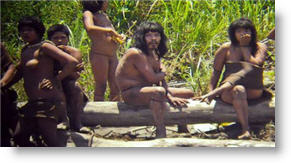
Some weeks ago two events, one of them startling, came together to pin-point the mysterious new conundrum of the Amazon. The first was the appearance on a busy riverbank in the Madre de Dios of a few dozen members of a previously-isolated group of Indians. They killed someone who had been trying to help them. The naked Indians, seen on TV screens around the world, were described by anthropologists as descendants of an unbroken line of hunting and gathering savages, living fossils of our neolithic past.
Area of Coverage
This is, according to new Amazon thinking, incorrect. These Indians are the sad, socially degenerated remnants of nations and tribes that were productive, sophisticated and stable just a few centuries ago.The other event was an article in The New York Times that reported on the discovery in Acre, only a few hours travel from the Madre de Dios Indians, of extensive, deep straight, or sometimes circular, trenches, ridges and mounds dating back to pre-Columbian times, indicating a large, well-developed society. This was just the latest evidence that the Amazon, or at least parts of it, was heavily populated by well-organized societies in much the same way as the high Andes were remodelled by the Tiahuanuco, the Chavin, the Chachapoyas, the Huari, and the Incas.
Over the past couple of decades the pre-history of the Americas has been revolutionized, setting off poison-tipped academic and ecological vendettas. First of all, the Americas were populated much earlier, at least 33-35,000 years ago, double the time previously calculated. That is back to Neanderthal epochs.
An Excellent Read
Second, there were many more people here when Columbus arrived than was earlier thought. And, most important, the societies and nations of the Americas were much more sophisticated and structured than was previously understood. They were agriculturalists, not the war-whoopers of the movies. Their mode of life and agriculture had massive, long-term effects on the original pre-human forests. Fire was a basic control mechanism.
Today the evidence of genetics, linguistics and archaeology is clear that the Amazon was not just an impenetrable green hell populated by primitive hunters and fishermen eking out an unchanging, culturally marginal existence. The same applies to North America. Here most of the descriptions of primitive Indians come from 18th and 19th century travelers who were seeing only the sorry leftovers of great nations that had been obliterated by smallpox, viral hepatitis, influenza and other European and African diseases. The Conquest set off the Dark Ages in the Americas. read the rest of this story…
The wonder of a palm frond in the morning sun, nz.
I’ve often been thinking how having a child is like teaching an 18-yr Outward Bound course, for the parents. The bus arrives when the baby is born and it may leave when the teen turns 18, but maybe not. Of course, no one wants to hear the worn our phrase, “you learn through your children” but I’m reminded of the Kogi tribe (see the BBC film Elder Brother’s Warning) in the Colombian Sierra Nevada mountains who hide their shamans-in-training in a darkened hut, never seeing the light of day until their 18th birthday. Then, after years of preparation, after telling them what the world looks like, they see their world for themselves, for the first time with their own eyes. As the wonder of a baby, with new eyes, but with training, so they can see their world more clearly to do their shamanic work.
Seeing our baby boy look with glee at the morning sunrise, and the light shining through some palm leaves this morning is an eye opener. I felt “more aware” after I survived being tossed around in a van roll-over in 1988. “Everything looked new and pristine”, as Eckhart Tolle put it after his awakening experience. I felt like lucky to still be on the planet. That default feeling subsided after a few weeks, and now I have to work at being present by doing what I call “remembering my spiritual practice”. For me it’s meditating and listening to Eckhart Tolle’s Power of Now. Reminders can take almost any form as long as it helps
An Eye Catcher - Are you watching though?
bring one back to their center. In recent talks with newly elected Mountain Spirit Instituteboard member and mountain guide/instructor Ken Wyle, he’s been relating how writing his book on being buried in an avalanche which killed seven people, is a catharsis. Tolle says that people who are more conscious in their lives have usually had some tragic loss in their life that shook them out of the dream state we call normal life.
Our baby boy, laughing as he looks out the window of our van whizzing down main street in Kingston New Zealand, is a reminder to me – “What am I missing? I want to see like he sees!” The good news, it’s wholly possible. I’ve been seeing, more than dreaming during the last ten years. And it’s obivous when I’m not present. I might go a whole morning or day and realize I’ve not been present until something catches my eye, like a detail of a stem in a vase, or the bustle in supermarket, or of course, a sunset.
Learning to see and live in the moment sure beats the alternative, and I’m not going back. When you beat your head against a wall long enough, you finally decide you’ve had enough of that, and make the choice to stay in peace, no matter what happens. A side benefit of being at peace is your mind isn’t filled with crap, so you are free to see such things as the morning light shining through some palm fronds.








 Mountain Spirit's Blog