Posts Tagged ‘Mountain Spirit’

Loving Linquistics

07/07/2011

By R. Richards

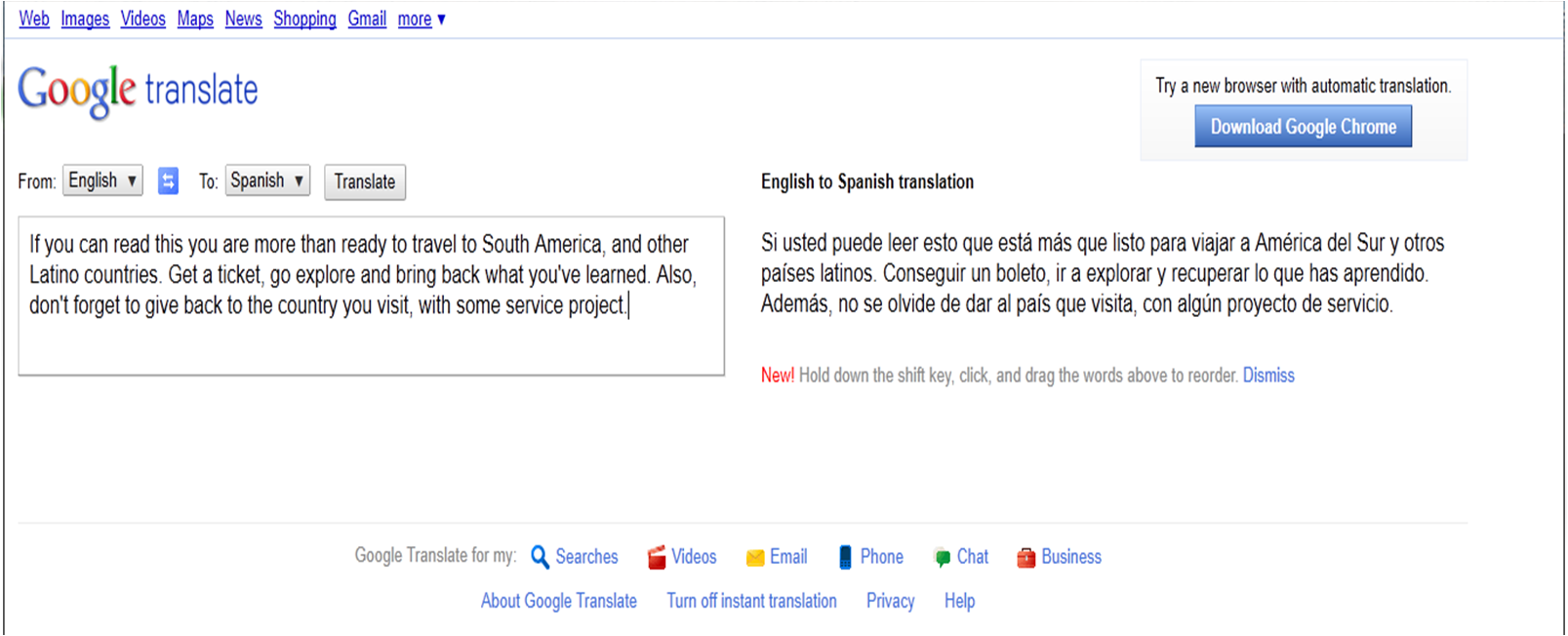
You probably know about Google Translator but I thought I’d briefly write about it here, just in case you’ve never used it. If  you haven’t, check it out.

Use this to write to friends old and new in foriegn lands

It’s a great tool for reaching out across cultures and languages to those you may have met while doing your overseas expedition, and kept their address but never wrote to them because of the language barrier. It also features on-the-fly translation for those using gmail, and for other email clients, quick cut and past from the website into emails works effortlessly.

I must admit, my Spanish grammar isn’t the best, (I’ve been told I speak “Tarzan Spanish”). One of these days, I’ll get my conjugations down, but for now, in order to write a somewhat grammatically correct email to my friends in Peru, I admit it, I often use Google Translator.

Another cool site I stumbled upon yesterday is Freelang.net where I found a free downloadable Quechua English Dictionary. How cool is that?

I’m sure this  particular dictionary hasn’t been around that long, so I was excited to see and download it. It works quite well. I haven’t checked out the other languages but you can, at  here.

So get out there and start writing to someone, anyone and bridge the language gap. Enjoy.

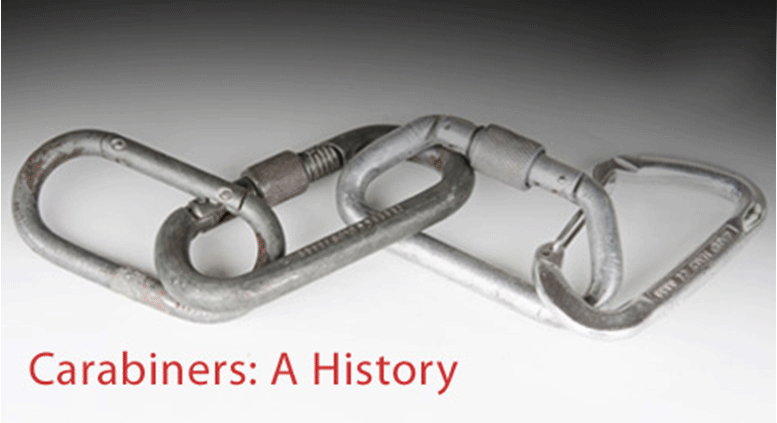
A History of the Carabiner

02/07/2011

Linking History...

From: Alpinist
Working his bare-feet up the face, the climber takes a knotted sling from his shoulder and places it around a stone horn. He takes a second sling, deftly unknots it and feeds the cord carefully around his hempen lead rope and the slung rock. With the rope now connected to his natural protection he ties the second cord back into a sling and climbs on….

Before Otto “Rambo” Herzog first conceived using carabiners, climbers had only two options for connecting their ropes to protection: tie the rope and protection together, or untie and run the rope directly through the gear. Neither option was quick or especially safe.
In Alpinist 35 we examine the history of the carabiner; why Otto “Rambo” Herzog first thought of using the device, how it was modified over the last century and how the carabiner got its name.

Rambo Herzog

Rambo
Otto “Rambo” Herzog earned his nickname seventy years before the Sylvester Stallone movies. “Ramponieren” in German means “to batter” or “to bash,” and Herzog got his nickname, “Rambo,” not for flailing up climbs but for the hours he spent ramponieren specific problems. Today, Herzog is remembered for introducing the carabiner and breaking Hans Dülfer’s grading system. In 1913, he climbed the south wall of the Schüsselkarspitze (2537m) with Hans Fiechtl, a route that reached the limit of grade V (5.8/9), the highest grade in Dülfer’s I-V scale. In 1921, Herzog, together with Gustav Haber, climbed the “Ha-He Verschneidung” on the Dreizinkenspitze (2306m). Today rated 5.10, Herzog and Haber’s climb was so difficult that grade VI had to be added onto the I-V grading scale.

Today all climbing carabiners are made from solid metal. But in the 1970s SALEWA introduced a hollow design, that weighed only forty grams. This model was not only revolutionary because of its form but also because of the safety testing done on every unit. For the first time, each carabiner was individually tested before hitting the market. The slight indent on the curve of the pictured ‘biner, is the mark left by the 1000kg test. Many climbers will look at the empty interior and imagine that hollow carabiners were unsafe. However, in a recent interview with Alpinist, SALEWA’s former General Manager Hermann Huber said the hollow designs were abandoned because of breakthroughs in cold forging that allowed for lighter and stronger designs from solid aluminum.  Read the rest of this story…

Corn & The Advantage of Backwardness

02/07/2011

Machu Picchu, Maize and the Advantage of Backwardness
June 30, 2011 by Andean Air Mail & PERUVIAN TIMES
By Nicholas Asheshov
Special for the Machu Picchu Centennial –

Maize

Machu Picchu and the Inca Empire were the creation of an import from Central America, maize, and a dramatic climate shift that turned the Andean highlands from inhospitable wet-and-cold to pleasant, as it is today, dry-and-warm.

For more than half a millenium before this shift the high Andes had been miserable.  With the new dry-and-warm, starting around 1000 AD, a backwoods tribe, the Incas, put together the new climate and technology breakthroughs and by 1500AD had produced the world’s most go-ahead empire, heavily populated and larger, richer, healthier and better organized than Ming Dynasty China and the Ottoman Empire, its nearest contemporaries. Read the rest of this story…

Don’t Buy It

17/06/2011

Selling Success Thru Consuming

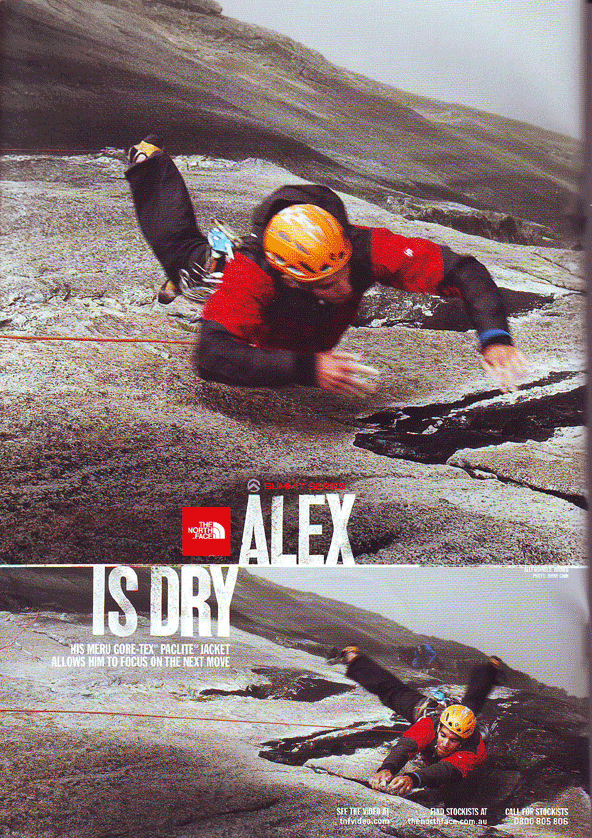
A recent full page ad on the inside front cover of New Zealand Alpine Club‘s The Climber* Magazine shows a truly burly shot of climber Alex Honnold in Borneo, doing a dyno move on what looks like a long potential fall on a big wall. Granted the sequence is impressive, (let’s be clear, I can’t do that), but the ad states, “ALEX IS DRY, His Meru Goretex Paclite Jacket allows him to focus on the next move.”

OK, ok, stop the music. Does this make we want to rush right out and buy a Meru Paclite Jacket? Not. But if  the Meru Paclite jacket allows him to focus on that dyno, maybe it will allow ME to focus on my next move too, just like the ad in the picture.  My criticism is albeit a cliche, nevertheless, I don’t buy it.

Kiwis are known for being a self-depreciating, humble bunch. They seem to buy used whenever possible, plus it blends into the backcountry better. Have you ever heard the saying, “Don’t go climbing with someone who has new gear?”  This doesn’t mean to avoid climbing and teaching new to the sport, but more it means watching out for a poser.

The Kiwi quietude is making me, in my conditioned Americanism,  feel downright goofy. I feel I may be tooting my own horn without even knowing . Mind you, I consider myself on the humble side, but New Zealanders make me look like Donald Trump.   I wonder however, how many climbers reading that magazine are taken by the ad. I would suspect a few more of my fellow Yankees stateside might be taken in. What do you think? Comment below.

Don’t buy it – buy used. Even though I’m able to buy on pro-purchase programs, I just bought a pair of Karhu BC skis on Craigslist, and it feels good. Did I even need them in the first place, yes. Maybe a step further, and a pair from the Salvation Army here in Queenstown for $40 would have sufficed. We can always improve.

Buying this Book? Share it.

Nope, I wouldn’t buy a used rope, or even cams,  but buying  most other stuff used just helps the planet, and you look better in a used jacket anyway. It’s another dirtbag move for the planet. Madison Avenue and the big corps who now own The North Face, (and now Karhu) don’t like guys like us. We’re terrible consumers – Have you joined the crowd?

According to a new book by Rachel Botsman and Roo Rogers, What’s Mine is Yours, The rise of Collaborative Consumption, the trend is huge – to buy less, buy used and share. I’ll write more about this book after I finish it. So far it’s fascinating.

*This is no way meant to be a slam on The Climber advertising policies, in fact the author encourages readers to support the magazine by supporting its advertisers, appropriately. A tricky one, eh?

By the way, nice move Alex.
Taking Time for the View

15/06/2011

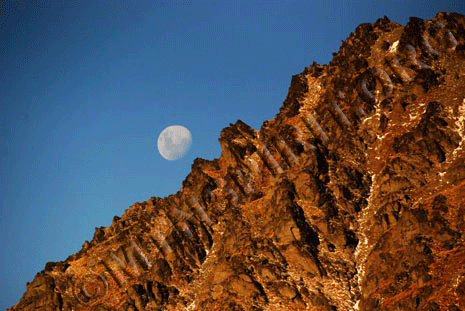
Remarkable Moonrise

I had an hour available on my way home after running some errands in nearby Queenstown, and thought I’d take a quick drive up the access road to the Remarkables Ski Area.  Although there’s no snow on the slopes, I thought I’d have a pretty good chance of getting some evening shots. I had missed out on the night before with an incredible red sky on the waters

Alta Basin, The Remarkables, Queenstown, NZ

of Lake Wakatipu, a hue created from the Chile volcano, so thought see what I could find tonight. It doesn’t take much to make a good photo here. Just show up and point the camera, the land and light do the rest.

You might have a busy day, but take the time to get out, bring your camera or better yet, a sketch book or some water colours, or go for a climb, and take a break.

Peru: Protests Against Illegal Gold Mining

30/05/2011

Tourists Leave Puno Amid Escalating Protests

By: Andean Air Mail & PERUVIAN TIMES
More than 200 tourists who were stranded in southern Peru’s Puno department due to protests against mining activities have managed to leave the area, according to the president of the Regional Chamber of Tourism (Caretur), Manuel Quiñones.
The tourists were able to leave the region through the airport at Juliaca, state news agency Andina reported.
“The tourists, mostly Europeans, traveled to Cusco, Lima and others to Arequipa,” Quiñones said.
Many of the tourists, taken out of Puno on the small launches to visit the Uros and Taquile and Amantaní islands, spent a night on the islands and sought other exits from Puno the following day, while others returned to the city of Puno in the evening and went ashore at different hotel piers under dark, a lakefront source told, Read the rest of this story..

Nobel Peace Prize Nominee’s Fight

30/05/2011

See the movie China doesn't want you to see

The film 10 Conditions of Love, is the story of Rebiya Kadeer from East Turkestan, the other Tibet,  (which the Chinese call Xinjiang Province), and her dramatic fight against the ruthless oppression of 20 million people and the obliteration of 1500 years of Uyghur culture, of the global politics of energy, of super power politicking over the War on Terror, and the pain of a deeply loving family torn violently apart.

New Zealand Backcountry

28/05/2011

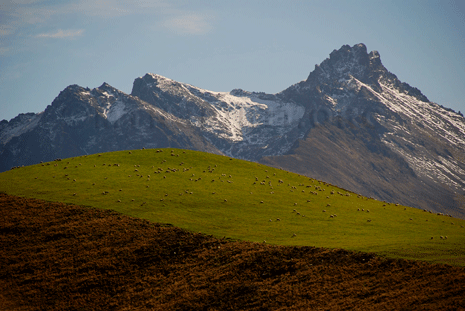
Mt Eyre, NZ Backcountry

I feel a  backcountry ski  adventure coming on. Last week I ventured out  15 minutes from our house here in Kingston, New Zealand and ended up driving down a farm road, off the nearest side canyon from the main north-south road to NZ’s southern tip. A view similar to this can be seen from the main road, but the closer I got into the back valley, following the Mataura River, I was led to this view of Mt. Eyre.  This is not one of the major peaks in the area, by any stretch, but it’s close to our place and what looks like some good backcountry skiing potential. As we near winter down here in the southern hemisphere, I’ll getting my skis sharpened, this may be my a ski area of choice due to its proximity, at least to the trailhead.

Elitism in the Mountains

27/05/2011

By R. Richards

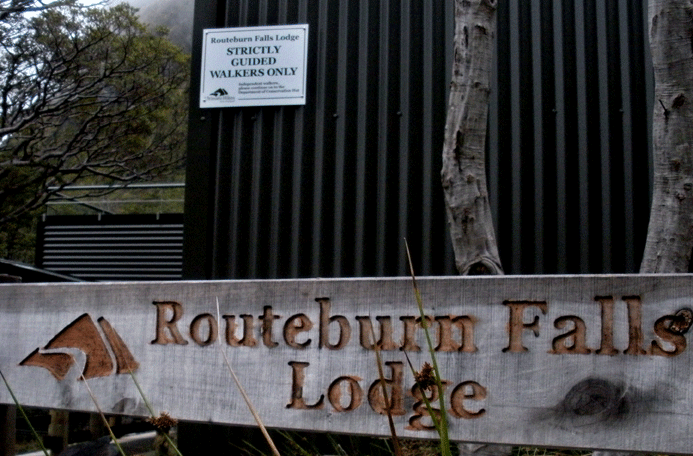
The "Lodge" at Routeburn!

Fellow MSI board member Bob Stremba and I recently decided to spend a  couple of days on New Zealand’s Routeburn walk, one of the famous tracks in the Southern Alps. We did it last week, during the shoulder season so there were only a handful of people on the trail. But I can imagine the numbers grow exorbitantly during the summer months. Fair enough, that’s how New Zealand has decided to funnel foreign hikers, and showcase tourism into a few of the well-known tramps. Milford Sound not far away is another.

Hi There!

All went well, aside from a bit of rain. We met some nice hikers, one from Ireland, Australia, Switzerland and four from Canada. We stayed at the small Routeburn Flats hut, and the next day proceeded to the Routeburn Falls hut for a quick lunch break . That’s when something seemed out of place. First, the size of the Department of Conservation (DOC) hut was quite impressive, equipped to handle large amounts of hikers. I then noticed above me, and pondered what in the world, could the huge building possibly be that stood above the DOC hut? Since it was the off season, this larger upper building was closed, bit we could peek in the windows . As I approached,  a big wooden sign in front of the building called out  the “Routeburn Falls Lodge”.  I saw a smaller sign behind it, mounted on the wall stating: “Strictly Guided Walkers Only” adding “Independent walkers please continue on to the DOC Hut.”

Private Rooms for the Gentry

The irony of first class and coach system arriving in the mountains struck me immediately with the thought that there should be a sign on the DOC hut stating, “Strictly Independent Walkers, Guided hikers should continue on to the nearest Hilton”. Of  course I don’t really feel that way, but it was the first thing that came to mind. Better yet, maybe the cognoscenti should overthrow the highfalutin hut and invite the coach class to join them, (and possibly even have a food fight).

The only site I can remotely remember seeing like this was in the Alps. Of course high living gentiles are still staying in the hotels just below the faces of the Matterhorn and Eiger. The only class arrangement I can remember seeing was in the Alpine Club huts of the Alps where the mountain quide’s quarters, were separated from us chattel climbers. But this, here in New Zealand was a whole other matter. I’m sure Oliver James, author of Affluenza would be proud of most Kiwis who shun this sort of thing in their mountains. I then found my tolerance level further tested with another sign telling “independent hikers” to a) turn around, b)  march their little butts down to where they belong  c) and stay there, all with the Orwellian salutation of “Hi There!”  See the actual text in the image above.

Bob Stremba, overlooking the Backcountry (?)

I hope that “haute couture” in the backcountry stops with this hut. I’m assuming there may be others though.  Even  though this super-duper hut sits in the heart of the Routeburn,  in the real backcountry, we’re still all the same. The problem is, having such a lodge like this goes a long way in destroying the very experience the concession is trying to offer. By its very nature, it removes itself from the backcountry. It brings the virulent virus – the epidemic of affluenza to the doorstep of paradise.  Tell us what you think about allowing such multiple uses on government land such as  luxury lodges (such as this one  run by Ultimate Hikes) Is it a bad idea? Are we missing something about the land use plans of NZ?

If you’re thinking of taking a  guided hike, suggest to your guide that he put you up with the rest of us. You’ll find it much more inspiring. Also suggest that they could change their signs to a less snooty sort.

Joe Simpson’s Beckoning Silence

26/05/2011

Bravo, Joe Simpson

Joe Simpson’s documentary, The Beckoning Silence, is a well-done re-enactment of Tony Kurtz’s infamous climb on the Eiger. It’s part adventure, part history and part personal reflection. It shows the insight of wisdom that, in this case, comes with age. Having almost died more than once, the first time in Peru, Simpson has arrived at place in his life that is refreshingly thoughtful. Simpson is a climber who is growing older and facing his own mortality. Congrats to Simpson for making this “on the edge of your seat” film and letting us into his personal growth.

I reflect on Eckhart Tolle who writes in his first book The Power of Now about thrill seekers such as climbers who get addicted to the calm that comes with climbing, where past and future fade away and one must focus next move or ice axe placement,  because “taking your attention away from the task at hand, even for a split second can mean death”. Tolle  adds, “Fortunately you don’t have to climb the north face of the Eiger in order to feel the presence of the moment,  you can do it, right here and now*.”

I just did a bit of leading on rock yesterday, for the first time in a while, getting out from behind the desk here in New Zealand. It was great to clear the head and be on the  cliffs right outside our house here in Kingston on Shirttail Cliffs.

Top of Shirt-tail Cliffs, Kingston, NZ

Great quality climbs in a spectacular setting. Moving on the rock again felt great, and motivating, being on the sharp end. However,  I’ve never had that wild-eyed look of adrenaline, pumped, on the sharp end, need of the thrill . I like to test myself, but my survivalist instinct is too strong to be too bold. There are old climbers, bold climbers but not a lot of old bold climbers.   I know quite a few fellow climbers who I’ve lost to the mountains over the years, including one of my mentors, Alan Bard. I think of these things too, as does Simpson, as we have a baby boy expected to arrive in four weeks.  It’s good to be in the mountains, but to those hardcore dudes, don’t be afraid to take the easy way up, it won’t kill you.

*A free translation