Peru’s Inca History Rich with Experiential Education: At least from what we see at current Inti Raymi Festival
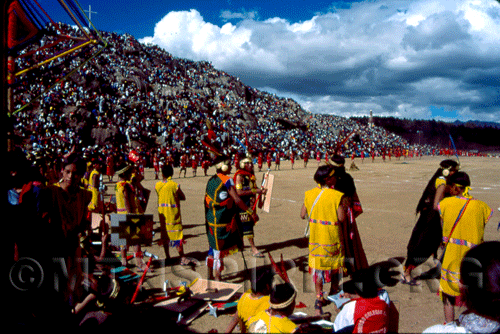
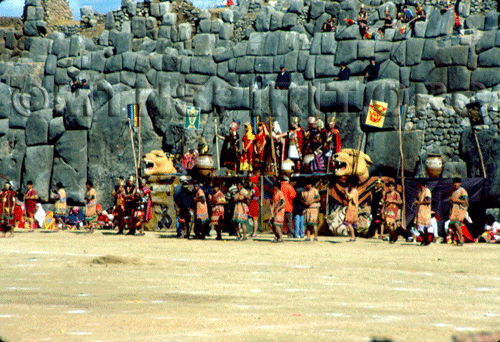
Every year on June 24 Cusco celebrates the festival of Inti Raymi at the Inca Fortress of Sacsayhuaman.
This festival was celebrated by the Incas as the Festival of the Sun in honor of the God of the Sun: Wiracocha. The Inti Raymi symbolizes the eternal consecration of marriage between the Sun and human beings. The festival is
Inca Royalty Observe Inti Raymi
now the second largest festival in Latin America with an expected 200,000 people visiting Cusco.
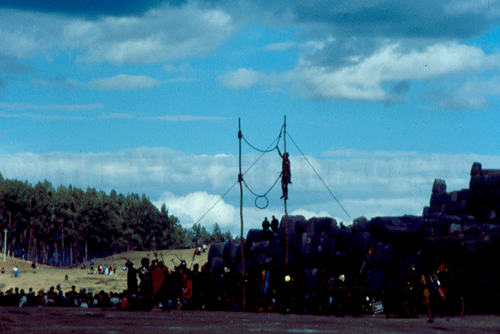
But from an educator’s eye, there is more going on than just a festival. Groups of students from all over Peru but especially from the Quechua speaking, and Inca origins, come to participate in experiential tests of courage and craftsmanship. It is a wonderful and proud event in which to participate,
An 18-Yr-Old Balances
where young from come to throw, climb and balance, all the while, with elders looking on. The sense of pride and community at the Inti Raymi is palpable.
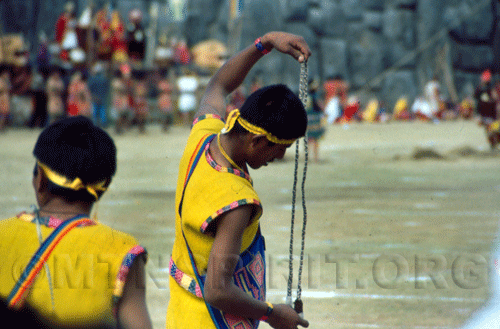
When I first attended some 12 years ago, it had not been so big. So be it. The
Stone Throwing Competition
festival is popular and deservedly so, not only for the sense of history of the Inca, and Quechua heritage, but to see teens competing, representing their communities, here at this historical place, Sacsayhuaman. Images: R. Richards, Mountain Spirit Institute
Mountain Spirit Institute has been running programs in Peru since the late 1990’s that focus on experientially learning and giving back to the people of the Andean villages we encounter. We pride ourselves in staying off the beaten path. See our website at www.mtnspirit.org for more information. MSI is a non-profit educational organization.
We’ve decided to add a second program headed to Peru for August. If you’d like to learn more about the program, dates and cost, visit our webpage. The program will focus Cusco, Machu Picchu, the Sacred Valley and Lake Titicaca. This is our twelfth year leading educational programs to Peru. Before that, R. Richards was guiding high altitude summits.
“It’s not about tourism and snapping images” says founder Richards. “Like all our programs, it’s about learning from the culture, giving back with service, a smile and learning the language, and of course stepping out of your comfort zone.”
We will also be working more with Jorge Martel in the Cordillera Blanca on the range’s east side. Stay tuned to see images of this region. If you’d like information please contact us.
Mountain Spirit Institute announces Benefit Concert with Snatam Kaur
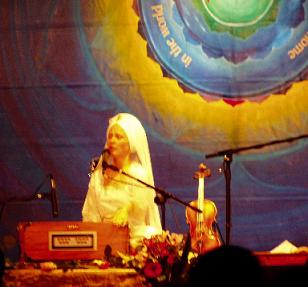
Snatam Kaur
Snatam Kaur will be playing at the Lebanon, NH, USA Opera House on September 1st, 2010 for a evening of meditative music. Kaur is an internationally known recording artist, who’s music is highly soul soothing.
Say Cindy Heath, Mountain Spirit Board Member and Coordinator of the concert, “I happened to be at a Kripalu event and heard her playing for a yoga event. I had remembered her music when we had it playing at a MSI board meeting.” Adds Heath, “When I approached them to see if they’d be interested in Snatam playing under an invitation from Mountain Spirit Institute as a fundraiser concert for the organization, they eventually said yes.”
It took a while, but after the booking person looked at MSI’s website, they deemed our organization has a similar mission to Snatam’s. Tickets for the concert will be sold through the Lebanon Opera House
Concert in Toronto
“I was first introduced to Snatam’s music by my wife, Amanda, who listened to Kaur’s music while attending meditation and yoga retreats in India during the summer of 2008,” says Randy Richards, director of Mountain Spirit. “I have just about worn out Snatam’s CD’s, and when we heard from Cindy that she had met Snatam and there might be the possibility of a concert, we jumped at the chance.”
Read more about the upcoming Snatam Kaur/Mountain Spirit Institute Benefit Concert at our webpage on the concert. To listen and learn more about Snatam’s music visit her website.
Handwoven Fabrics: Living History
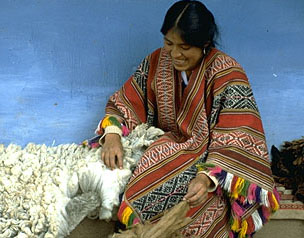
Handwoven fabrics are the living history and cultural treasure of the Peruvian Highlands. The weavers who create these extraordinary textiles are the keepers of the culture and sustainers of a noble but difficult lifestyle in tune with the earth. This book, Weaving in the Peruvian Andes celebrates their authentic, well-crafted work by showing varied and distinctive styles of traditional clothing, the basics of how fabric is created from spinning to dyeing to weaving, the way traditional crafts are passed from one generation to another, the names and meaning of the myriad textile designs that reflect the culture and history of the people, and the rituals and celebrations in which woven fabrics play such an important role.
N.C. Alvarez
Author Nilda Callañaupa Alverez is founder and director of the Center for Traditional Textiles of Cusco. She has established weaving associations through the Andean highlands to preserve a tradition of handmade textiles and to promote economic development. She lives in Cusco and in her native community of Chinchereo, Peru.
During their last tour in the U.S., Chimu Inka had some time to check out New England, kick their feet up and have some fun. Here are some images of light moments during their stay with us in Sunapee, NH.
We stopped at a novelty shop in Portsmouth, NH. Guillermo Seminario had time to try on some of of the various headpieces that the U.S. has to offer.
Wachi Taype, stylin'
Wachi Taype also saw some sunglasses that seemed to fit him quite well. At least that’s what we thought.
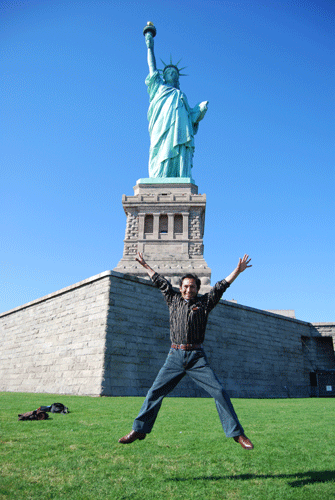
When we visited the Statue or Liberty, Mario Montalvo was jumping for joy over his opportunity to visit the Big Apple. When we last saw the group in Cuzco, Wachi reflected on his U.S. experience – “Randy, our visit to the U.S. seems like dream”, adding, “Did it really happen?”
Mario, enthusiastic in NYC
I assured him it had, and with providence, it will happen again! We can’t wait to have these bright souls back in the U.S.A., and of course for a tour to New Zealand when we’re there.
I got some shots of this ice climber practicing on the glacier just near the entrance of the Mont Blanc tunnel in Chamonix, France. It’s a great place to practice with good top-rope sites.
There are more images but these two seemed the most dramatic, especially with the gaping circular crevasse below. It reminds me of the threat of circling the drain.
Where do you start? How do you lower to flat ground? Not to worry, there was a good ice ledge where climbers can tie in. Ykes!
Ho’O What?
Old Hawaiian system of communication and engaging with the universe that actually works to make a better world.
I’ve been meaning to write about this book for a while, and a recent email prompted me to follow through. On one hand, while the cover, and some of the book’s precepts are a bit hokey, such as getting the woman and car you want, I doubt I’d be married to the wonderful woman that’s my wife, had I not actively engaged the universe and actually asked for what I want. I was using this technique during the summer just before we met. I was leading a mountaineering course in Alaska at the time, and while in the mountains, practiced the technique about 30 times per day. This book illustrates a technique that has quite a track record and impressive story behind it. Below is an email from a good friend to whom I recommended the book and technique. As Tolle says, “Are you polluting the world or cleaning up the mess?” This technique helps you do your part to clean up the mess.
Hi Randy,
I really enjoyed our conversation today.
Shortly after our conversation, I Googled some reviews of “Zero Limits” as well as several pages of the book itself in the form of a preview. In it are perhaps the most potentially life changing ideas I have ever encountered. I thank you very much for introducing it to me. I am going to order copies for several friends and myself.
Thanks J.M.
Dear J,
Yes, this technique of simply saying “I love you, I’m sorry, Please forgive me, Thank you”, is still working wonders in my life. It’s time to raise the bar for all of us, isn’t it.
Thanks for the link to Meninger. I’ll check it out.
Looking forward to seeing you. Warmest regards,
Randy
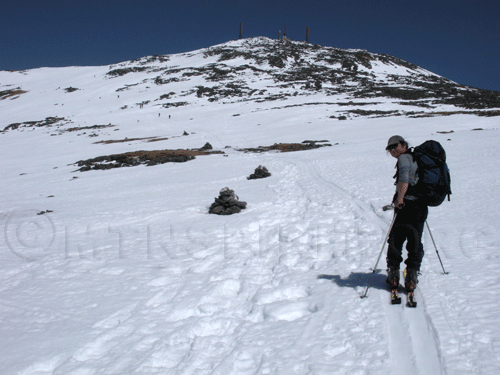
I’d grown up, skiing every spring, on Mt. Washington’s east side – Tuckerman’s, Gulf of Slides, and Great Gulf. Once, I think I took one run, years ago on the west side, but last week Junji Itagaki suggested we head up to his favorite haunt. I don’t often get in ski touring mode when back east, but the west side of Mt. Washington is as close as it gets to a wonderful alpine touring experience on the east coast of the U.S.
We climbed up Munro Gully, then headed to the Lake of the Clouds, then over to the summit of Mt. Washington, for a nice descent down Ammonoosuc Ravine, on thick but great snow. I think we had record-breaking temperatures that day. (See my earlier post on getting kids outside, which was filmed in Ammonoosuc Ravine).
Mt. Washington's West Side
Pictured above, Junji Itagaki, Lake of the Clouds and its Hut, Mt. Washington to the right.
Mountain Family Doesn’t Stop Exploring When Kids Enter the Picture
Junji Itagaki, Mt. Washington, NH, USA
Junji Itagaki and I were backcountry skiing from Mount Washington’s summit last week, and descended down Ammonoosuc Ravine when we passed by family encamped in the base of the ravine. They were still setting up camp in a safe area, off to the side of the avalanche zone, when I asked them for a short interview.
The families in many cultures don’t stop going outside, hiking or backcountry skiing in the mountains when their children are born. They intentionally introduce their children to camping, hiking and skiing. Here’s a great example of that in New England….
Robert Nagle, Eco-Challenge Multi-Winner: “Teamwork and Communication, Some Major Keys to Wins” By D.R. Richards
I recently met Robert Nagle at a Professional Ski Instructors of America Telemark Spring Rally, and when he mentioned that a particular piece of clothing he was wearing was great for “desert runs”, it got my attention. “Desert runs?” I asked,
“Yeah,” he responded, “I was a professional competitor for a number of years, and did a Sahara Desert Run, where we had to carry everything on our back, except water.”
“What?” I replied. I’d never heard of such a race. He added, “Yes, I also used to compete in the EcoChallenge,” adding humbly, “We won it a number of times.”
Below, Robert shares what was were keys to his team’s success.






 Mountain Spirit's Blog