Archive for April 18th, 2009
18/04/2009

Governor's Bay, Picton, NZ
Early Bird Catches the Shot
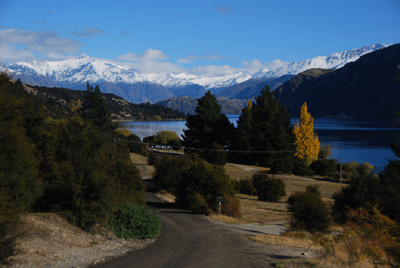
We were to catch the ferry from New Zealand’s South Island to the North island. The Ferry first weaves its way from Picton Harbor, through a long sound, before opening out into the open water between north and south islands. The passage is seen in the image at right. The crossing takes about 3.5 hours, which departed at 8am. We encamped on the Queen Charlotte Drive just west of Picton, and this early morning sunrise of the sound started our day.
Tags:adventure travel, Dexter R. Richards, ecospiritual psychology, Experiential Education, Governor's Bay, Holistic Living, Meditation, Mountain Spirit, mtnspirit.co.nz, mtnspirit.org, New Hampshire, New Zealand, Peru, Picton, Randy Richards, Solo, Spiritual, Sunapee, Sustainability, USA, Utah, wilderness yoga
Posted in New Zealand, Power of Place, Traveling | Leave a Comment »
18/04/2009

Tom Bogdan & his Prius taxi
A Wellington, New Zealand taxi company called “Green Cabs” has thought of a better business plan. They have a fleet of Toyota Prius’s not only in the nation’s capital but in two other cities as well. According to taxi driver Tomislav Bogdan, pictured at right, Green Cabs has forty-five Prius taxis in Wellington alone. When we asked about the price comparison of taking the Prius taxi versus a non-hybrid we were surpised to learn the rates were actually cheaper. Bogdan adds, “The rate around town is NZ$2.50/kilometer (About US$1.50), which you won’t see our competitors offering such a price. The operating costs are cheaper, less gas! We are getting very low in-city fuel consumption rates because of the hybrid.”

Cool Graphics promote sustainability
The bright green Prius sports a cool logo, big global graphic, a catchy phrase stating “Safer for you and safer for the environment”, and a driver with matching green tie. The model Tom was driving was a 2007 standard Prius, with right side driver’s wheel of course. I doubt the paint color is standard!
Maybe other capital cities will encourage and invest in such green taxis, if they’ve not done so already. City managers take note. For information or if you’d like to take a ride in a bright green hybrid taxi you can contact Green Cabs at http://www.greencabs.co.nz
Posted in Climate Change, Leadership, New Zealand, Sustainable Living/Communities | Leave a Comment »
18/04/2009
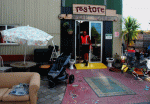
Wanaka ReStart Store
A group of women in Wanaka, New Zealand saw a need for a better way to recycle perfectly good items that were going to the landfill. That’s when they decided to do something about it and started the “ReStore” a number of years ago. The store is a success story in that it serves a vital function in reducing the landfill flow, allows a source for people to purchase used items, and allows the community to re-think their priorities on what happens in the use-cycle of their stuff. The ReStore is actually called Wanaka Wastebusters (www.wanakawastebusters.co.nz) and their store is a feast for the eyes.
(Image: Dan Robertson, an employee of Wanaka Recycling, exits the ReStore to tend the recycle bins)
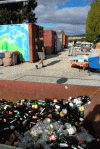
Wanaka Waste-busters Glass
There’s a cult following in Salt Lake City Utah of Deseret Industries stores, operated by the Mormons. Most of the author’s wardrobe comes from high quality used clothes from Deseret Industries. Talking to others who frequent the Deseret Industries stores is like sharing a rock-climbing or alpine adventure story. And all of my favorite clothes are those from “D.I.” as it’s affectionately called amongst Utah locals.
(Image: The glass recycle bin and containers for household items and building materials at Wanaka Wastebusters)
In Wanaka, the ReStore looks like any other thrift store but it’s part of an in the center of the town recycle center. They’ve got recycling down to a fine art. A huge percentage of New Zealanders recycle and it can be seen in the activities at Wanaka Wastebusters.

Wanaka's Angus Ho at "ReStore"
Project Team Member, Angus Ho is soft spoken but talks intensely about his project, Get Real.org.nz which aims at educating people and government in reducing and eventually eliminating plastic bag use at stores throughout the country. Ho has set up an info board and laptop where citizens can sign a petition for legislation on the subject. The following are a few Q&A from the Wastebusters newsletter, (Yes, they have a newsletter):
Angus, what do you do in your job?
Angus Ho: I promote and design projects and campaigns. I set up the green Christmas Presents Campaign and the Recycled Envelope Campaign. I’m also doing waste check-ups for households and businesses. (more…)
Tags:adventure travel, Angus Ho, Dexter R. Richards, ecospiritual psychology, Experiential Education, getreal.org.nz, Holistic Living, Meditation, Mountain Spirit, mtnspirit.co.nz, mtnspirit.org, New Hampshire, New Zealand, Peru, Randy Richards, recycling, Solo, Spiritual, starting a recycle store, Sue Coutts, Sunapee, Sustainability, town dumps, USA, Utah, Wanaka ReStore, Wanaka Wastebusters, wilderness yoga
Posted in Climate Change, Leadership, New Zealand, Sustainable Living/Communities | Leave a Comment »
18/04/2009
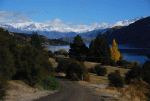
Lake Outlet Campground, Wanaka NZ
Lake Outlet Campground in Wanaka, New Zealand might look like your every-day campground in a stunning setting, tucked in amongst the low windswept trees alongside the shores of Lake Wanaka, but I assure this is no ordinary campground. Owners Glenn Tattersall and Tracy Addison happened to be at the right place at the right time a few years ago when they expressed interest in taking over the campground from landowner and operator Liam Urquhart. According to campground employee Joshua, Urquhart no longer was interested in running the campground, apparently the land developers caught word of his intentions and offered him millions for the lakefront property. ( Private lakefront property ownership doesn’t exist in New Zealand due to a national law called the Queen’s Chain that declares all land, starting from the high water line at the shore and going 40 meters (120 feet) back are public property and right of way. This also goes for rivers. The public is allowed to use this land for recreation and fishing access.)
About that time, enters Tattersall and Addison. The owner had no interest in selling to developers and with a lot of work was able to come up with a thirty-five year lease which not only provided Glenn and Tracy with a way in which to operate the campground, but put the land in protection during the next 35 year lease.
The author’s father once owned a lakefront campground near Fisher’s Bay in Sunapee New Hampshire, USA, in the mid 1960’s. The tents eventually gave way to million dollar homes in the form of a “funnel development “ called Oakledge. (The term “funnel development” is used for subdivisions which use a small amount of lake frontage to sell and support a large number of home lots away from the lakefront. This shared access allows many homeowners access to boat docks, beaches, launching ramps etc. Funnel developments were no longer allowed in the early 1970’s in New Hampshire, USA)
In the free market , it was an obvious course of events, as tents wouldn’t pay the bills as much as a subdivision. So I had personal experience of the value of what Mr. Urquhart and Tattersall and Ms. Addison had accomplished at Lake Outlet.
And Lakeside is no mere campground. Tattersall states his goals in running the operation – “We are making this operation as green as possible. Through our improvements and renovations we will be installing energy efficient appliances in the renovated green building of the main shower and kitchen complex.
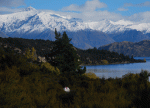
Tentsite: Working with nature, not dominating it.
We are also working with the landscape rather than dominating it. Our tent and RV sites are interspersed around the existing trees and we intend to plant more trees.” He concluded, “This land is locked up in preservation for the next 35 years, and we’re proud to have had a part in that.” Of course none of this would have been possible without the stalwart vision and forward thinking of the landowner.
Tags:adventure travel, Dexter R. Richards, ecospiritual psychology, Experiential Education, Glenn Tattersall, Holistic Living, Lake Outlet Holiday Park and Campground, Meditation, Mountain Spirit, mtnspirit.co.nz, mtnspirit.org, New Hampshire, New Zealand, Peru, Randy Richards, Solo, Spiritual, Sunapee, Sustainability, Tracy Addison, USA, Utah, Wanaka, wilderness yoga
Posted in Conservation, Inspirational People, Leadership, New Zealand, Power of Place, Service, Sustainable Living/Communities | Leave a Comment »



 Mountain Spirit's Blog