Responsible Tourism Begins With a Good Attitude
A short interview with Amanda Richards on her encounter with a group of tourists in Aquas Caliente, Peru, near Machu Picchu.
Archive for August, 2009
Room For Improvement Dept.
18/08/2009Room for Improvement Dept.
18/08/2009By Randall Richards
I finally had to do it – I had to open up a “Room for Improvement Department”. I’ve been holding off for as long as possible. I almost started the category in New Zealand but didn’t really feel the need. Now I must say, I do. And I think you’ll see a few more entries under this category in the next day or so.
"Wealth Group" Visits Machu Picchu
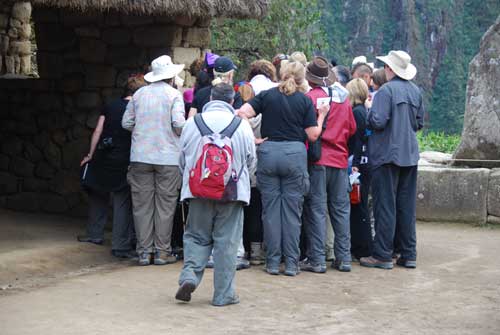
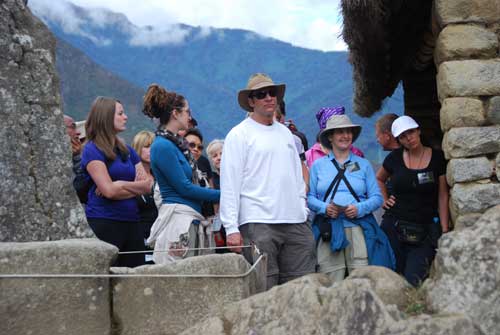
When at Machu Picchu the other day, Amanda and I sat at the “Sacred Rock” area to Machu Picchu’s north end, and along with some French, observed a curious looking group. They were obviously Americans, but seemed to be huddled around someone or something. There also appeared a professional film crew hovering around the group, complete with sound man with headphones, camera man and assistant. There were a few people hugging for long periods of time. While I hug as well, something seemed a bit odd about all this. When I quietly approached the group, I saw an elderly Quechua man and woman in traditional dress waiting, waiting for (it seemed more like “attending”) the group, apparently as local knowledge of some sort. I still really couldn’t see the focus of the group’s attention, so I retreated and upon doing so, asked the film crew what this was all about.
Wealth Group Guru
They replied that “This was a wealth creation group” and the founder of the organization was leading the group of “V.I.P’s” here at Machu Picchu.” He added that, “the leader takes people to various sites worldwide such as the Egyptian Pyramids.”
“So, a pyramid business?” I asked. “Well yeah” he responded.
Machu Picchu’s Face
17/08/2009By Randall Richards
"The Face" peering over Machu Picchu
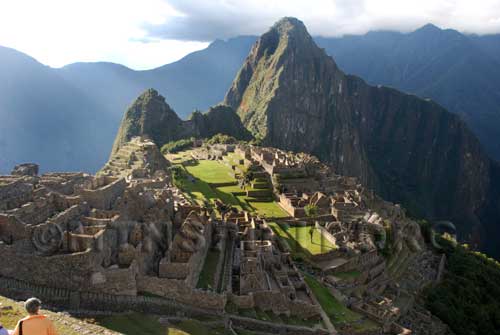
I’ve been to Machu Picchu for over ten years, and I’ve heard tell of “the face on Huayna Picchu Mountain” for years. I have been able to pick out the stylized puma face that everyone talks about, with its ears and eyes, but the other day, human face jumped out at me as I looked at these images I’d taken, from the classic view on the sloping rock just above Machu Picchu. When I was looking through my images of the day, I clearly saw the face of an older man, wearing a “chulla” or Peruvian hat with ear flaps, as he looks over the Machu Picchu Citadel.

Details of Huayna Picchu's Face
I’d recently run across an “optical illusion” website that features the profile of an Inka man looking skyward, shown by a profile of the ridge from the ruins to Huayna Picchu Mountain, but after close examination of the ridgeline in the website’s images, and comparing them to ridgeline in my images, there is clearly some Photoshop imagery going on. A Peruvian author has used the profile on the cover of his book. I even walked by a hotel here in Cusco the other day which is using a drawing of “the profile” for its logo. The profile, whether Photoshop enhanced or not, is still a stretch, any way you look at it, and may not be the real face that has been hidden in plain sight all along.
Back to the face that I’ve observed. It clearly has eyes, a nose mouth, chin and whole face, at least in my mind’s eye. (Let me know if you see it too). The second image at right is a blow up of the image with my text and pointer lines inserted. A word about Photoshop: these images are un-retouched. Take any other image from the same location, at late afternoon during the southern winter, and you’ll get the same results.
Every time I see an image of Machu Picchu from that angle, the face now jumps out at me. I am interested in hearing your comments or experiences when visiting Machu Picchu. Do you see the face?
Peru by Bike
17/08/2009By Amanda Richards
Eva and I met while we were both studying at Copenhagen University about 5 years ago. We were both sad when we said our good-byes because neither of us had any idea when we would see each other again as she was heading home to Germany and I was returning to Australia. Yet, now here we are in South America!
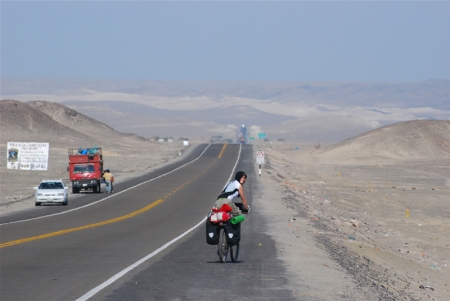
Eva is traveling with Sebastien and they arrived here in Peru intent on cycling and hoping to explore `a strange new world, its countryside, people, cultures and languages for 2.5 months…´ Their adventures began in Lima and they first headed down south to Nazca (a desert area) and then up to Cusco.
On the way to Nazca
They have both been surprised at just how many other cyclists there are on the road – their expectation was that they would be almost the only ones on this big adventure!
After the chaos of Cairo (where they are both currently working) they are particularly enjoying the times when they are higher up in the mountains (sometimes above 4,000m) where there are fewer people.
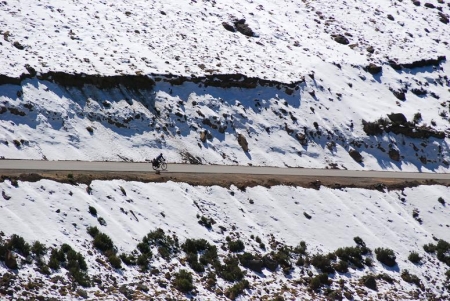
Up up up and down down down
Eva and Sebastien are at Machu Picchu today and will continue with their cycle tour when they return to Cusco tomorrow. Once again Eva and I will sadly say our good-byes and who knows when or where we will meet again. Somewhere fun!
Ridgewalking Inca Ruins
17/08/2009This footage was taken today as we explored the ridge high above the Inka ruins above Pisac, the Sacred Valley, near Cusco and Machu Picchu. Although I’ve been bringing groups to Peru and have guided the high peaks of South America, today was my first day in Pisac.
The ridge got our attention when we descended a narrow staircase leading to an exposed drop off, but at the brink, a sharp turn to the left led into a steep narrow slot with steps. Straightforward, but it cleaned out our cobwebs for the day.
The footage was prior to the descent to the ceremonial center on the ridge below, then to the village and market of Pisac, Peru.
Peru’09- Trading Places
11/08/2009By Randall Richards
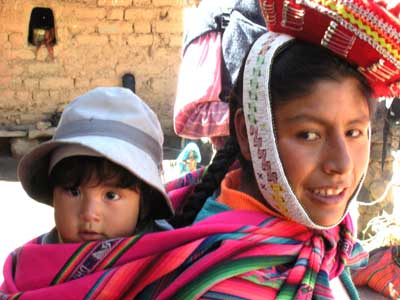
Willoc woman with child
Before I knew it I had a baby on my back. We were being shown how the Peruvian weaving process works from start to finish. We were in the town of Willoc for the afternoon, above Ollantaytambo, the gateway to Machu Picchu. We were being shown how the wool is shorn, carded, and spun, then dyed and weaved on a back-strap loom. The women showing us were wonderful and very gracious. I’d been there a number of times before taking a few MSI participants up to the mountain village, known for its weavings.

Gringo guide with child
I have always been curious how the woman use the mantas, or clothes to carry everything from children to corn. I had been shown the day before how to fold and tie the knot but still was asking a woman who carried a child how it was done so the baby didn’t fall out. Her idea was to show me by handing over the the whole lot, baby and manta to me. As she helped me tie the knot, I thought, “this knot is as important as any climbing knot I’ve tied over the years. It better be good” The young one hung out with me for about fifteen minutes when he decided he’d had enough and wanted his mom again. I still need to figure out exactly how the folds in the material go, so the baby doesn’t fall out. I’ve got the knot down though!
I highly reccomend losing your stroller for this manta. We sell them at our fair-trade webpage, and I can even post some directions on how you too can carry everything from a child, to corn or even your groceries from Trader Joe’s, Hannaford’s, New World.
Peru’09: Planting Corn at Anna’s
06/08/2009
Corn, Peru Style
Tomorrow, Amanda and I head back for Anna’s place in Ollantaytambo. I was just there a few weeks ago with our participants. I look forward to our second visit this year. A few weeks ago, we spent an afternoon getting tutored by Anna on how she grows amazing varieties of corn. She took us down to her fields in the Sacred Valley, just a stone’s throw from her home, and showed us the different sorts of corn, and how she plants them. She explained that these are not mono-species. Most of the corn cross-breed every season creating a multitude of colors and styles of corn, used for everything from Chicha to toasting corn. She explained that most times every row will have a mix colors, which in fact makes them stronger against disease and drought. She also explained how all the other neighbors work together to share various tasks such as irrigation and maintaining the fields.

Anna giving a lecture on planting corn
Unlike Monsanto corn, these varieties reproduce and are carried down through generations. Not to say there weren’t problems. Some twenty years ago, there were serious health issues with the villages due to pesticide use in the fields. Cancer rates were high and people were really being affected. Now though, things are mostly if not totally organic. Most of Anna’s corn goes to feed her family and chickens, and doesn’t reach the local market. She also grows grains to feed her guinea pigs which she sells to neighbors and other villagers. We’ll keep you posted on what we learn next at Anna’s.
Peru’09: Willoc Weaving
04/08/2009By Randall Richards
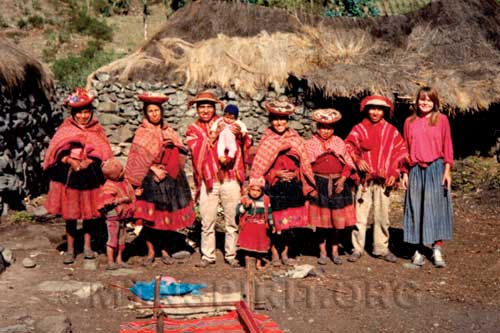
Kate J. at Willoc circa 1980's
The first time I visited the small mountain village of Willoc, near Ollantaytambo was about 12 years ago. Coincidently, my cousin Kate Jones spent a semester from the Lakeside School in Ollantaytambo and spent some time with a family in Willoc about twenty or thirty years before I showed up. This was before I knew where Peru was. She sent a photo of her with her host family in Willoc, which I had on my desk for a number of years. Then when I finally went Willoc, and recognized the local dress, I wondered if Willoc might be the place that Katy ended up. I called her from Peru to solve the issue, and yes it was. Another year in Willoc, I tracked down her family. I’m headed there again in a few days, and will take a copy of the picture with me again to give to them.

Shearing & Drop Spindle, Willoc
On our Peru’09 program we again visited Willoc, and were shown a demonstration from start to finish of how the weaving is done – from shearing the wool to drop-spindle making the yarn, to dying the wool and finally the back-strap loom weaving.
While there we also were treated to a traditional meal and were shown the varieties of corn that are grown on the surrounding hillsides. The diffierent types are used for the fermented Chicha drink, toasting, cornmeal and other specialties.
As in other places in Peru, visitors are occasionally brought to small mountain villages. Mountain Spirit Institute limits our group size to a maximum of eight participants. Sustainable Travel International has guidelines on how to visit such communities as Willoc.
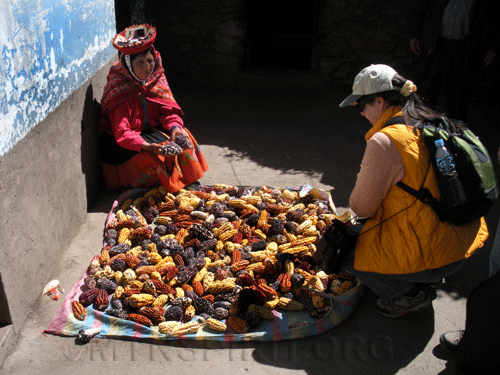
Learning about varieties of corn, Willoc
We feel at this point, there is a benefit to both the visitors and the villages for such visits, but they must be organized and done with care. One example, I always brief my particpants at the program start, and remind them of low-impact travel techniques, such as respectful use of the camera, matching voice volumes to that of local inhabitants, and follow cues from our hosts.
Our good friend, Anna Sequeros, a former president of the woman’s organization in the region has really worked wonders in bringing equality to village women in the area. More on that in another entry.
Generosity in Peru
04/08/2009By Amanda Richards
We had been invited for lunch at the home of Guillermo’s parents-in-law who live in the upper hills of Cusco. Although I had not met them before, Ernistina and her husband were all smiles and welcomed us with hugs and kisses when we arrived. They appeared very humble and live in a simple home. Although spartan and with dirt floors it was clean and comfortable. We sat down to eat and were served soup followed by a lamb stew. The food was delicious and the thing that struck me was that we were given what seemed to be the best meat and they went without any meat at all in their stew. I was a stranger and yet they gave the best of what they had. It reminded me of being on a train in India when complete strangers who obvioulsy had very little, offered me their food and bought me chai, refusing to accept any payment from me. There is still this idea that having guests is an honour and it makes me wonder if this concept is being lost in our western culture.
After lunch we sat outside and again were given the ‘best’ as our chairs were placed in the little bit of sun that was shining in the courtyard. It was a gracious act.
‘We make a living by what we get, but we make a life by what we give’
Winston Churchill
There is no beautifier of complexion, or form, or behavior, like the wish to scatter joy and not pain around us. ‘Tis good to give a stranger a meal, or a night’s lodging. ‘Tis better to be hospitable to his good meaning and thought, and give courage to a companion. We must be as courteous to a man as we are to a picture, which we are willing to give the advantage of a good light.
Ralph Waldo Emerson
Peru’09- Sacsayhuaman
03/08/2009
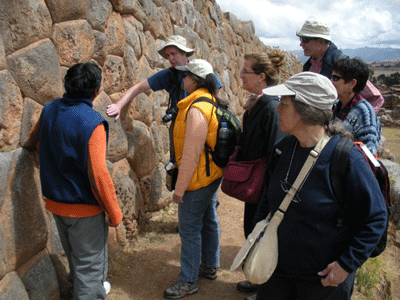
Participants check out the stonework of Sacsayhuaman
The citadel ruins overlooking the town of Cuzco called Sacsayhuaman, about a 20 minute hike from the San Blas area is the site of one of the last stands of the Inka Empire. It’s here where the last emperor fought off the Spaniards, but finally lost. Many were lost on the grounds surrounding the battlements. The stonework and size of the stones themselves is legendary.
There are few places that rival the massive 130 ton blocks that are fitted together so well, it’s difficult to wedge a knife between the cracks. Although there’s specualation, they’re still not sure how the stones were fitted together.
This was a good place to start our program.
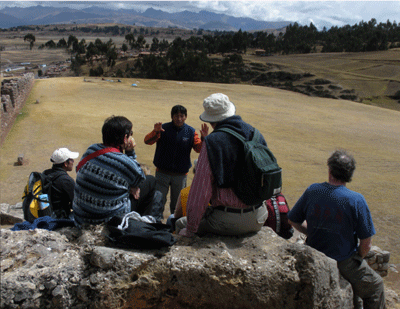
Local Guide tells of the Inti Raymi held annually
Participants were shown the area by a local guide who shared information about the Inti Raymi festival held every year in June, about the stonework and the storehouses of grain and water, and the fact that most of the ruins were taken apart, block by block and used for Spanish buildings and churches in the Cusco center.
Sacsayhuaman is a beautiful place for an early morning walk, which Amanda and I did a few days ago. If you’re there before 7am, they usually don’t charge, plus that’s the best time to be there anyway.
 Mountain Spirit's Blog
