Many of us fear death. We believe in death because we have been told we will die.
Editor’s Note:
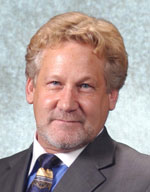
Dannion Brinkley
For some reason, death has not been a stranger in my life. Western society is almost totally ignorant of death, it is something to be brushed under the rug, and feared. Stay tuned for a posting on “Death, The Funny Side” a talk by Dannion Brinkley, author of Saved by the Light. I heard Brinkley speak at a Whole-Life Expo in Seattle in the late ’80’s – he was promoting his book. I liked his half-hour talk so much that I bought a copy of it andeventually converted it mp3 format. I plan on posting it here, once I have Brinkley’s permission of course. It’s a classic, that has changed my understanding of what death is, and what it means to be fully alive. His sense of humor perspective, depth and compassion, after having died more than once and come back to talk about it, is remarkable, especially after having been a hit man for the U.S. government. Ykes.
At Mountain Spirit Institute, one of our core values is addressing our “ultimate concerns”. We believe that by helping to reconnect people to the natural environment, each other and a deeper connection to one’s self, we can help participants start looking beyond the veil. Eckhart Tolle writes” The secret to death is to die before you die, and realize there is no death.” Hmm. Maybe he’s onto something. Dannion Brinkley is, as well. R. Richards
Does Death Exist? New Theory Says ‘No’
From: KipNews (Open your mind, Prepare)
A case for staying no death - Biocentrism
We associate ourselves with the body, and we know that bodies die. But a new scientific theory suggests that death is not the terminal event we think.
One well-known aspect of quantum physics is that certain observations cannot be predicted absolutely. Instead, there is a range of possible observations each with a different probability. One mainstream explanation, the “many-worlds” interpretation, states that each of these possible observations corresponds to a different universe (the ‘multiverse’).
A new scientific theory – called biocentrism – refines these ideas. There are an infinite number of universes, and everything that could possibly happen occurs in some universe. Death does not exist in any real sense in these scenarios.
All possible universes exist simultaneously, regardless of what happens in any of them. Although individual bodies are destined to self-destruct, the alive feeling – the ‘Who am I?’- is just a 20-watt fountain of energy operating in the brain. But this energy doesn’t go away at death. One of the surest axioms of science is that energy never dies; it can neither be created nor destroyed. But does this energy transcend from one world to the other?
Consider an experiment that was recently published in the journal Science showing that scientists could retroactively change something that had happened in the past.
Particles had to decide how to behave when they hit a beam splitter. Later on, the experimenter could turn a second switch on or off. It turns out that what the observer decided at that point, determined what the particle did in the past. Regardless of the choice you, the observer, make, it is you who will experience the outcomes that will result. The linkages between these various histories and universes transcend our ordinary classical ideas of space and time. Think of the 20-watts of energy as simply holo-projecting either this or that result onto a screen. Read the rest of this story…
Robert and Robyn Guyton were determined to start a food forest instead of mowing a front lawn. And a forest did they grow, when in the mid-’90’s, they purchased some land and a house in the small coastal town of Riverton, New Zealand. Riverton along with its neighbor, Invercargill rank as one of the southernmost towns in the world, and back then Riverton was an affordable place to buy land. It still is compared to the northern resort towns of Wanaka and Queenstown, the latter which graces its runway with private jets, rivaling Aspen Colorado.
The Guytons worked in earnest on their two lots planting trees and plants based on permaculture practices. When they first started, they received some odd looks from the neighbors, as their front yard started to take on the forest look. There were no other like-minded people in Riverton when they arrived, but undeterred, they started a cooperative learning center called the South Coast Environment Society.
YOUR FOOD SUPPLY #30: Build it & They Will Come Note: (This video series started in 2010, while listening to the audio version of the book, “The Omnivore’s Dilemma”, when Amanda and I were driving across the U.S. and were seeing the effects of industrial farming in real time while listening to the book.Here’s that first entry Your Food Supply #1To see the whole series, click on the category “Your Food Supply” in the category section of this blog on the right of your screen.
Today the organization modestly states on its website it is an umbrella group for a “several” local environmental groups who have information,displays and meetings in the centre. Those several groups include:
Groups working for protection and enhancement of local ecosystems:
Riverton Estuary Care Society
Aparima Pest Busters
Aparima Nursery Enterprise
Seed Balls for Restoration projects
Groups working to promote sustainable lifestyles:
Riverton Natural Health Group
South Coast Permaculture
Sustainable Lifestyles project
Riverton Organic Food Co-op
Groups promoting sustainable growing methods
Riverton Organic Growers Gardeners Group
Southland Seed Savers
Riverton Organic Farmers Market
Riverton Community Orchard
Rivertonians for Alternatives to Toxic Substances (RATS)
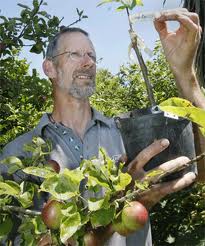
Robert Guyton
My wife and I met the Guytons when they were giving a presentation on sustainability to the ultra small Garston School, (which deserves its own blog post), New Zealand. We were intrigued with their presentation, which included a movie (to be posted on this blog) called “Welcome to the Food Forest”. We decided to take our chances and take the hour and half drive from our place and show up unannounced. Even though we had a standing invitation, we happened to miss them, when we stopped by to say hi. Nevertheless, I decided to interview Mark Baily while visiting the centre. You can see the video on my adjacent post. We’ll have to get down there again when Robert and Robyn are home, so we can get the proper tour of their food forest!
YOUR FOOD SUPPLY #30: Build it & They Will Come Note: (This video series started 13 years ago, while listening to the audio version of the book, The Omnivore’s Dilemma, when Amanda and I were driving across the U.S. and were seeing the effects of industrial farming in real time while listening to the book.Here’s that first entry Your Food Supply #1To see the whole series, click on the category “Your Food Supply” in the category section of this blog on the right of your screen.
A New Zealand Farmer Does Good by Following His Passion
Tom O'Brien of High Country Walks
Tom O’Brien, owner of Blackmore Farm and founder of High Country Walks has followed his passion by offering up a little hut on the back side of his 5000 acre farm. Called the Chinaman’s Hut, it was restored some years ago, by local volunteers, Tom and his father. The hut is situated on the rolling mountains of the Slate Range, just south of the Remarkables Mountains, on the border of Otago and Southland. Tom took the afternoon to show me his farm, the backcountry and the Chinaman’s Hut. below is a short piece on the hut, and a chat with Tom about his philosophy and passion of sharing this part of the world with others.We’re in hopes, here at Mountain Spirit Institute of collaborating with Tom by running some programs on the Slate Range and Blackmore Farm. We chatted about providing Solo’s and other types of programs.
Thanks for the time you took to show me around Tom!
Note: I’ve met one of the volunteers who helped restore the Chinaman’s Hut, a neighbor of ours here in Kingston named Dusty, who I’ll see if I can get on tape in the next few days. He has an interesting story to tell of not only this restoration project by many others.
Graeme Dingle is fast becoming one of my role models, and I’ve never met the man. I intend to though. Maybe if I’m fortunate, we may collaborate on a co-venture project helping to connect people to the mountains, who knows. The more I learn about Mr. Dingle, the more I like and respect who he is, what he stands for, and what he’s accomplished in outdoor education.
Here’s an article from the Directions Magazine By Laura Crooks
Inspiring New Zealand teenagers to reach their potential was a plan born during a trip to the Arctic by adventurer Graeme Dingle and partner Jo-anne Wilkinson in the early ’90s.
Why did you think New Zealand needed a specific programme to help the country’s youth?
I set up the Sir Edmund Hillary Outdoor Pursuits Centre (OPC) in 1972 and I thought that was my contribution to New Zealand in terms of young people. But it was really just the start, because I learnt so much about youth development through it and I got to thinking about the business of dealing with harder kids than those we met at OPC. I felt that for kids who had low confidence and low self-esteem, a one week experience in the wilderness wasn’t enough – it needed to be a continuum of things that really built on what had been learnt in that first period. I then set out to do the first continuous circumnavigation of the Arctic and in the Arctic you get a lot of very unusual communities – they’re very isolated and they live in such extraordinary circumstances where it’s light half the year, then continuously dark the other half of the year. They have very high rates of suicide, the kids don’t have too much to look forward to, and that started us thinking. But it didn’t really hit home until we got back to New Zealand – that here we lived in paradise and yet we had one of the highest rates of youth suicide, youth incarceration, dropouts from school unplanned teenage pregnancy – the works. The main catalyst was going to see Once Were Warriors – that was the thing that finally made us say: “Let’s do something about this”. So, Jo-anne and I invented Project K. basically. The Project K Trust grew into the Foundation for Youth Development (FYD) with nearly 20,000 young people in programmes each year. The FYD runs programmes for kids aged 5 – 18, and Project K is one of these. (more…)
Copper and gold mine project in Peru suspended in face of protests
LIMA, PERU, AND BOGOTA, COLOMBIA — Faced with increasingly violent local opposition, the developers of the giant Conga gold and copper mine in northern Peru suspended the project late Tuesday night, saying they were bowing to a demand from the government of President Ollanta Humala.
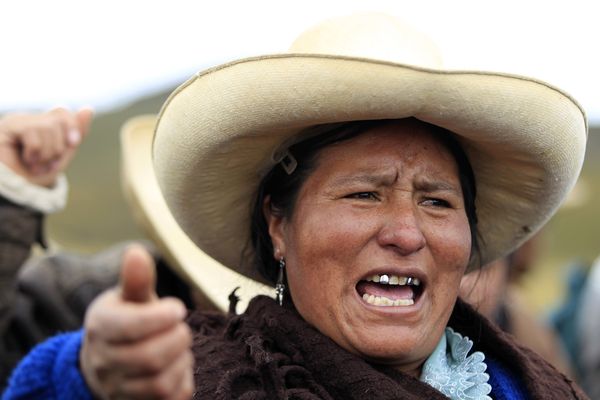
Much of the northern district of Cajamarca has been paralyzed the last six days by general strikes called by Conga opponents that closed businesses and schools. Residents were concerned that the massive gold and copper mine could pollute the region’s water supply, a charge the mine’s operators, led by Colorado-based Newmont Mining, strenuously denied.
The situation became more violent Tuesday, as protesters burned an office at the site of the proposed mine and clashes between protesters and police in the area left 17 injured and two arrested. Thousands of demonstrators massed in the central square of Cajamarca, the region’s largest city.
As proposed, Conga would be a giant open pit gold mine similar to the Yanacocha mine 20 miles to the north, which is also operated by Newmont. But it would include a copper mine and smelter.
Newmont has proposed investing $4 billion in the new project, which could produce between 580,000 and 680,000 ounces of gold a year. The government had projected it would receive royalties and taxes totaling $800 million annually once the mine was fully operational after 2014, income the left-leaning Humala government was counting on to finance social and infrastructure project. Read the rest of this story..
Life has such an ebb and flow. One minute you can be riding the wave, the next minute you are under the wave. One minute you can feel safe and secure in your life, and the next minute you can feel totally threatened by something.
I find that when I meditate it helps me to separate myself from the sting of something to realize that it is all coming from God’s Divine Will. Usually the most emotionally charged things aren’t really that big of a deal anyway. (more…)
Humala Signs Prior Consultation Law During Jungle Ceremony by Andean Air Mail & PERUVIAN TIMES
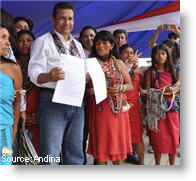
President Ollanta Humala enacted the prior consultation law on Tuesday during a ceremony in the north jungle town of Bagua.
The bill was unanimously approved by Congress and has been strongly supported by international and national rights organizations. It is intended to ensure that Peru’s local laws are in compliance with the International Labour Organization’s Convention 169.
The convention requires the State to consult indigenous people prior to adopting administrative and legislative measures, as well as investment projects and development plans, that could affect their communities.
“This law has the objective of [promoting] development for native peoples, of the Amazonian communities and the entire region,” Humala said. “That is the spirit of this law.”
“Today we have taken an important step in the construction of a nation, the construction of a republic,” Humala added.
Ex-President Alan Garcia rejected a similar prior consultation bill during his recent term, expressing worries that the legislation would provide veto powers to indigenous communities that could deter mining and energy projects.
Humala and members of his Gana Peru party have said the new law will help address the more than 200 social conflicts in Peru that have impacted projects in the extractive industries.
What does it mean to be a good citizen these days?
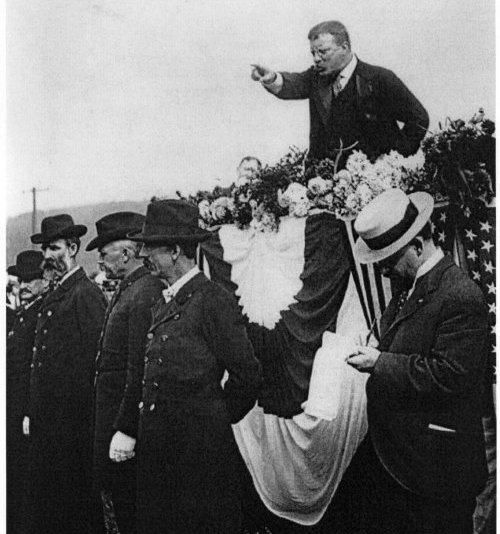
Teddy Roosevelt had some definite ideas on the subject. Below is an excerpt from his speech Citizenship in a Republic. And from where does the term Tenacity of Pursuit come?
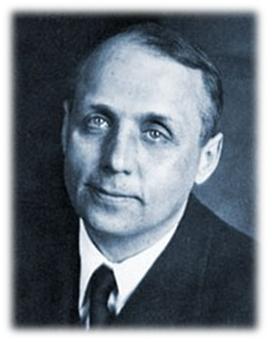
Kurt Hahn, the founder of Outward Bound considered “the tenacity of pursuit” to be one of his key outcomes of a good education.
Kurt Hahn
Says Hahn, “I regard it as the foremost task of education to insure the survival of these qualities: an enterprising curiosity, an undefeatable spirit, tenacity in pursuit, readiness for sensible self denial, and above all, compassion.”
TR’s life shows us that hard work, tenacity, and a desire to do the right thing can get you far in life. In the most memorable section of his “Citizenship in a Republic” speech, Roosevelt captured his life philosophy in just a few sentences. “The Man in the Arena” tells us that the man we should praise is the man who’s out there fighting the big battles, even if those battles end in defeat. In our day, when cynicism and aloof detachment are considered hip and cool, TR reminds us that glory and honor come to those “who spend themselves in a worthy cause.”
The Man in the Arena
It is not the critic who counts; not the man who points out how the strong man stumbles, or where the doer of deeds could have done them better. The credit belongs to the man who is actually in the arena, whose face is marred by dust and sweat and blood; who strives valiantly; who errs, who comes short again and again, because there is no effort without error and shortcoming; but who does actually strive to do the deeds; who knows great enthusiasms, the great devotions; who spends himself in a worthy cause; who at the best knows in the end the triumph of high achievement, and who at the worst, if he fails, at least fails while daring greatly, so that his place shall never be with those cold and timid souls who neither know victory nor defeat.
When the Mountain Bites Back, And What Are the Lessons To Be Learned
Mountain guide, writer and longtime friend from Outward Bound days, Ken Wyle is writing a book about his accounts the day he was caught in the La Traviata avalanche in Canada that killed seven people. I had heard through the grapevine that Ken had been caught in a big one, and I felt a wrench in my gut. Mountaineering accidents, in which friends are involved affect me more than most things in life. Alan Bard was one of my ski-guiding mentors, and he goes and dies on the Grand Teton. One’s teacher isn’t supposed to do that. There was a cloud over me for a time after I had heard the news, and I did’t feel comfortable on the rock for a time too. There have been other friends too that are no longer with us, and I ask myself the same questions that we all do about events like this, and the meaning of it all.
Reading a few of Ken’s Facebook posts and on his blog, give me the impression, he too has been asking some questions. And while the answers are secondary, the questions he’s asking have weight, at least from my humble perspective. While compassion is one of outcomes of teaching an Outward Bound course, it looks like Ken is living it.
I caught up with Ken on Facebook last week, and he suggested I check out his blog The Energies of Adventure. Some glimpses of what will most likely be included his book can be seen on his blog.
Here’s the lead-in to his first post on that blog:
Seven Cairns
Chapter 1, “Lost in the Fog”
January 20th 2003, deep in the Selkirk mountains of Canada’s British Columbia. It is overcast and white out. Snow flakes are lightly falling from the clouds. The air is moving softly out of the southeast. Two groups of backcountry ski tourers collect at the frozen, snow covered, Tumbledown Lake for our first tea break of the day. My smaller group of read the rest of this story..
The film 10 Conditions of Love, is the story of Rebiya Kadeer from East Turkestan, the other Tibet, (which the Chinese call Xinjiang Province), and her dramatic fight against the ruthless oppression of 20 million people and the obliteration of 1500 years of Uyghur culture, of the global politics of energy, of super power politicking over the War on Terror, and the pain of a deeply loving family torn violently apart.






 Mountain Spirit's Blog