Fellow MSI board member Bob Stremba and I recently decided to spend a couple of days on New Zealand’s Routeburn walk, one of the famous tracks in the Southern Alps. We did it last week, during the shoulder season so there were only a handful of people on the trail. But I can imagine the numbers grow exorbitantly during the summer months. Fair enough, that’s how New Zealand has decided to funnel foreign hikers, and showcase tourism into a few of the well-known tramps. Milford Sound not far away is another.
Hi There!
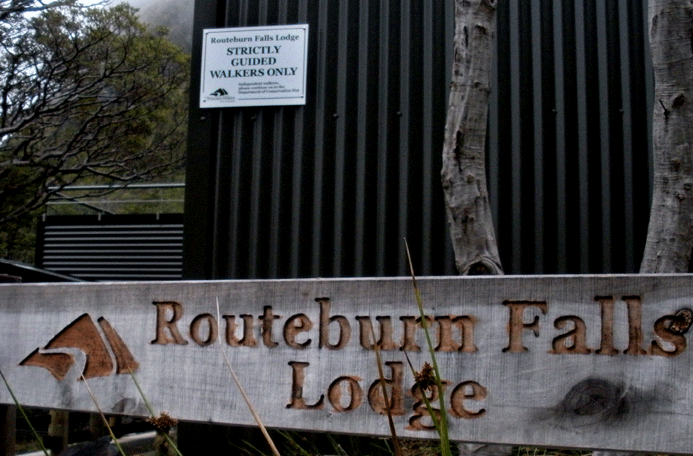
All went well, aside from a bit of rain. We met some nice hikers, one from Ireland, Australia, Switzerland and four from Canada. We stayed at the small Routeburn Flats hut, and the next day proceeded to the Routeburn Falls hut for a quick lunch break . That’s when something seemed out of place. First, the size of the Department of Conservation (DOC) hut was quite impressive, equipped to handle large amounts of hikers. I then noticed above me, and pondered what in the world, could the huge building possibly be that stood above the DOC hut? Since it was the off season, this larger upper building was closed, bit we could peek in the windows . As I approached, a big wooden sign in front of the building called out the “Routeburn Falls Lodge”. I saw a smaller sign behind it, mounted on the wall stating: “Strictly Guided Walkers Only” adding “Independent walkers please continue on to the DOC Hut.”
Private Rooms for the Gentry
The irony of first class and coach system arriving in the mountains struck me immediately with the thought that there should be a sign on the DOC hut stating, “Strictly Independent Walkers, Guided hikers should continue on to the nearest Hilton”. Of course I don’t really feel that way, but it was the first thing that came to mind. Better yet, maybe the cognoscenti should overthrow the highfalutin hut and invite the coach class to join them, (and possibly even have a food fight).
The only site I can remotely remember seeing like this was in the Alps. Of course high living gentiles are still staying in the hotels just below the faces of the Matterhorn and Eiger. The only class arrangement I can remember seeing was in the Alpine Club huts of the Alps where the mountain quide’s quarters, were separated from us chattel climbers. But this, here in New Zealand was a whole other matter. I’m sure Oliver James, author of Affluenza would be proud of most Kiwis who shun this sort of thing in their mountains. I then found my tolerance level further tested with another sign telling “independent hikers” to a) turn around, b) march their little butts down to where they belong c) and stay there, all with the Orwellian salutation of “Hi There!” See the actual text in the image above.
Bob Stremba, overlooking the Backcountry (?)
I hope that “haute couture” in the backcountry stops with this hut. I’m assuming there may be others though. Even though this super-duper hut sits in the heart of the Routeburn, in the real backcountry, we’re still all the same. The problem is, having such a lodge like this goes a long way in destroying the very experience the concession is trying to offer. By its very nature, it removes itself from the backcountry. It brings the virulent virus – the epidemic of affluenza to the doorstep of paradise. Tell us what you think about allowing such multiple uses on government land such as luxury lodges (such as this one run by Ultimate Hikes) Is it a bad idea? Are we missing something about the land use plans of NZ?
If you’re thinking of taking a guided hike, suggest to your guide that he put you up with the rest of us. You’ll find it much more inspiring. Also suggest that they could change their signs to a less snooty sort.
The Revolution will begin our food supply
Over the past 12 days, the Obama administration has unbelievably chosen to approve two biotech crops, Roundup Ready genetically modified (GMO) alfalfa and Roundup Ready genetically modified (GMO) sugar beets. Obama’s recent approval of them will allow them to be planted as early as this spring, despite widespread acknowledgment that these crops are certain to contaminate both conventional and organic farmers non-GMO crops. Their approval only benefits one company — Monsanto.
These decisions are a devastating blow to our democracy and the basic rights of farmers to choose how they want to grow food on their land and the rights of consumers who increasingly choose organic and sustainably grown food for its positive health and environmental impacts. Click here to join us in telling President Obama that it’s time to stand up to Monsanto and reject these GMO crops today.
The Revolution will begin our food supply
Over the past 12 days, the Obama administration has unbelievably chosen to approve two biotech crops, Roundup Ready genetically modified (GMO) alfalfa and Roundup Ready genetically modified (GMO) sugar beets. Obama’s recent approval of them will allow them to be planted as early as this spring, despite widespread acknowledgement that these crops are certain to contaminate both conventional and organic farmers non-GMO crops. Their approval only benefits one company — Monsanto.
These decisions are a devastating blow to our democracy and the basic rights of farmers to choose how they want to grow food on their land and the rights of consumers who increasingly choose organic and sustainably grown food for its positive health and environmental impacts. Click here to join us in telling President Obama that it’s time to stand up to Monsanto and reject these GMO crops today.
By R. Richards, Founder,
Mountain Spirit Institute [Don’t miss the chart at the end of this post]
Once again, I’ve crossed the U.S. border, and am back in New Zealand (by way of Australia) experiencing medical system the way it was meant to be – compassionate, not based on profit over people. My wife is pregnant, and before we left, we decided to have an initial visit with a midwife in New Hampshire. Once in Australia/New Zealand, we planned to have further tests. We were traveling to Australia to be with family Christmas, not to have pre-natal tests.
After the Holidays, we returned to New Zealand and are now here on the South Island. So, in addition to our holiday trip, we’ve also been on a medical tour, getting a sampling three different medical systems, starting in the U.S. (more…)
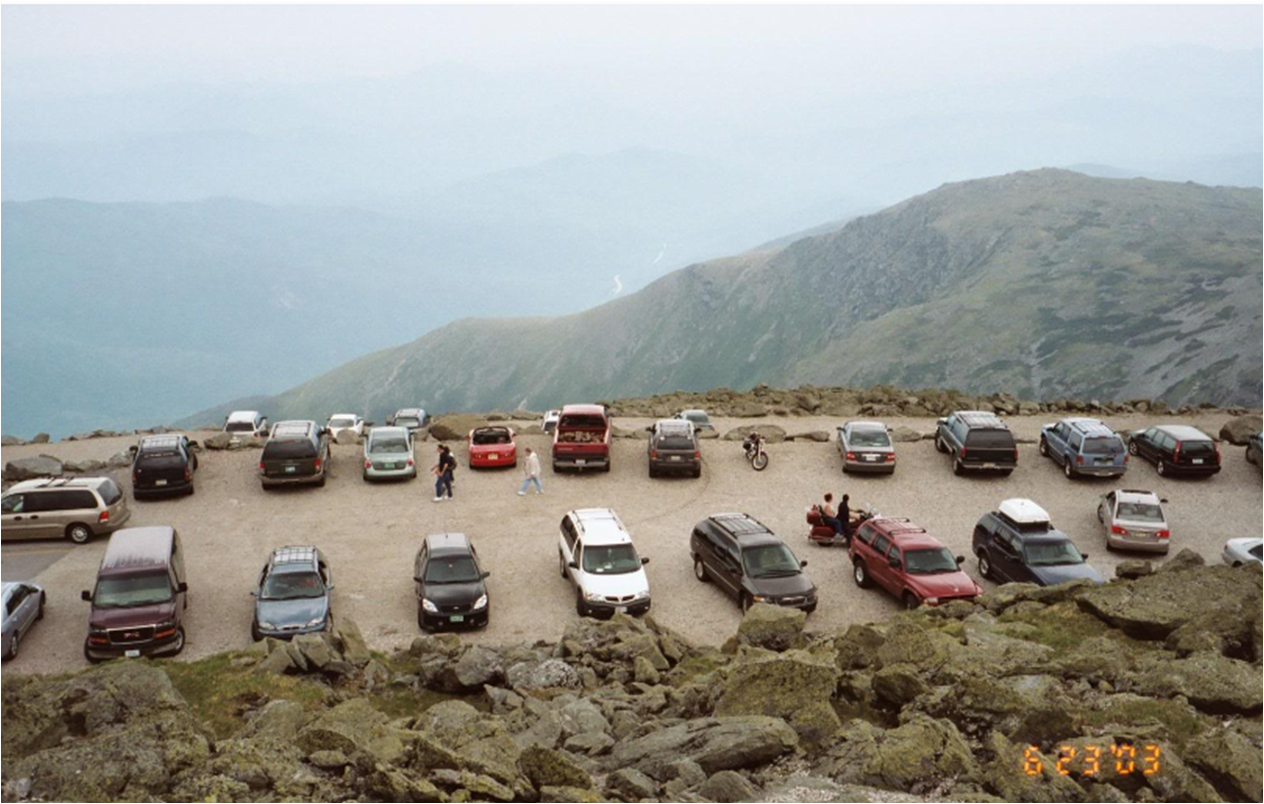
As we approached the last few feet of the Tuckerman’s Trail, at the summit of Mt. Washington. we took the last steps… to what? A parking lot filled with camera toting, Lay’s Potato Chip bag eating, heavy handed, and heavy set “summiteers”.
They had just driven up the highest peak in the land.
And they were taking pictures of us, the hikers, as if we were wildlife…maybe we were.
I’m a native of New Hampshire, and after all these years, had forgotten to avoid the White Mountains in the summer. I’ve been living in other parts of the world and usually come back to New Hampshire during the off seasons. So, when Amanda and I decided to climb to the Northeast’s highest summit on a midweek day last August, I vaguely warned Amanda about a crowded summit. But nothing prepared either of us for the sheer numberof poeple. While I’m the first to share the mountains with others, and gladly give way on the trails, the element of an auto-road raises the stakes of tolerance.
The day started and ended nicely, it was the middle part that was challenging. As we headed up Lion’s Head Trail, we passed a few people here and there. It was Amanda’s first time on a bigger peak in the Northeastern US, and she enjoyed getting a sense of the mountain, feeling the “mountain spirit” which each unique to each mountain. The Inca have a word for it, “Los Apus”, the “Mountain Spirits” which reside in and on every mountain, or in essence, are the mountain. Mountains are either maculine or feminine, and have certain traits, such as strength, or flexability or love, or supporting compassion for example. Amanda was getting a feel for what she felt as the female, but big, loving energy of Mt. Washington, whose indigenous name is *Agiocochook (or Agiochook), and Waumbeket Methna meaning “The place of the Great Spirit”; “The place of the Concealed One.” (and in one other reference also named, Kodaak wadso). (*Referred to by Emerson as well, in his journals).
When one quiets the mind, and tunes into the surrounding natural environment, the place and natural features will speak to one. But because of our incessant need for mind chatter, and our worried lives, we rarely tune into the pulse of nature, as exemplified by our summit experience.
The Summiteers
Amanda has been reading Postcards from Ed, a collection of letters and postcards from Edward Abby, which we both highly recommend. Our suggestion, dismantle the road, and the cog railway while they’re at it.
Note: Stay tuned for another post featuring “Ingram’s Law”: A law based on Gresham’s Law of economics, in which Ingram applied the same principles to recreational management in our national and state parks and other public lands.
The first in a series of video posts about Your Food Supply
#1 The Trip West: An Experiential Rude Awakening By Randy and Amanda Richards
This was Amanda’s first trip across the U.S., so we thought we’d drive. Destination? Colorado, where we would house-sit for a fellow Mountain Spirit board member. We thought we’d stay off the interstates, instead, crossing rural routes, starting with Indiana Route 24, then Missouri Route 36 west of Macon. Shortly after departing we decided to listen to The Omnivore’s Dilemma, a book on tape by Michael Pollan.
Want to know what’s in your food?
As we traveled through Indiana, Missouri, and then Kansas, the book narrated our trip with views of tightly packed cornfields, and more corn, and then more corn. It turns out, about the only thing the U.S. is growing is corn, at least from what we saw. Sure there are apples in Washington, and spinach, avocados etc, in California, but in the Midwest, there’s corn, and a lot of it. We did see some soybean fields, but nothing much else than corn. We certainly didn’t see many pastoral scenes of cows grazing on open pastures. But we did see lots and lots of corn. As we listened to Pollan’s book, we were shocked to learn where all this corn is ending up in the food supply, plus how many bushels per acre of corn the farmers were squeezing out of the land. Read his book for the stark details of our homogenized food supply, and as you do, imagine seeing it in front of your eyes, passing by the window of your car. It was eery for us. I’ve driven across the U.S. probably over 45 or 50 times, and each time I’ve felt grateful to do so, and very cognizant of my impact by doing so.
I won’t go into detail about all we learned in Pollan’s book. Buy his book. However, one of the major topics he covered was how corn is not only a food, but a commodity, that is in almost all our food in a wide variety of forms. Corn drives the modern industrial food machine, being sent to beef feedlots where cows are forced to eat corn. Grass is their natural diet. Monsanto’s Roundup Ready genetically Modified Corn was another scary thing we learned about, plus how our farmers are forced work for fewer and fewer dollars, while ADM and the other monopolies make the money.
So starts our video series, rows and rows of corn, somewhere in Kansas on Route 36, but it could be anywhere in the Midwest. Stay tuned for Your Food Supply #2, for a feedlot and processing plant scene west of Dodge City Kansas, which may shock you.
Please sign this petition to Chevron’s CEO, Mr. Watson asking that Chevron finally do the right thing in Ecuador. (En español aquí)
Dear Mr. Watson:
As the new CEO of Chevron, climate change and the environmental and human rights impacts of Chevron’s operations are the two issues that will define your tenure at the helm of one of the world’s largest oil companies. Chevron has fallen behind other businesses and many political leaders already taking a leadership position on climate change. Furthermore, your company is drawing increasing criticism for failing to rectify its massive human rights and environmental disaster in Ecuador. Taking the following steps will demonstrate a true commitment to environmental responsibility and respect for human rights – which will only strengthen your company’s future.
We the undersigned call on Chevron CEO John Watson to:
* Clean up Chevron’s toxic legacy in Ecuador, compensate affected communities for health and environmental impacts, and provide affected people real access to health care and potable water.
* Develop a global environment and human rights policy that will prevent similar tragedies in the future.
* Adopt aggressive strategies to provide clean energy to a carbon-constrained world.
While countries around the world continue to watch their economies collapse, and Goldman-Sachs leaders testify to Congress about how they manipulated both their shareholders and the American public, we are also faced with a tragic oil spill on our most fragile coastlines.
The sad truth is that oil, greed and fake accounting work hand in hand to empower those who have — and significantly disempower those who do not.
In my book, Hoodwinked I talk about the 30,000 Ecuadorians who filed a lawsuit against Texaco (since purchased by Chevron). The company destroyed vast sections of rain forest and the toxic wastes from its operations allegedly killed many people and made many more chronically sick. (more…)
On May 10, 2010, British Petroleum’s Chief Executive Officer, Tony Hayward, was interviewed by Michele Norris on NPR’s All Things Considered concerning the failed attempt to cap the broken oil rig on May 8th and 9th. (listen to the interview)
The part that most disturbed me about this interview was Dr. Hayward’s comparison of this accident to the Apollo 13 mission, and the Air France Flight AF447 which crashed in the ocean last June. Here is a transcript from part of the interview:
NORRIS: Mr. Hayward, this is the deepest well blowout on record. And the people are most knowledgeable in dealing with deep water wells are at the outer edge of their expertise, even when things are going well. The Coast Guard and oil industry analysts say that drilling here is almost like visiting outer space. It’s like a great unknown. So why are you drilling there if there’s so much that is not known about this territory?Dr. HAYWARD: Well, we’re drilling because it’s a very important source of energy for the United States and the world. That is the reality. Almost 30 percent of the United States oil production today comes from the deep waters. That is where there is the opportunity to provide domestic energy security. That is where there is an opportunity to provide energy security for the world. And, of course, oil isnt all of the solution but it’s a part of the solution.
NORRIS: That opportunity obviously comes, though, with great peril. Is deepwater drilling riskier than BP believed?
Dr. HAYWARD: I think you have to go back to, you know, the track record of the industry and BP’s over the last 20 years. The industry has drilled over 5,000 wells. BP has drilled around 1,500 of those 5,000 wells, and this is the first time that we’ve had a major incident. And I think it is legitimate to draw analogies with, for example, the space program.
The space program was not canceled because of the issues around Apollo 13. It’s also legitimate to draw comparisons with the airline industry. When the Air France plane fell out of the sky coming out of Brazil, we didnt ground the airline industry. So we need to learn the lessons here. They will be learned and they will shape, I’m certain, the industry as it moves forward.
Drawing analogies between this accident and the Apollo 13 mission makes no sense at all and he uses it to distract from the severity of this incident. There were, first off, no deaths associated with the Apollo 13 mission, and second, Dr. Hayward is completely disregarding the damage the leaking oil and gas is causing to the environment and the coastline communities.
The same is true of the Air France flight. Yes, 228 people died in the accident, but Dr Hayward is saying we should not stop deep oil drilling because we did not ground the airline industry after the plane went down. This analogy illustrates how disconnected Dr. Hayward is from the severity of the oil spill. He is only seeing the deaths, and the money lost. He is not considering the vast unaccountable ecological damage the oil is causing. Moreover, the Apollo 13 mission and Flight AF447 did not lead to an economic disaster causing hundreds of people to lose their livelihood as is happening on the Gulf coast right now. Flight AF447 did not continue to reek havoc on the surrounding environments for months after the crash.
This sort of thinking is how we got into the environmental situation we are in now. People in power in these large corporations are not willing to say, “You know, this technology is not necessary, it is just too harmful.” Their focus is always on shareholder profits, never on wider ecological impacts. Our disconnection from the natural systems that keep our communities and economies alive is leading us to our own destruction.
Think about this: people talk of nuclear power as a “clean, alternative” energy source. However, what will a CEO say when a plant starts leaking radioactive material into the environment, killing everything? Will he or she say, “We didn’t stop the oil companies from drilling when they had accidents, why should we be shut down?”
Where would we be if a hundred years ago people noticed how dirty and destructive fossil fuels were and decided to try alternatives instead?
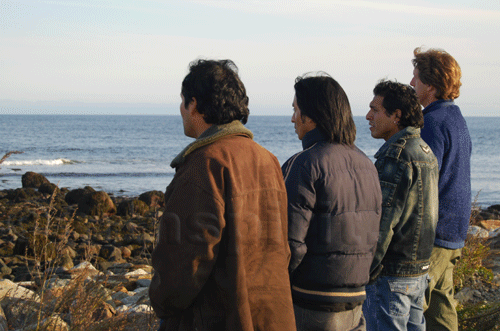
Guillermo Seminario, the director of Chimu Inka, the Peruvian band came to the U.S under invitation from Mountain Spirit Institute to run a program to perform and teach about Peruvian folklore music in 2008. In one Vermont town, we were being housed in a very nice old residence in one of the more ritzy parts of town. At one point during the evening, Guillermo turned to me, shaking his head, saying, “In Peru, there are children without food, and a place to sleep.” He queried, “It confusing me, seeing such wealth in your country when Peru is so poor in many parts of my country.”
Our Peruvian Guests on the Coast, NH
We have thought and discussed this much since that day. Tearing down a perfectly good house just doesn’t seem right.
It’s more than, “Finish your broccoli, there are people starving in other countries,” but it stems from the same disconnect. It’s true the U.S and other 1st world country’s inhabitants are happily oblivious to our role in contributing to The Empire’s excesses. It’s time to think small, and stop the waste. I have a gut feeling this level of living will not continue, mostly due to peak oil. It’s actually quite obvious.






 Mountain Spirit's Blog