Archive for the ‘South America’ Category
09/09/2011
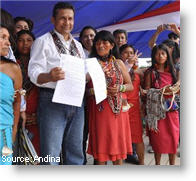
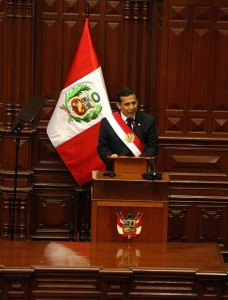
Humala at Bagua Convention
Humala Signs Prior Consultation Law During Jungle Ceremony
by Andean Air Mail & PERUVIAN TIMES
President Ollanta Humala enacted the prior consultation law on Tuesday during a ceremony in the north jungle town of Bagua.
The bill was unanimously approved by Congress and has been strongly supported by international and national rights organizations. It is intended to ensure that Peru’s local laws are in compliance with the International Labour Organization’s Convention 169.
The convention requires the State to consult indigenous people prior to adopting administrative and legislative measures, as well as investment projects and development plans, that could affect their communities.
“This law has the objective of [promoting] development for native peoples, of the Amazonian communities and the entire region,” Humala said. “That is the spirit of this law.”
“Today we have taken an important step in the construction of a nation, the construction of a republic,” Humala added.
Ex-President Alan Garcia rejected a similar prior consultation bill during his recent term, expressing worries that the legislation would provide veto powers to indigenous communities that could deter mining and energy projects.
Humala and members of his Gana Peru party have said the new law will help address the more than 200 social conflicts in Peru that have impacted projects in the extractive industries.
The president’s signing of the law in Bagua was a clear sign Read the rest of this post…
Tags:Amazon, Congress, Humala, indigenous rights, Mountain Spirit Instittue, Peru, Sustainable Communities
Posted in Indigenous Wisdom, Inspirational People, Leadership, Peru, South America, Sustainable Living/Communities | 1 Comment »
30/08/2011
The Mapuche are an indigenous people living in central Chile. Their cultural center is the town of Temuco. This film was voted the People’s Choice on Culture Unplugged. To view the
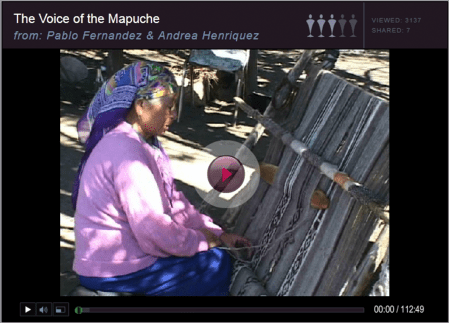
Voice of the Mapuche People
Tags:Chile, indigenous rights, Indigenous wisdom, Mapuche, Mountain Spirit, South America, Temuco
Posted in Environment, Health, Holistic Living, Indigenous Wisdom, South America, Spiritual, Sustainable Living/Communities | Leave a Comment »
15/08/2011
The surge in the price of gold brings wealth and unrest to Peru.
From Reuters: Katharine Jackson reports

Click Image to see Reuters Video
Also see our earlier post on Barrack Mines in Huaraz, Peru.
Tags:Gold mining, Mountain Spirit, Open Pit Mining, Peru, Problems with mining gold, unrest
Posted in Conservation, Environment, Fair Trade, Indigenous Wisdom, Peru, Room For Improvement, South America | Leave a Comment »
13/08/2011
Hiram Bigham, “the discoverer” of Machu Picchu was a amateur archeoligist and worked at Yale. Many artifacts have been finally returned to Peru.Cusco’s Casa Concha opens doors for Machu Picchu exhibition
From: Andean Air Mail and Peruvian Times
 Cusco’s Casa Concha, owned by the Universidad Nacional San Antonio Abad de Cusco (UNSAAC), has opened its doors for two weeks to exhibit more than 360 artifacts from Machu Picchu that were recently returned by Yale University. The artifacts will be displayed in two rooms in the Casa Concha, located about half a block from Cusco’s main plaza, state news agency Andina reported.
The opening was inaugurated by UNSAAC’s rector, Victor Raul Aguilar. In the first two hours of the opening, which is free for locals and tourists, the exhibition attracted about 100 visitors, read the rest of this story..
Tags:Archeology, Casa Concha, Hiram Bigham, Inca, Inka Artifacts, Machu Picchu exhibition, Mountain Spirit, returned, Universidad Nacional San Antonio Abad de Cusco, UNSAAC, Victor Raul Aguilar, Yale
Posted in Archeology, Peru, South America | Leave a Comment »
08/08/2011
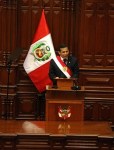
Peru's new President Humala
A Topsy Turvy World:
The more I read, the more it’s looking like the world is indeed being turned upside down. The southern hemisphere is looking better all the time. In addition to the article below, also check out : Chinese investments in Peru to reach $10 billion in five years and Fitch Ratings sees Peru’s economy growing over 6 percent in 2011
South America Unites Against “Irresponsible Debtors” in the North
By: Mario Osava, Inter Press Service

North American Funny Money
Default, insolvency, fiscal irresponsibility, debt crisis and similar terms form part of the vocabulary used to describe countries in the developing South in the 1980s and 1990s. A decade later, the world seems to have turned upside down.
The “irresponsible debtors” are now in the industrialized North, and the countries of South America, victims of the “lost decade” of the 1980s and the subsequent financial crises, are now working hard to protect themselves against contagion from the crisis in the United States and Europe.
A meeting of economy ministers in Lima Thursday Read the rest of this story…
Tags:alternative press, censored news, China investment Peru, Economy ministers meet in Lima, financial crisis, Fitch Rating, Mountain Spirit, Peru, South America growth, supressed news
Posted in Leadership, Peru, South America, Sustainable Living/Communities | Leave a Comment »
03/08/2011
Peru's Enviro Minsiter Sr. Giesecke
Environment Minister says tackling social conflicts is “urgent”.
From Andean AirMail & Peruvian Times
Peru’s Environment Minister Ricardo Giesecke said Monday that tackling social conflicts in the country will be an “urgent” task in his portfolio, state news agency Andina reported. Social conflicts sky-rocketed during the Alan Garcia’s administration.
When Garcia took office in 2006, Peru’s ombudsman – the Defensoria del Pueblo – reported about 80 social conflicts in the country. Towards the end of his term, which wrapped up last Thursday, there were over 200 social conflicts, of which an overwhelming number are related to socio-environmental issues in the extractive industries.
In addition to delaying projects and investments, the conflicts have cost numerous lives and cost millions of dollars in collateral damage Read the rest of this story…
Tags:Alan Garcia, Environment, Environment Minister Ricardo Giesecke, extractive industries, Gold mining, mines, Mountain Spirit, Peru, social conflicts, socio-environmental issues
Posted in Conservation, Environment, Fair Trade, Indigenous Wisdom, Peru, South America, Sustainable Living/Communities | 3 Comments »
01/08/2011
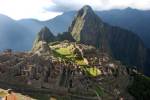
Machu Picchu ©Mtnspirit.org
Peru Gov’t looks to increase visitor limit to Machu Picchu
From: Andean Air Mail & PERUVIAN TIMES
Peru’s Ministry of Tourism and Foreign Trade said Tuesday that a recent study supports more than doubling the number of visitors to Machu Picchu, the ancient Inca citadel perched on a mountain top in Cusco region.
Currently, the daily limit on tourists that can enter the Machu Picchu site is set at 2,200. According to state news agency Andina, the ministry’s study suggests the citadel can withstand 5,479 visitors a day. This would allow Machu Picchu, a World Heritage Site, to receive approximately 2 million tourists a year.
The study is in direct contrast to the opinion of UNESCO, read the rest of this story..
Tags:abuse, Conservation, eroision, Limits to visitors, Machu Picchu, Mountain Spirit, overuse, problems, protecting, Sustainable Travel, UNESCO
Posted in Archeology, Conservation, Environment, MSI News, Peru, South America, Sustainable Travel, Traveling | Leave a Comment »
07/07/2011
By R. Richards
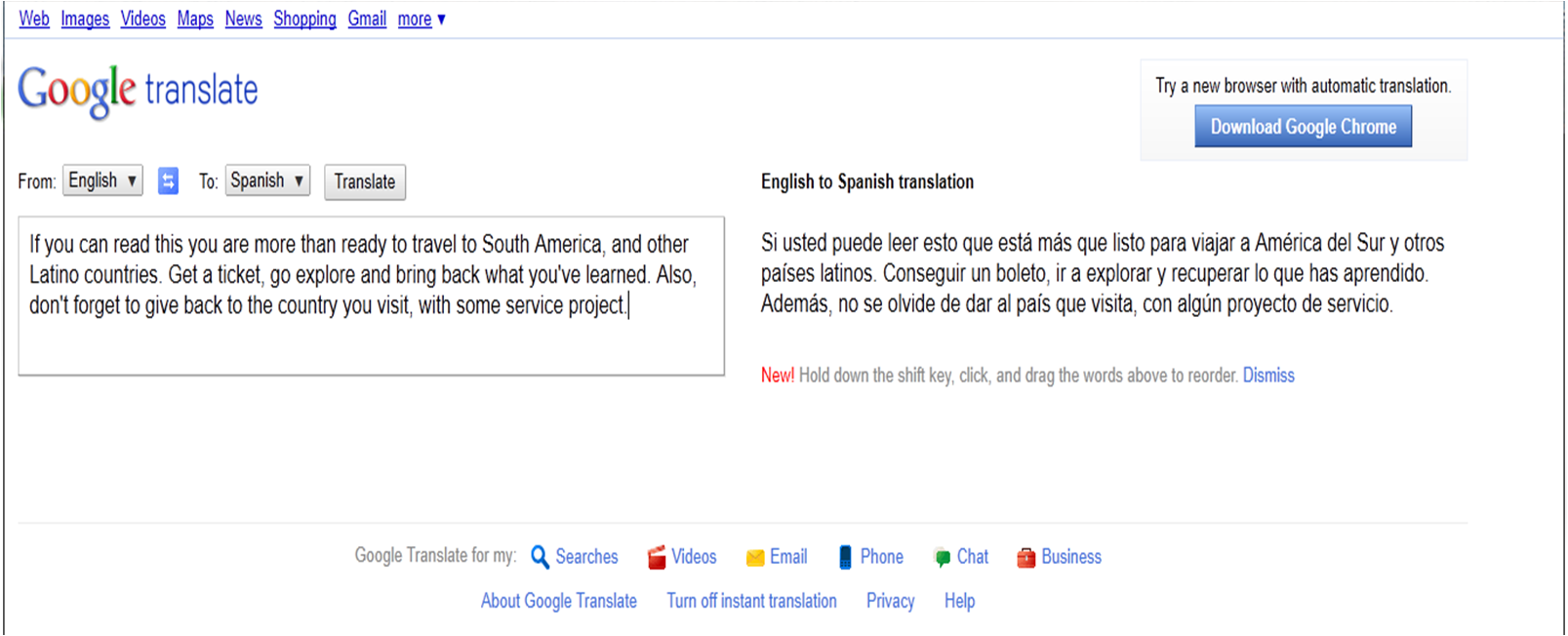
You probably know about Google Translator but I thought I’d briefly write about it here, just in case you’ve never used it. If you haven’t, check it out.
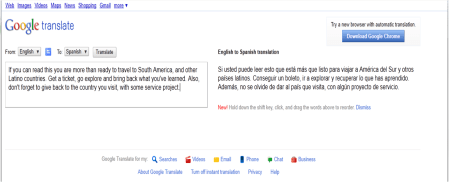
Use this to write to friends old and new in foriegn lands
It’s a great tool for reaching out across cultures and languages to those you may have met while doing your overseas expedition, and kept their address but never wrote to them because of the language barrier. It also features on-the-fly translation for those using gmail, and for other email clients, quick cut and past from the website into emails works effortlessly.
I must admit, my Spanish grammar isn’t the best, (I’ve been told I speak “Tarzan Spanish”). One of these days, I’ll get my conjugations down, but for now, in order to write a somewhat grammatically correct email to my friends in Peru, I admit it, I often use Google Translator.
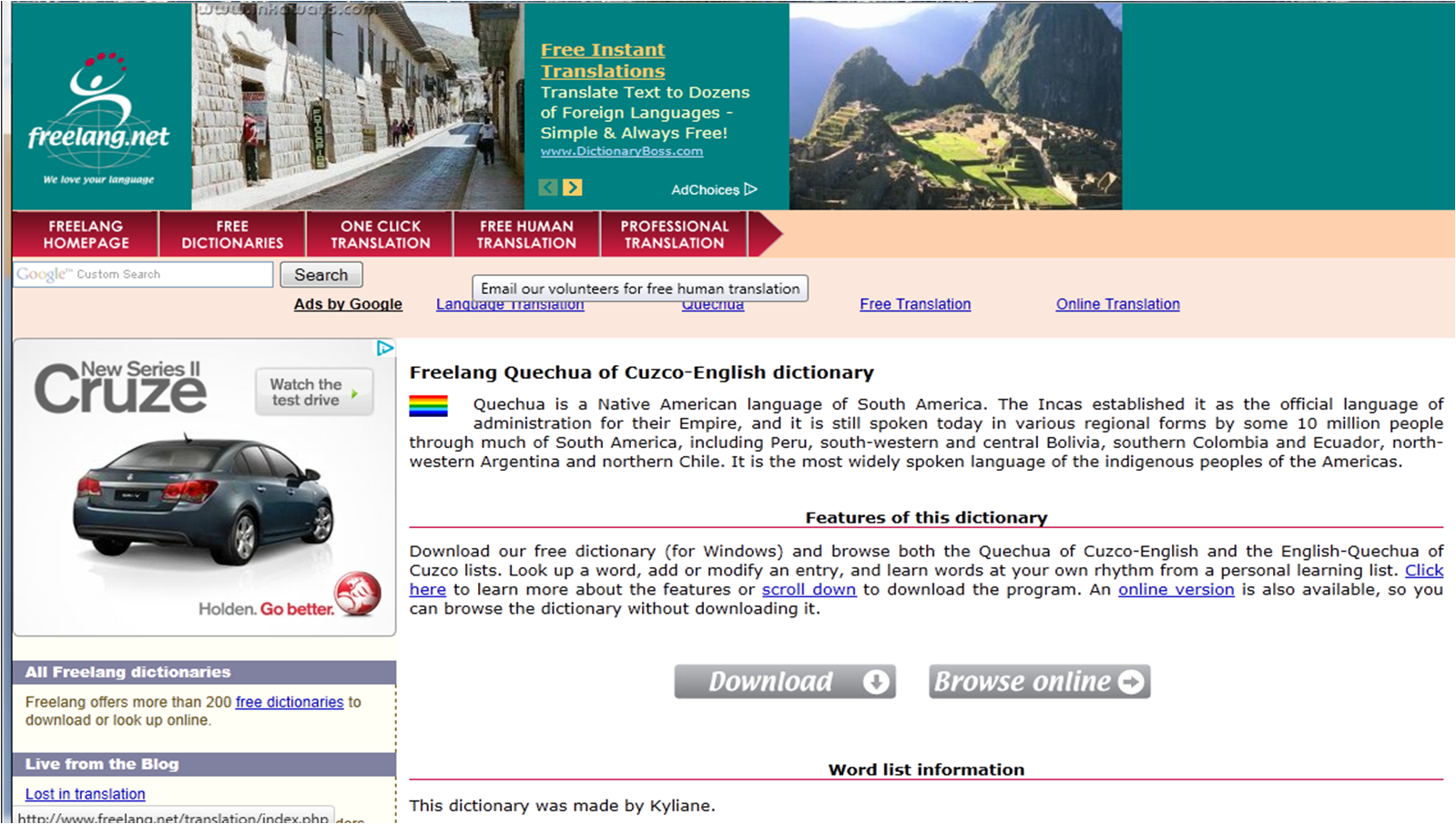
Another cool site I stumbled upon yesterday is Freelang.net where I found a free downloadable Quechua English Dictionary. How cool is that?
I’m sure this particular dictionary hasn’t been around that long, so I was excited to see and download it. It works quite well. I haven’t checked out the other languages but you can, at here.
So get out there and start writing to someone, anyone and bridge the language gap. Enjoy.
Tags:downloads, freelang.net, Google Translator Page, Mountain Spirit, Online dictionary, Quehua English Dictionary
Posted in Experiential Education, Peru, South America, Traveling | Leave a Comment »
02/07/2011
Machu Picchu, Maize and the Advantage of Backwardness
June 30, 2011 by Andean Air Mail & PERUVIAN TIMES
By Nicholas Asheshov
Special for the Machu Picchu Centennial –

Maize
Machu Picchu and the Inca Empire were the creation of an import from Central America, maize, and a dramatic climate shift that turned the Andean highlands from inhospitable wet-and-cold to pleasant, as it is today, dry-and-warm.
For more than half a millenium before this shift the high Andes had been miserable. With the new dry-and-warm, starting around 1000 AD, a backwoods tribe, the Incas, put together the new climate and technology breakthroughs and by 1500AD had produced the world’s most go-ahead empire, heavily populated and larger, richer, healthier and better organized than Ming Dynasty China and the Ottoman Empire, its nearest contemporaries. Read the rest of this story…
Tags:Corn, Inca, Indiginous wisdom, Maize, Mountain Spirit, Peru, South America
Posted in Conservation, Environment, Indigenous Wisdom, Peru, South America, Sustainable Living/Communities | Leave a Comment »



 Mountain Spirit's Blog