This footage was taken today as we explored the ridge high above the Inka ruins above Pisac, the Sacred Valley, near Cusco and Machu Picchu. Although I’ve been bringing groups to Peru and have guided the high peaks of South America, today was my first day in Pisac.
The ridge got our attention when we descended a narrow staircase leading to an exposed drop off, but at the brink, a sharp turn to the left led into a steep narrow slot with steps. Straightforward, but it cleaned out our cobwebs for the day.
The footage was prior to the descent to the ceremonial center on the ridge below, then to the village and market of Pisac, Peru.
Archive for the ‘South America’ Category
Ridgewalking Inca Ruins
17/08/2009Peru’09- Trading Places
11/08/2009By Randall Richards
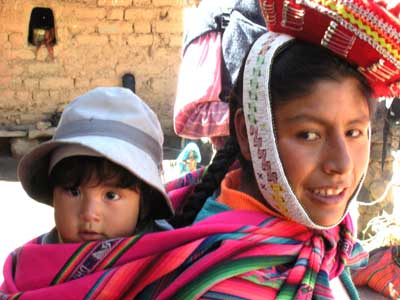
Willoc woman with child
Before I knew it I had a baby on my back. We were being shown how the Peruvian weaving process works from start to finish. We were in the town of Willoc for the afternoon, above Ollantaytambo, the gateway to Machu Picchu. We were being shown how the wool is shorn, carded, and spun, then dyed and weaved on a back-strap loom. The women showing us were wonderful and very gracious. I’d been there a number of times before taking a few MSI participants up to the mountain village, known for its weavings.

Gringo guide with child
I have always been curious how the woman use the mantas, or clothes to carry everything from children to corn. I had been shown the day before how to fold and tie the knot but still was asking a woman who carried a child how it was done so the baby didn’t fall out. Her idea was to show me by handing over the the whole lot, baby and manta to me. As she helped me tie the knot, I thought, “this knot is as important as any climbing knot I’ve tied over the years. It better be good” The young one hung out with me for about fifteen minutes when he decided he’d had enough and wanted his mom again. I still need to figure out exactly how the folds in the material go, so the baby doesn’t fall out. I’ve got the knot down though!
I highly reccomend losing your stroller for this manta. We sell them at our fair-trade webpage, and I can even post some directions on how you too can carry everything from a child, to corn or even your groceries from Trader Joe’s, Hannaford’s, New World.
Peru’09: Planting Corn at Anna’s
06/08/2009
Corn, Peru Style
Tomorrow, Amanda and I head back for Anna’s place in Ollantaytambo. I was just there a few weeks ago with our participants. I look forward to our second visit this year. A few weeks ago, we spent an afternoon getting tutored by Anna on how she grows amazing varieties of corn. She took us down to her fields in the Sacred Valley, just a stone’s throw from her home, and showed us the different sorts of corn, and how she plants them. She explained that these are not mono-species. Most of the corn cross-breed every season creating a multitude of colors and styles of corn, used for everything from Chicha to toasting corn. She explained that most times every row will have a mix colors, which in fact makes them stronger against disease and drought. She also explained how all the other neighbors work together to share various tasks such as irrigation and maintaining the fields.

Anna giving a lecture on planting corn
Unlike Monsanto corn, these varieties reproduce and are carried down through generations. Not to say there weren’t problems. Some twenty years ago, there were serious health issues with the villages due to pesticide use in the fields. Cancer rates were high and people were really being affected. Now though, things are mostly if not totally organic. Most of Anna’s corn goes to feed her family and chickens, and doesn’t reach the local market. She also grows grains to feed her guinea pigs which she sells to neighbors and other villagers. We’ll keep you posted on what we learn next at Anna’s.
Peru’09: Willoc Weaving
04/08/2009By Randall Richards
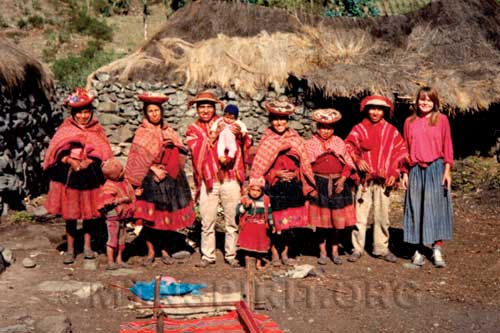
Kate J. at Willoc circa 1980's
The first time I visited the small mountain village of Willoc, near Ollantaytambo was about 12 years ago. Coincidently, my cousin Kate Jones spent a semester from the Lakeside School in Ollantaytambo and spent some time with a family in Willoc about twenty or thirty years before I showed up. This was before I knew where Peru was. She sent a photo of her with her host family in Willoc, which I had on my desk for a number of years. Then when I finally went Willoc, and recognized the local dress, I wondered if Willoc might be the place that Katy ended up. I called her from Peru to solve the issue, and yes it was. Another year in Willoc, I tracked down her family. I’m headed there again in a few days, and will take a copy of the picture with me again to give to them.

Shearing & Drop Spindle, Willoc
On our Peru’09 program we again visited Willoc, and were shown a demonstration from start to finish of how the weaving is done – from shearing the wool to drop-spindle making the yarn, to dying the wool and finally the back-strap loom weaving.
While there we also were treated to a traditional meal and were shown the varieties of corn that are grown on the surrounding hillsides. The diffierent types are used for the fermented Chicha drink, toasting, cornmeal and other specialties.
As in other places in Peru, visitors are occasionally brought to small mountain villages. Mountain Spirit Institute limits our group size to a maximum of eight participants. Sustainable Travel International has guidelines on how to visit such communities as Willoc.
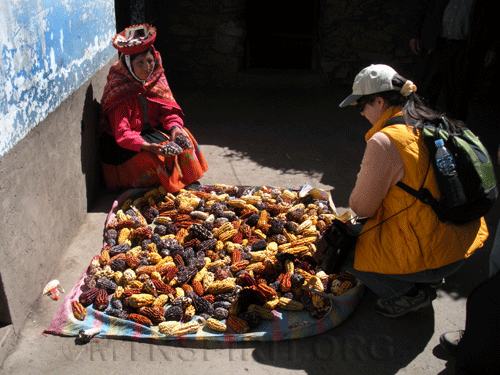
Learning about varieties of corn, Willoc
We feel at this point, there is a benefit to both the visitors and the villages for such visits, but they must be organized and done with care. One example, I always brief my particpants at the program start, and remind them of low-impact travel techniques, such as respectful use of the camera, matching voice volumes to that of local inhabitants, and follow cues from our hosts.
Our good friend, Anna Sequeros, a former president of the woman’s organization in the region has really worked wonders in bringing equality to village women in the area. More on that in another entry.
Generosity in Peru
04/08/2009By Amanda Richards
We had been invited for lunch at the home of Guillermo’s parents-in-law who live in the upper hills of Cusco. Although I had not met them before, Ernistina and her husband were all smiles and welcomed us with hugs and kisses when we arrived. They appeared very humble and live in a simple home. Although spartan and with dirt floors it was clean and comfortable. We sat down to eat and were served soup followed by a lamb stew. The food was delicious and the thing that struck me was that we were given what seemed to be the best meat and they went without any meat at all in their stew. I was a stranger and yet they gave the best of what they had. It reminded me of being on a train in India when complete strangers who obvioulsy had very little, offered me their food and bought me chai, refusing to accept any payment from me. There is still this idea that having guests is an honour and it makes me wonder if this concept is being lost in our western culture.
After lunch we sat outside and again were given the ‘best’ as our chairs were placed in the little bit of sun that was shining in the courtyard. It was a gracious act.
‘We make a living by what we get, but we make a life by what we give’
Winston Churchill
There is no beautifier of complexion, or form, or behavior, like the wish to scatter joy and not pain around us. ‘Tis good to give a stranger a meal, or a night’s lodging. ‘Tis better to be hospitable to his good meaning and thought, and give courage to a companion. We must be as courteous to a man as we are to a picture, which we are willing to give the advantage of a good light.
Ralph Waldo Emerson
Peru’09- Sacsayhuaman
03/08/2009
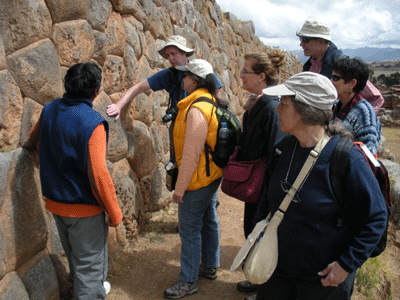
Participants check out the stonework of Sacsayhuaman
The citadel ruins overlooking the town of Cuzco called Sacsayhuaman, about a 20 minute hike from the San Blas area is the site of one of the last stands of the Inka Empire. It’s here where the last emperor fought off the Spaniards, but finally lost. Many were lost on the grounds surrounding the battlements. The stonework and size of the stones themselves is legendary.
There are few places that rival the massive 130 ton blocks that are fitted together so well, it’s difficult to wedge a knife between the cracks. Although there’s specualation, they’re still not sure how the stones were fitted together.
This was a good place to start our program.
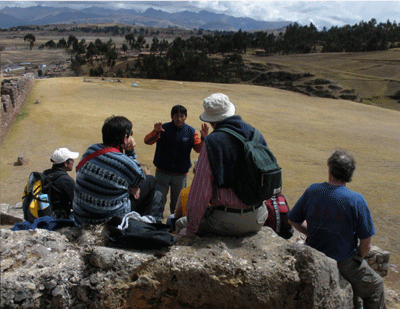
Local Guide tells of the Inti Raymi held annually
Participants were shown the area by a local guide who shared information about the Inti Raymi festival held every year in June, about the stonework and the storehouses of grain and water, and the fact that most of the ruins were taken apart, block by block and used for Spanish buildings and churches in the Cusco center.
Sacsayhuaman is a beautiful place for an early morning walk, which Amanda and I did a few days ago. If you’re there before 7am, they usually don’t charge, plus that’s the best time to be there anyway.
Peru’09: To Ollantaytambo
02/08/2009By R. Richards
In the next few weeks I’ll be journaling the Peru 2009 Cultural Immersion program which lasted 14 days. I won’t chronicle every day but the most important highlights of our experience.
We had 7 participants: Sally R. and her husband Scott S., Gail and Hal B. of Sunapee NH, newlyweds Tim Y. and Amy G. and Betsy S. of Grantham NH. Most were teachers which made for good dynamics. On our first day in Cusco, we hiked up to Sacsayhuaman ruins. After walking the great walls, we had a little meeting as the sun set, setting the tone for open communication and willing to stretch outside of one’s comfort zone. The group all agreed they’d give it their best shot. That night we had dinner at the Retama where Guillermo is the music director of his band Chimu’s/Chimu Inka and plays there almost nightly.
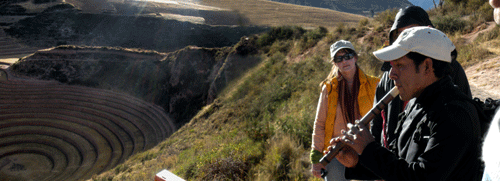
Guillermo plays "Quena" flute at Moray
After a night in Tika Wasi in Cusco, we headed for the Chinchero and the fascinating agricultural terraces of Moray. Here, Guillermo took out his flute and played, setting a surreal tone in the ruins. You could hear the music echo through the terraces below. Then there was a hair-raising ride (not so much much for me, I’m used to the heights) to the Inka salt pans just before the sun set, then off to Anna’s pension. Many thanks goes to Julio of Personal Travel Service for setting up our ride with Ernesto and the Mercedes bus plus all tickets and other logistics in the Sacred Valley.

Anna's Family, Guillermo & Ernesto
It had been a few years since I’d seen Anna when I stayed at her pension for night. It was good to see Anna again, her daughter Katey and her other daughter who had been in Italy for four years, who I’d not yet met. Anyway, we all settled in nicely, the participants heading off to stay in nearby homes, down the street. We’d all met up for dinner at Anna’s though. Although it was a bit of a switch from the four star Hotel Antigua in Lima, everyone adjusted well to Anna’s where we’d be basing ourselves over the next few days. Below is a short clip as we arrived at Anna’s. Ernesto our knowledgeable driver, Anna, her godchild, daughter, and Guillermo are featured.
The Enigma of the Nazca Lines
26/07/2009The Enigma of the Nazca Lines
By Amanda Richards

Trapezoid Designs
Peru is an incredibly beautiful, diverse and historically rich country. The Peruvian people are an upbeat, warm and friendly culture, with a sense of optimism. The country is a magical place, considered the spiritual center of the Americas. Cusco, the outlying Sacred Valley, and Machu Picchu all have a special feeling to which no picture can do justice, not to mention the physical beauty of the land and the warmth of its people.
The Mountain Spirit Peru ’09 program is in its 11th day and the group are in Ica, having spent the day at the famous Nazca Lines. The Nazca Lines are an enigma. No one has proof who built them or why.
I came across a great article by Holly Hayes on her website
Sacred-Destinations.
Writes Hayes, “The Nazca Lines are giant sketches drawn in the desert of western Peru by ancient peoples. The drawings were created on such a large scale is such that the shapes can be readily discerned only from the air, leading to a variety of theories about their purpose.”
“Since their discovery, the Nazca Lines have inspired fantastic explanations from ancient gods, a landing strip for returning aliens, a celestial calendar created by the ancient Nazca civilization — putting the creation of the lines between 200 BC and 600 AD, used for rituals probably related to astronomy, to confirm the ayllus or clans who made up the population and to determine through ritual their economic functions held up by reciprocity and redistribution, or a map of underground water supplies. To read the rest of this article on Hayes’s website click here.
Cultural Immersion, The Creative Way
16/07/2009By Amanda Richards
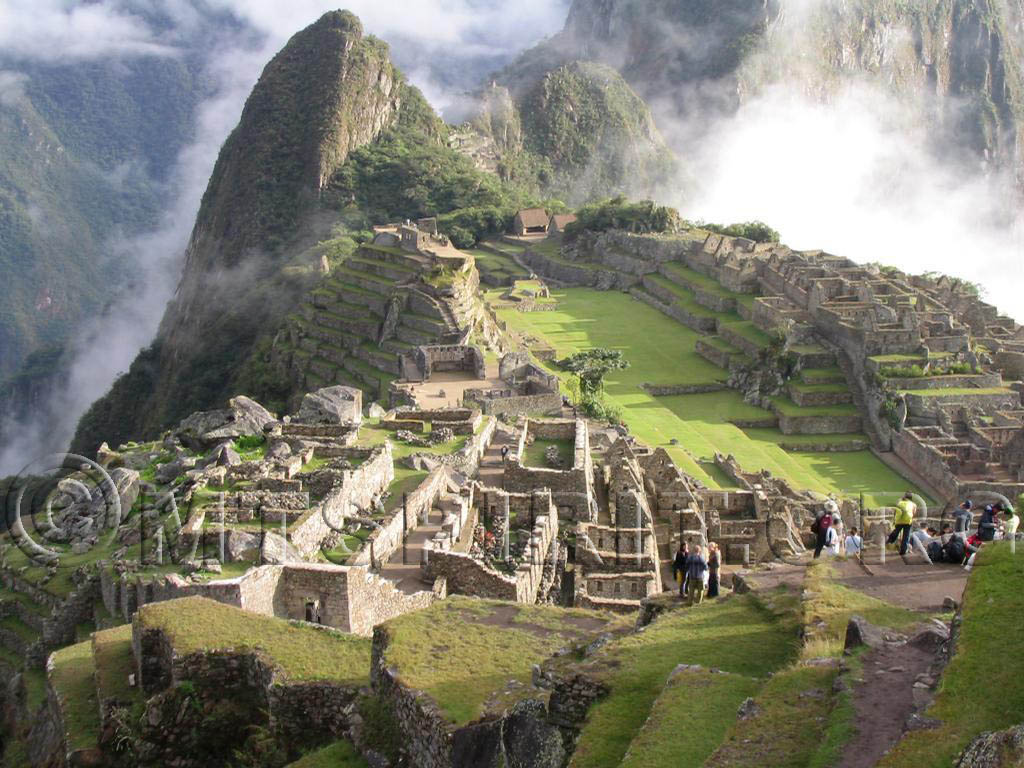
Machu Picchu
The Mountain Spirit Peru 2009 cultural immersion trip is already into Day 4 of the exciting program. The group of 7 clients with Randy Richards and Guillermo Seminario as their facilitators, are currently at Ollantaytambo, staying with Anna Sequiros and her family. Today is a day to learn more about local customs, sustainable agriculture, women’s issues and visit the local school. The group will also help prepare their own meal, which for some will include preparing and eating guinea pig – a national dish of Peru. Tomorrow they will set off for Machu Picchu and discover more about the richness of the Inca Empire. An excellent book to learn more about the ruins is by Peter Frost, ‘Exploring Cusco’.
I am here in Cusco, my fourth day in Peru. Randy has always spoken so fondly of the Peruvian people and I am experiencing what he means.The people are so open and gentle and kind, its a delight to be here. The group will be back in Cusco on Saturday and we will spend some time with the very special Chimu Inkas – Guillermo, Mario and Wach i.
i.
Incredible journey
25/06/2009After decades of international debate, Auckland University researchers have found the first concrete evidence that Polynesian explorers reached South America before Europeans. The research team, led by archaeologist Elizabeth A. Matisoo-Smith, used genetic analysis and radiocarbon dating of chicken bones found in Chile to show that the fowl originated in Polynesia and not Europe, as was previously believed. (more…)
 Mountain Spirit's Blog