Archive for the ‘Sustainable Travel’ Category

A Coloring Book, Then a Smile

30/01/2010

By D.R.Richards

Coloring for the first time, Amantani Island, Peru

The simple act of giving a child a coloring book on the high mountain island of Amantani on Lake Titicaca, where we have been taking small groups for years, bridges our cultures. It also helps reach out by giving a little something back. By no means is it as big as building a school, or other major project that other more established organisations are doing in Peru. As mother Teresa said, “Peace begins with a  smile,” and in this case a coloring book, then a smile.

We at Mountain Spirit Institute believe that to truly connect with others in our world, when we travel its good to reach out in anyway you can. Reaching out  might be that smile, the  coloring book,  or listening well to the people you’re visiting rather than building them what you think they need, a good lesson from Greg Mortenson’s Three Cups of Tea. Of course listening well implies you need a good interpreter or hopefully have studies the local lanquage, and I don’t mean Spanish.  Next time you travel, load up on some coloring books and colored pencils. Leave the chocolates at the city, and take some paper and pencils instead. The local kids will love it, and you’ll smile too.


New Zealand by Sustainable Travel

27/01/2010

The splendours of New Zealand are best seen by rail
By Dan Poole
The Independent

TranzCoastal crosses the Waimakariri

Grand Central, St Pancras, Milano Centrale – and, er, Britomart? The main station in New Zealand’s largest city sounds as though it is named after a discount car-parts retailer. In fact, Auckland’s Britomart Transport Centre occupies a handsome Victorian building on Queen Elizabeth II Square, and is apparently named after a character from The Faerie Queene.

It is also the northern terminus of New Zealand’s longest train ride – the 12-hour haul south to the capital, Wellington – known as the Overlander. And as if to hint at the views that lie ahead, it is run by Tranz Scenic.  Read the rest of this story

Mountain Spirit and Simple Living

10/12/2009

by Bob Stremba, PhD
MSI Board Member

TV- Not all it's cracked up to be

A couple of weeks ago I stumbled onto the Simple Living Network and was reminded about what’s important in life. I don’t think it’s Thanksgiving day football games on a bazillion inch widescreen flatscreen high def LCD 1080p 120 megahertz TiVo Wifi iPod-enabled TV. What’s important, I’m convinced, is authentic connections to self, others and the environment, and that happens to be what Mountain Spirit Institute (MSI) is all about.

The Simple Living Network has its roots in a movement, which began in the 1970’s with publication of the book, Voluntary Simplicity, by Duane Elgin and Arnold Mitchell. Simple living, according to their website, is about living an examined life—one in which you have determined what is important, or “enough,” for you, discarding or minimizing the rest. Living in a way that is outwardly simple and inwardly rich. So I recently cleaned out some closets, donated more clothes to the local thrift shop, and got rid of more clutter. More stuff brings more stress.

Weaving in Willoc, Peru

It struck me that Mountain Spirit Institute is doing today what voluntary simplicity launched over 30 years ago. The values at the heart of a simpler way of life are…

1.    Material simplicity: Owning and buying things that promote activity, self-reliance, and involvement, rather than items that induce passivity and dependence.
2.    Human scale: A preference for human-sized living and working environments, rather than institutions and living environments that are anonymous, incomprehensible, and artificial.
3.    Self-Determination: Less dependence upon large, complex institutions whether in the private sector (the economy) or public sector (the political processes); a desire to assume greater control over one’s personal destiny and not lead a life so tied to installment payments, maintenance costs and the expectations of others.

Field/Lake near Chinchero, Peru

4.    Ecological Awareness: The interconnectedness and interdependence of people and resources. This awareness often seems to extend beyond a concern for purely physical resources to include other human beings as well. A preference for living where there is ready access to nature.
5.    Personal Growth: For many persons taking up a materially simple way of life, the primary reason is to clear away external clutter so as to be freer to explore the “inner life.” (more…)

Letting the Place Change You

30/09/2009

Perceiving Without Naming – Why Traveling Can Quiet the Mind

MSI Dir. R. Richards with Children, Lake Titicaca

MSI Dir., Richards with Children, Lake Titicaca

An excerpt from Eckhart Tolle’s A New Earth aptly describes how some people can travel to a country without actually experiencing anything new. I’d not quite heard it put this way, and always felt I had observed two types of travelers, but couldn’t put my finger on it, that is, not until I heard the passage below by Tolle.

Our goal at Mountain Spirit Institute, and the reason we strive to take people to Peru and other such magical places, is to encourage radical growth of inner wisdom and help participants reconnect with one’s self, fellow world community members, and the mountains of a place.

Tolle writes, “Most people are only peripherally aware of the world that surrounds them. Especially if their surroundings are familiar. The voice in the head absorbs a greater part of their attention. Some people feel more alive when they travel and visit unfamiliar places or foreign countries because at those times sense perception, experiencing takes up more of their consciousness than thinking. They become more present.”

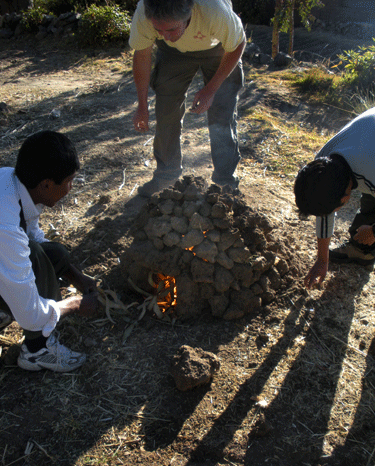
Learning about a Mud Oven, Lake Titicaca

Learning about a Mud Oven, Lake Titicaca

He adds, “Others become completely possessed by the voice in the head even then, their perceptions and experiences are distorted by instant judgments. They really haven’t gone anywhere. Only their body is traveling, while they remain where they have always been, in their head.”

Tolle concludes, “This is most people’s reality. As soon as something is perceived, it is named, interpreted, compared with something else, liked, disliked, or called good or bad by the phantom self, the ego.  They are inprisoned in thought forms, in object consciousness.  [One does] not awaken spiritually until the compulsive and unconsciousness naming ceases, or at least until [one becomes] aware of it.”

This may be why a participant on our Peru program spontaneously had a wave of emotion come over him, at a historical site in Cusco. Maybe it had something to do with the tone setting I’d done a few minutes prior, at the start of the program, where I encouraged participants to step out of their comfort zone, open their minds and try new things.

Our job is to simply put the people, the setting, and situations in place so that the participant may have an insight.  Of course, you don’t need the mountains or a foriegn country to do that, but it can’t hurt.

MSI Director Writes Article for Travel Assoc.

18/09/2009

Richards Writes Article for Sustainable Travel International Assoc.
MSI Founder R. Richards was invited to write an article for Sustainable Travel International, an association to which MSI belongs. Richards returned to Amantani Island, Lake Titicaca, Peru shortly after having led a program to the island in July of this year.
When Richards mentioned some troubling trends he’d observed on the island, to Sustainable Travel International’s Val Vanderpool, she asked him to write an article on what he’d seen during a second trip back to the island in August. Richards went back to not only observe trends and interview islands about the state of tourism in their villages and homes, but to find families willing to host MSI particpants for future programs. Read the article.

Tourism On Amantani, Peru

11/09/2009

Small Island on Lake Titicaca Peru faces Tourism Issues.

Jose Mamani & Family circa 1997

Jose Mamani & Family circa 1997

Amantani is a small remote island on Lake Titicaca, Peru. It can be reached by a four-hour passenger boat ride from Puno. It’s an island facing growth and tourism issues.

During my first trip to Amantani in 1997, I fell in love with the place. There were no cars nor roads, virtually no electricity, and only a few dogs, cats, and few horses, and three thousand people which made for a serene place. What struck me then, was the way the islanders worked together to make the community function. Most of that is still true, but unplanned tourism is threatening how the islanders work and live together as a community.

Tourism has had an impact, both good and bad.  My last visit to Amantani was two weeks ago, which was part, fact finding mission to discover what’s going on, and part reconnaissance for Mountain Spirit Institute’s intercultural experiential education semester programs. Although I had just been there three weeks prior, with a small group of Mountain Spirit students, I returned because I needed to update my perspective about the island. (more…)

‘Rebuilding’ the ruins of Machu Picchu

26/08/2009
Inca ruins get 'The Treatment'

Inca ruins get 'The Treatment'

By Amanda Richards

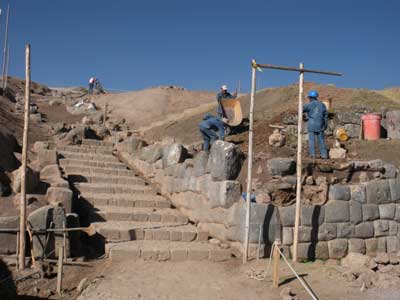
Peruvian authorities in charge of archaeological sites seem to have a voracious appetite to ‘rebuild’ the Inca ruins. They seem to think that the ruins need to be ‘reconstructed’ in order for them to become worth something more – ‘puesta en valor’ as the signs tell us.  The ruins in themselves are just not enough.

As we explored the ruins,we realized just how much had been ‘reconstructed’ and continues to be.  At Macchu Pichu for example, you can’t even see the ‘most beautiful wall in the world’ (as described by Hiram Bingham) as it is currently under ‘reconstruction’ and the area is only open to workers carrying bags of cement. It felt strange to watch the ‘ruins’ being rebuilt and made to look ‘tidy and new’.

Building a 'new' Inca wall

Building a 'new' Inca wall

Peter Frost raises this issue in his book ‘ Exploring Cusco’ hoping to ignite some discussion as he argues that there has never been a debate in Peru about this.  No one has ever questioned the authorities. And so the rebuilding of the old ruins – ‘The Treatment’ as Frost describes it, continues unimpeded.

I have to admit that on one hand there is something nice about seeing the ruins ‘new and rebuilt’ like the beautiful, big terraces at Moray for example.  However, I agree with Frost that this theme park approach takes away the ‘mystery, allure and enchantment’ that only our own imaginations can add to the experience of being there at these intriguing and mystical ruins.