Sustainable Travel, Off the Beaten Track, Lake Titicaca, Peru Dear Randall,
I hope you don’t mind my contacting you. I saw your blog post about staying on Amantani Island and I wanted to ask your advice. I had been planning to go to the island and stay with Richard Cari at Kantuta Lodge. However, having read your post I am wondering if I should be staying elsewhere in order to be a bit fairer and in the interest of sustainable tourism – such as going to stay with the islanders who don’t usually see a lot of tourists.
I felt a bit nervous not booking something in advance and am also not sure how easy it would be to organise something like this (I will only have one night and we arrive in Puno the evening before we hope to go to the island). Do you know any responsible tour agencies who give back to the islanders and could help me find somewhere to stay? Or would you recommend just turning up and hoping to find a boat / somewhere to stay on the island?
Many thanks for any help you can give. Kind regards,
Lucy H.
Hi Lucy,
Family Mamani, Occopampa, Amantani
Thanks for your email, and for your concern about sustainable tourism on Amantani on Lake Titicaca. Here are a few suggestions.
Richard Cari and family are good friends of mine, and we do hire his launch/boat to get our clients to the island, and although we might stay one night at his lodge, the lodge has evolved into something bigger than I want my participants to experience, (semester students excluded, plus Richard will help facilitate these longer programs). So we may bypass the lodge in favor of the other families who are wanting to have guests visit them. However, depending upon your comfort zone, and interest, you would enjoy Richard’s family and small lodge in any event. But more about staying with other families:
There’s no real problem with taking one of the boats run by the community of Amantani which you can pick up (more…)
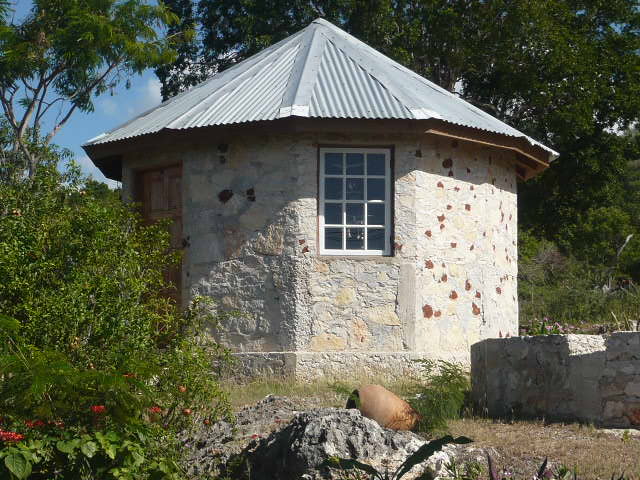
On a morning bike ride around Treasure Beach, Jamaica recently, I was drawn to stop and admire a beautiful hand built sandstone building, surrounded by lush perennial herb and flower gardens, fruit trees and meandering pathways. Shirley, the owner, walked down the hillside, greeted me with a warm, broad smile and welcomed me into her yard for a chat, typical of the Jamaican residents we had met during our two week stay. It turns out Shirley is a well-known herbalist and massage therapist in town, had built the structure herself for her massage business, and within minutes I had signed up to have one of her legendary herbal sweats and relaxation massages. With this vitally important step out of the way, we toured the gardens and learned about the fragrant mixture of wild Jamaican herbs and fruit juices Shirley uses to send her clients to relaxation nirvana.
In Jamaica, the elder women pass their knowledge of herbs and plants from generation to generation, as Shirley’s mother had while she was growing up in nearby Great Bay. Shirley explained the provenence of each plant, either planted from seed, field dug, or gifted from a friend or family member. Her knowledge of the individual characteristics and uses of each plant was remarkable. When we parted over an hour later, I could barely wait until it was my turn to savor her herbal ‘detox’ treatment and relaxation massage.
So it was that the next day, I watched as Shirley chose from her yard the pimento, lemon grass and eucalyptus to help clear my lungs, and lime juice for cleansing my skin. She tossed these and other herbal delights into a cauldron of boiling water over an open fire. She then poured the boiling, aromatic mixture into a clay cauldron tucked inside a three-sided steam room with a cloth door.
In I went, with Shirley’s instructions to stir the mix, ‘breathe’ and stay hydrated with the water she provided. This was not your typical steambath! Immediately, the rich herbal smells filled the small space and I settled in to enjoy a blissful 30 minutes of total relaxation. Next came the oil massage, which included a fascinating philosophical commentary by Shirley about the history of Jamaica, the value of massage, the state of our busy lives, her world travels and education in the United States, and good humored bantering about gender differences. Shirley’s massage combined many styles, and is uniquely her own brand. I dare say it’s one of the finest massages I’ve ever had.
As I ventured back to reality toward the end of the hour, I asked Shirley when she was going to write the Book of Shirley. She laughed heartily and replied, “Everyone wants me to write a book. I say to them, come back and see me and we will continue to talk together and teach each other.” I think I will, Shirley, thanks.
What is it, that makes Quebec, Canada a breath of fresh air for those of us who often escape there from the northeastern U.S.? It’s interesting to experience this question through the eyes of my wife, who’s from New Zealand, Australia and South Africa. She’s new to the U.S, and to New England, and is not afraid to share her observations. I always felt more comfortable when I lived in Europe, South America and New Zealand, but, honestly, still struggle to put into words exactly why an ex-pat life could still be my destiny. I had my “Euro-epiphany” at 21, after having a chance meeting with Erga Rehns in Portugal. It took two years to sink in, and I almost didn’t return stateside. I still have that ex-pat perspective. I still look at the U.S. with the eyes of an foreigner.
My wife just got her Green Card a few days ago, on the 22nd, and the next day we were outa here, off to Magog, Canada. Partly because my birthday was on the 23rd, and partly because she was on the wait list for a Vipassana course for which she was accepted and started the following day.
Mt. Orford with "Visitor's Center"*
As we walked the streets of the little Quebec towns, and went for a walk at Mt. Orford Provincial Park, we discussed what exactly is it that makes us feel more relaxed away from the U.S.? Here’s what our conversation yielded: For one, the people take care, and pay attention of their food and time. They are not as stressed. Immediately it’s obvious that there isn’t an anxiety in the air – in fact, there’s a calmness. Kids are smiling, people are quietly enjoying their week-day afternoon. We also concluded it takes a lot more effort in the U.S. to relax because of the nervousness of the collective consciousness. Today’s Health Care Summit in Washington illustrates the deep crisis Americans are experiencing about such basics as going to the doctor. In other countries, people are incredulous that there’s even a debate in the U.S. about profit over people. The idea that someone could lose their house should they become sick is a foriegn concept. It would simply not happen in France or New Zealand, or in Canada. (See the movie Sicko)
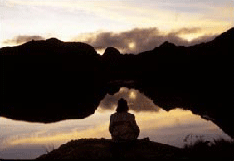
Meditation: The Ripple Effect
As I write this, my wife is sitting peacefully in the mountains of Quebec at a Vipassna retreat center. I feel the ripple effect, and I hope you do as well. Janice Vien, in her Iyengar yoga classes always closes with the phrase, “May the benefits of this practice be extended to others”. It’s clear Americans face difficult roads ahead because of the greed of the “corporatracy”. And yes, of course, one can keep their center no matter where one is, as put forth by Eckhart Tolle. But for those that are sensitive, the difference in energy between the U.S. and Quebec is striking.
Maison Verte's B&B = Quality and Care
*The reason I put quotes around the Mt. Orford Visitor’s Center is the sense of scale in Quebec, and other countries is more realistic than in the U.S. When one thinks of “Visitor’s Centers” in the U.S., usually the image of the Denali National Park, Arches National Park, or the Smithsonian most likely comes to mine. The Center is Quebec however, is a small lodge, (with fireplace, bathrooms and picnic tables), despite it being a popular national park.
Specialists in Peru & Holistic Education Since 1998
Mountain Spirit Institute announces June 18th Holistic Learning Program in Peru
By R. Richards
Mountain Spirit first started leading programs to Peru in 1998. I guided high altitude mountains for Alpine Ascents International, such as Mt. Huascaran in Peru, Aconcagua in Argentina and other volcanoes in Ecuador prior to that for a number of years , but then decided holistic experiential education was more for me.
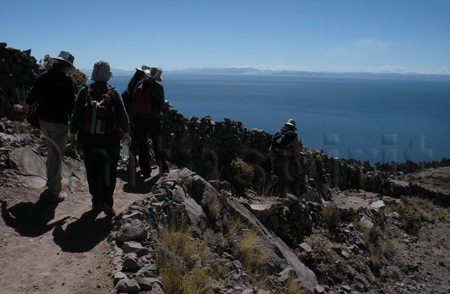
Hiking on Amantani Island, Lake Titicaca
Readers may have heard of the term “nature deficit disorder”, coined by Richard Louv in his book, Last Child in the Woods. MSI also addresses “cultural deficit disorder” by taking people to Peru. We were doing Peru before it was fashionable, and know the country well. We focus on education, service, hiking, music and mountains. We’ll be headed to the Sacred Valley, Machu Picchu, Cusco, and Lake Titicaca.
Our program is limited to 8 participants and will start on June 18th and last for 14 days. We will be staying with long time friends and educational partners. Our logistics is well organized after leading many trips to Peru.
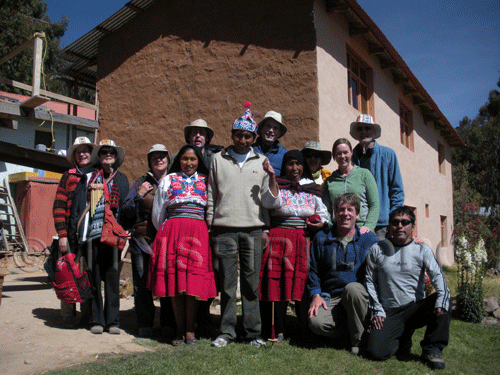
MSI Peru'09 with Cari Family, Amantani
Description of Curriculum:
MSI’s Cultural immersion focuses on learning rather than touristing, giving back through service, hiking in the Andes, weaving, agriculture, community building, learning music, language and indigenous shamanism and socioeconomic issues. Some hotels and lodges, but also family stays and off-the-beaten track. Machu Picchu, Lake Titicaca, Cusco. Oh, and great time too.
Testimonials from two Peru’09 particpants:
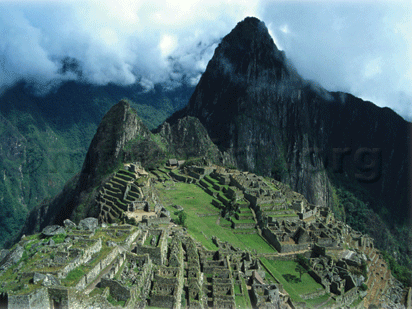
Machu Picchu
Thank you for a wonderful time in Peru!! You offered us such a diverse opportunity to really connect with the people, customs and languages. Your continued kindness, constant patience and
positive attitude really helped. We thank you from the bottom of our hearts for a job well done, an unforgettable time.. G. B.
Peru 2009 Cultural Immersion
I liked meeting the real people of Peru. Randy’s example of energetic interaction with the people worked well and set a good tone for the program. T. Y.
Peru 2009 Cultural Immersion More Tesimonials
Stay tuned for more posts about more details, and what we’ll be doing on this year’s 2010 Cultural Immersion Program in Peru. We hope you’ll consider joining us for a learning of a lifetime. See our detailed itinerary. Learn more about who’s leading the program. Also see posts on Peru to the right.
Coloring for the first time, Amantani Island, Peru
The simple act of giving a child a coloring book on the high mountain island of Amantani on Lake Titicaca, where we have been taking small groups for years, bridges our cultures. It also helps reach out by giving a little something back. By no means is it as big as building a school, or other major project that other more established organisations are doing in Peru. As mother Teresa said, “Peace begins with a smile,” and in this case a coloring book, then a smile.
We at Mountain Spirit Institute believe that to truly connect with others in our world, when we travel its good to reach out in anyway you can. Reaching out might be that smile, the coloring book, or listening well to the people you’re visiting rather than building them what you think they need, a good lesson from Greg Mortenson’s Three Cups of Tea. Of course listening well implies you need a good interpreter or hopefully have studies the local lanquage, and I don’t mean Spanish. Next time you travel, load up on some coloring books and colored pencils. Leave the chocolates at the city, and take some paper and pencils instead. The local kids will love it, and you’ll smile too.
U.S. helicopters help Peru evacuate hundreds after rail line was cut From AP Image: Mountain Spirit Institute
Helicopter at Aquas Caliente, MP. MSI file photo
Helicopters ferried almost 600 more tourists from the Machu Picchu area after rains slackened Wednesday, leaving up to 1,600 travelers still stranded by mudslides blocking the only land route from the famed Inca citadel.
Authorities said airlifts would continue throughout the week because more tourists had shown up at the evacuation site on foot after completing treks along the Inca trail to Machu Picchu, the 15th century Incan fortress that is 8,000 feet above sea level.
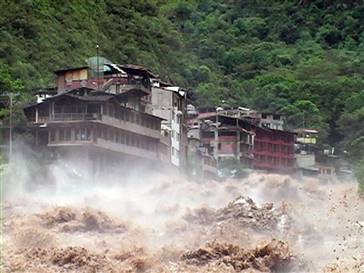
Rain-fueled mudslides on Sunday cut the train line that is the only transport link to the remote region atop an Andean mountain ridge. Adding to the worries, tourists flown out Wednesday reported that a rain-swollen river had eroded the site where rescue helicopters are landing.
Stranded tourists charged they are being victimized by price-gouging because food, water and accommodations are scarce in the now isolated Machu Picchu Pueblo, a village of 4,000 residents.
Peru slide kills tourist, guide near Machu Picchu
From The Times
Flooding at Aquas Caliente near Machu Picchu. Image: Reuters
A mudslide on the famed Inca trail to Machu Picchu killed an Argentine tourist and a Peruvian guide, as authorities evacuated hundreds of tourists by helicopter from a flood zone where more than 1,500 others were still stranded
Cuzco government spokesman Hernet Moscoso said the Argentine, identified as Lucia Ramallo, 23, and the guide, Washington Huaraya, were in their tents when a slope gave way and their tents were crushed. Three other tourists were injured.
Authorities closed the Inca trail, a popular tourist trek that follows a stone path built by the ancient civilization from their capital, Cuzco, to the Machu Picchu citadel.
The deaths raised to five the number of people killed by heavy rains that have caused floods and landslides and collapsed homes, Moscoso said. Read the rest of this story Image: The Times
A Ski Mountaineering Adventure
By Randall Richards
Mountaineering, and ski mountaineering mishaps that don’t kill you are chalked up to experience – a learning experience. I had one such experience in Lech and Zürs Austria when working for Strolz Boots G.m.B.H. I was still a greenhorn in the Alps. The Alps was a whole other ball game than the mountains of the western U.S. This was my first year in the Alps
I was just graduated from the University of Utah where I’d spent three years getting a basic, but great mountaineering education through the U of U recreation department with such climbers and teachers as Harold Goodro and Dennis Turville. It’s here where I cut my teeth, the Wasatch Range, in beginning rock climbing and mountaineering, snow shelter building and backcountry emergency medicine classes. Harold was the consummate old mountain man.
The author getting "mountain experience", Austria
In the late seventies, he was involved in teaching all the classes, and would observe other instructors manage the top rope sites. But he was always hands-on. On another day in my education there, I remember ascending Stairs Gulch with other Utah students under the tutilage of Dennis Turville. Our little group of neophytes were wide-eyed at one point on the ascent, when a few auto-sized blocks of snow and ice came tumbling down the slabs, bowling for students. Two in the group, by running this way and that, managed to avoid being mowed over. Dennis seemed somewhat nonplussed by the event, but that might have just been my perception at the time. Later on the narrow ridge which divides Big and Little Cottonwood, we carefully picked our way up to the summit of Dromedary Peak. Our eyes were still bugging out of our heads for the rest of the day due to exposed terrain and our lack of experience. We were quickly getting our mountain legs.
Fast forward to the Lectaler Alps in Western Austria. I usually had most of the day to explore the wild mountains above and around Zürs, St. Christophe and Lech on skis and out of bounds, having to report at the Strolz ski boot shop in Lech around 3pm. It was my first experience where the ski area trails and the high backcountry merged into one big ski experience. I went nuts, cutting it up, (more…)
Difficult to see from the ground,geoglyphs go unnoticed by locals
With the aid of satellite imagery from Google Earth, soon archeologists in Brazil will be finding more and more large geometric designs carved into the ground in the Amazon rainforest. The geoglyphs are believed to have been sculpted by ancient people from the Amazon region around 700 years ago, though their purpose is still unknown. So far, nearly 300 geoglyphs have been identified, but with advances in satellite imaging–and increased clearing of the jungle coverage–scientists are hoping to discover many more of these strange, geometric designs. Read the rest of this story Photo via Diego Gurgel
Josh Wilson a Singer/Songwriter signed to Sparrow Records was stuck in an airport recently.
“I’m always saying, “This is your life, enjoy it — even if you’re stuck at an airport!” HP:It looks like you know how to do just that based on your popular video that’s making the rounds. So where were you traveling to the day of the Newark Security Breach? JW:I was headed to Mumbai, India with my wife and some others.
I saw the video after someone forwarded it to me. They actually found it on Alyssa Milano’s Twitter Feed. HP: What inspired you to do the sing-along?
JW:Things had gotten really tense in the terminal. We were at about the six hour mark in terms of the delay. Some kids were crying near us and I wanted to cheer them up and maybe get everyone else to relax a little. Someone in our group said I should break out my guitar, and after a little convincing I did. But in that situation, it’s only safe to play the Beatles. Anything else would have led me to being pelted by luggage HP: Have you ever played for a crowd of passengers before?
You know, as a musician at some point you feel you’ve played every possible type of gig. But I do think it was my first airport performance. Read the rest of this story
Heather Poole is a flight attendant for a major US carrier. She lives in California and works in New York.









 Mountain Spirit's Blog