A friend just pointed out comedian Lee Camp’s YouTube message calling for a national “buy nothing/strike/call-in-sick” day. This message is worth considering. Post your comments, let us know what you think. For us, we’ll be doing nothing on May 1st.
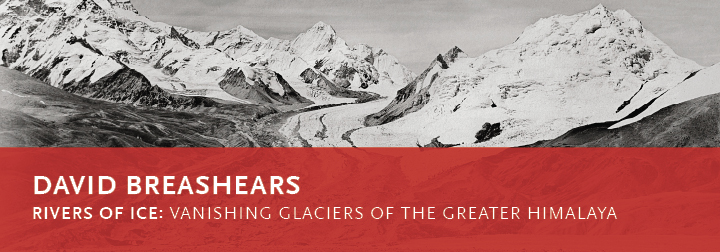
Mountaineer and Filmmaker Dave Breashers presents Rivers of Ice, Vanishing Glaciers of the Greater Himalaya
The Greater Himalaya has the largest concentration of glaciers outside the polar ice sheets, providing vital fresh water for almost every major system of Asia. Over the past five years, Breashears and the team of his nonprofit organization, GlacierWorks, has conducted ten photographic expeditions to the region, to study and document the effects of climate change on this delicate landscape.
Breashears presents at the Boston Museum of Science on April 12, but alas, tickets are sold out. Nevertheless we thought it was worth the post here. You might try to try the climber’s move and squeeze in somewhere.
Retracing the steps of pioneering alpine photographers and explorers George Mallory, Vittorio Sella and others, Breashears and the team have captured high-definition photographs that match those of the earliest expeditions. By comparing this contemporary imagery with the historic photographs, Breashears and his team are discovering staggering changes to the region—changes with potentially devastating consequences.
There is debate in the scientific community about the rate and extent to which Himalayan glaciers are shrinking. Nevertheless, scientists agree that there is a trend of melting beyond what is expected to occur naturally. Although future impacts of glacial melt cannot be known, any disruption to the water supply will inevitably present challenges to the millions of people living downstream.
Breashears plans on sharing his work in a blend of first-person story telling and imagery.
More info: Mount Washington Observatory
Thursday, April 12, from 6:30 to 9:30 pm
Museum of Science, Boston
THE HUNGER GAMES: Dystopian fiction & Predictive Programming
The following piece is by Richard Louv, Author of Last Child in the Woods. I’m glad he’s weighed in on the Hunger Games. One might also google Predictive Programming to learn more about why such movies are made. (ed.)
Stuck Inside Apocalypse with Dystopic Blues Again
By Richard Louv
“The Hunger Games,” the book, is a page-turner and the movie is gripping. Some of my colleagues, working hard to reconnect young people to nature, believe the popularity of the book and movie will, like the film “Avatar,” stimulate a deeper interest in the natural world. I hope they’re right, but after leaving the movie theater on Friday (having already read the book), I was, well, ambivalent.
In this story, there are two forests. The first forest is as natural as a forest can be with an electrified fence to keep the largest carnivores out of District 12, Katniss Everdeen’s starving Appalachian homeland.
At the beginning of the book, she describes sitting in a nook in the rocks with her hunting partner, Gale, looking out at a forest that sustains them: “From this place we are invisible but have a clear view of the valley, which is teeming with summer life, greens to gather, roots to dig, fish iridescent in the sunlight.” This forest keeps her family alive. Read the rest of this entry »
From: The Adventure Journal
I have biked everywhere within 4 miles of my apartment in the past 5 years, including every job I’ve had — I’ve never had to drive to work in Denver. I find riding a bicycle exhilarating, but that’s no reason for you to think you should. In fact, here are 9 reasons you shouldn’t bike to work. I’m sure you can think of others.
1. It’s too dangerous.
Can you imagine being out there on a bicycle with all these crazy drivers flying past you, nothing to protect you except a plastic and styrofoam shell on your head? You could get killed. The absolute best thing is to stay in the protective cage of your car, because no one’s ever been killed when they’re inside an automobile. Driving is safe.
2. You have to wear a tie to work. Or a suit. Or a skirt.
Not only that, it’s important to wear your tie/suit/business casual attire from the moment you leave your house in the morning until the moment you get home. There is no conceivable way you could leave some clothes at your office, and change into them after you ride your bike to work, two or three days a week. Plus, your suit/tie combination is so dialed, you can’t just spread your tie collection out over two locations. Where the hell is my cornflower blue tie? I need to see if it looks good with these shoes. And like there’s some way to ride a bike in skirt or a dress?
Read the rest of this story..
Thanks to Justin Canny for the post on FB.
By R. Richards,
Lama* Willa Miller, head of a Tibetan sect of Buddhism, based in Cambridge Mass, continues the interview on the new Wonderwell Refuge, the importance of being in nature, as well as her own early influences and experiences being in the wilderness with her father in Idaho. We also talked about Richard Louv’s concept of Nature Deficit Disorder, a term the author coined in his book, The Last Child in the Woods.
The early teachings of Buddhism emphasized the refuge of wilderness, the mountain top, the cave. Lama Miller sees this as a return to the traditional ways of Buddhism by encouraging her visitors to the refuge, to get out on mindfulness walks in nature. See Part I here.
*(Lama: A title given in Tibetan Buddhism to a venerated spiritual master, a monk/priest of high rank)
Mountain Spirit Institute is planning a collaborative effort with The Wonderwell Refuge to offer a Mindfulness in the Mountains retreat in the fall of 2012.
Lama Willa Miller, the spiritual leader of a Natural Dharma Fellowship branch in Massachusetts, talks about a new refuge center, and the importance of mindfulness in the mountains. Part 1
By R. Richards
Mountain Spirit Institute
The Dartmouth Lake Sunapee region of New Hampshire, USA has the good fortune of seeing a new Tibetan Buddhist Refuge open in the tiny town of Springfield. After a recent open house, we learned about what Lama Willa Miller, the leader of the Cambridge Mass based branch of The Natural Dharma Fellowship, has in mind for the new retreat center called Wonderwell, as well as the link between Buddhism and the mountains. Learn more, check out this first in series of interviews we conducted on location. See Part II
Downtown in The Lost Cities of the Amazon
by Andean Air Mail & PERUVIAN TIMES ·
By Nicholas Asheshov
Some weeks ago two events, one of them startling, came together to pin-point the mysterious new conundrum of the Amazon. The first was the appearance on a busy riverbank in the Madre de Dios of a few dozen members of a previously-isolated group of Indians. They killed someone who had been trying to help them. The naked Indians, seen on TV screens around the world, were described by anthropologists as descendants of an unbroken line of hunting and gathering savages, living fossils of our neolithic past.
This is, according to new Amazon thinking, incorrect. These Indians are the sad, socially degenerated remnants of nations and tribes that were productive, sophisticated and stable just a few centuries ago.The other event was an article in The New York Times that reported on the discovery in Acre, only a few hours travel from the Madre de Dios Indians, of extensive, deep straight, or sometimes circular, trenches, ridges and mounds dating back to pre-Columbian times, indicating a large, well-developed society. This was just the latest evidence that the Amazon, or at least parts of it, was heavily populated by well-organized societies in much the same way as the high Andes were remodelled by the Tiahuanuco, the Chavin, the Chachapoyas, the Huari, and the Incas.
Over the past couple of decades the pre-history of the Americas has been revolutionized, setting off poison-tipped academic and ecological vendettas. First of all, the Americas were populated much earlier, at least 33-35,000 years ago, double the time previously calculated. That is back to Neanderthal epochs.
Second, there were many more people here when Columbus arrived than was earlier thought. And, most important, the societies and nations of the Americas were much more sophisticated and structured than was previously understood. They were agriculturalists, not the war-whoopers of the movies. Their mode of life and agriculture had massive, long-term effects on the original pre-human forests. Fire was a basic control mechanism.
Today the evidence of genetics, linguistics and archaeology is clear that the Amazon was not just an impenetrable green hell populated by primitive hunters and fishermen eking out an unchanging, culturally marginal existence. The same applies to North America. Here most of the descriptions of primitive Indians come from 18th and 19th century travelers who were seeing only the sorry leftovers of great nations that had been obliterated by smallpox, viral hepatitis, influenza and other European and African diseases. The Conquest set off the Dark Ages in the Americas. read the rest of this story…