Cellphone Towers EMR Damaging Biological Systems of Birds, Insects, Humans By: Anthony Gucciardi NaturalSociety
Cell Towers affect wildlife/humans
The electromagnetic radiation (EMR) emitted from mobile towers is so powerful that it affects the biological systems of birds, insects, and even humans. The study, released by the environment ministry, called for the protection of flora and fauna by law.
“The review of existing literature shows that the EMRs are interfering with the biological systems in more ways than one and there had already been some warning bells sounded in the case on bees and birds, which probably heralds the seriousness of this issue and indicates the vulnerability of other species as well,” the study found. read the rest of this story..
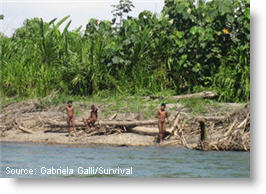
Peru’s government has said they are taking measures to protect an uncontacted tribe located in the south-east Amazon rainforest, nonprofit organization Survival International said in a press release.
“Government authorities in Peru have responded to Survival’s call to protect uncontacted Indians who have recently appeared on riverbanks near a popular tourist destination,” the organization said Wednesday.
The Indians are believed to be from the Mashco-Piro tribe in the Manu area. Tourists who visit the nearby national park have recently been leaving clothes on the riverbanks to “entice the Indians out of the forest,” Survival said.
The group has sent warnings to outsiders to stay out of their area. They recently hit a park ranger with an arrow with the tip removed as a warning sign, Survival said. “Uncontacted Indians lack immunity, Read the rest of this story..
British rock star Mick Jagger arrived at the ancient Inca citadel of Machu Picchu on Thursday, as part of a trip to Peru that has included a sit-down with President Ollanta Humala and a visit to an eco-lodge in the jungle region of Madre de Dios.
The front man for the Rolling Stones, Jagger travelled to Machu Picchu by train from Cusco and was expected to climb Huayna Picchu, the picturesque peak that overlooks the ruins, on Friday, state news agency Andina reported. Read the rest of this story..
“Now I see the secret of making the best person: it is to grow in the open air and to eat and sleep with the earth.” Walt Whitman
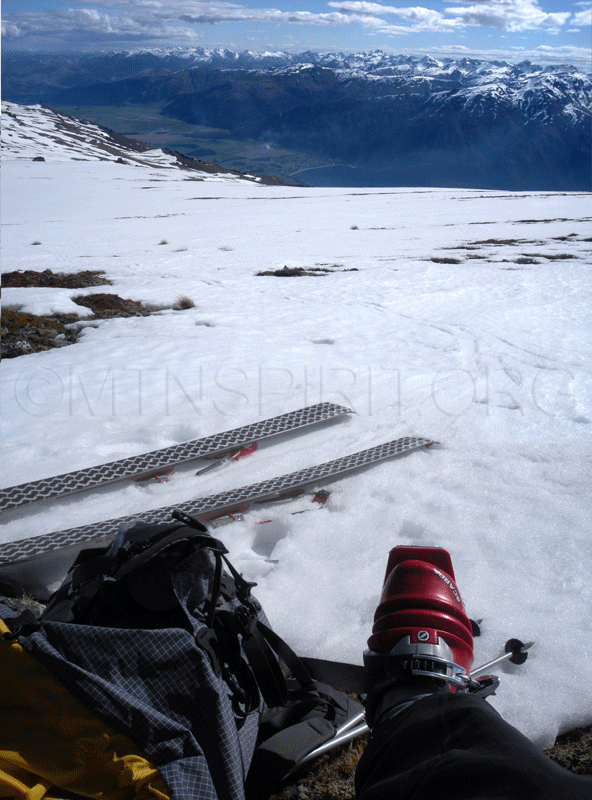
The other day, as the spring corn was coming onto the scene, I finally decided to investigate the moderate ridgetops of our valley here in the Wakatipu Basin in Kingston, New Zealand. The skiing wasn’t the steepest, and the “peaks” aren’t the sharpest in the Southern Alps, but the snow was damn perfect. After all, the first ski hut in New Zealand was just down the road on the Nevis Road. There must have been a reason for that being the first NZ ski field.
What I found after a two hour hike to snowline, were broad snowfields of cornsnow with some minor peaks along the ridge. Evidently this is where a snowmobile/heli-ski operation brought people up last season. I could see them lifting off, just across the road, and thought, “If they’re headed up there, must be something to it.” We live in Kingston, a sleepy little town, home of spectacular scenery, rock climbing, dramatic walks, a long pebble beach at the south end of the second largest lake in New Zealand, and home to an eclectic community that hasn’t been discovered by Queenstown yet. Oh I almost forgot to I mention the Kingston Flyer steam train, which is now up and running, after a number of years in receivership. Look closely at the image on right, the clouds of smoke are from the steam train’s maiden test run, and from the fires it started along side the tracks.
A long, fun day. Rising at 4:40 I hit the DOC trailhead by 5:30, and got back to the car around 18:30 I was a little tired, but jazzed. Fortunately there were freezing temperature up high, so by 10am, there was perfect corn on the northern aspects. I took some pix and video, so decided just to blend them into a movie for the day…Enjoy.
I couldn’t resist a great story.
Wally has always had the spirit of adventure and lightheartedness with his business building bindings, skis and boards. Good on ya Wally.
Good on ya Cowboy Kobernik for being tenacious with your idea.
A few days ago, our family started doing a daily meditation which was suggested by an invitation from Snatam Kaur. The meditation leads up to 11/11/11, when astrologically (and astronomically) speaking, we end the Piscean age and enter the Aquarian age. I thought I’d include this article below for one take on the changeover. There are other perspectives as well.
The Aquarian Sadhana: Last 40 Days until the Aquarian Age By Ravi Hari Singh Khalsa
We are forty days away from the historic date of November 11th, 2011 (11-11-11).
I’ve spent a large part of the past year researching Yogi Bhajan’s teachings about the Aquarian Age in preparation for writing the book We are the Aquarians, Yogi Bhajan’s Vision of the Aquarian Age. Yogi Bhajan spoke about the date 11-11-2011 repeatedly as a critical milestone marking the end of the cusp period that started on 11-11-1992 and the beginning of the transition to the Age of Nanak, which he also referred to as the Age of the Shabad Guru, and which officially begins in 2038. You might think of the period from 1991 up to the present as being the time during which changes have happened mostly on the level of vibrational frequencies. (more…)
Life has such an ebb and flow. One minute you can be riding the wave, the next minute you are under the wave. One minute you can feel safe and secure in your life, and the next minute you can feel totally threatened by something.
I find that when I meditate it helps me to separate myself from the sting of something to realize that it is all coming from God’s Divine Will. Usually the most emotionally charged things aren’t really that big of a deal anyway. (more…)
The Shweeb: Where's the passing lane? Aside from that, sign us up!
Shweeb’s bike-powered 200 meter monorail, pitched as an adrenalin-fueled sky cycling adventure in Rotorua, New Zealand, may be headed for bigger tracks. Google, who found out about it a few years ago, has been so enamored with the system, in which users are suspended form the track in transparent pods to cycle around the landscape a t speeds of up to 45 km per hour, they’ve invested 1.05 million in developing the technology. I t could be the future for alternative transportation, so Google claims. What one would do about traffic jams is something to ponder, but that’s a minor speed-bump compared to running fossil fuels till we’re extinct.
The Media Education Foundation does it again with another solid documentary, although this one, The Bro Code, is a bit hard to watch. The sad fact, that we all know, is that men are indoctrinated from day one to act and behave a certain way, especially towards women. This film lays bare the ways in which men get trapped into the tunnel vision of how they fit into the world.
In MEF’s powerful new release, The Bro Code, filmmaker Thomas Keith takes aim at the forces in male culture that condition boys and men to dehumanize and disrespect women. Keith breaks down a range of contemporary media forms that are saturated with sexism — movies and music videos that glamorize misogyny; pornography that trades in the brutalization of women; comedy routines that make fun of sexual assault; and a slate of men’s magazines and cable TV shows whose sole purpose is to revel in reactionary myths of American manhood. The message he uncovers in virtually every corner of our entertainment culture is clear: It’s not only normal — but cool — for boys and men to control and humiliate women. By showing how there’s nothing natural or inevitable about this mentality, and by setting it against the terrible reality of men’s violence against women in the real world, The Bro Code challenges young people to step up and fight back against the idea that being a real man means disrespecting women. Featuring interviews with Michael Kimmel, Robert Jensen, Shira Tarrant, J.W. Wiley, Douglas Rushkoff, Eric Anderson, and Neal King. To see the trailer click here..




 Mountain Spirit's Blog