Archive for the ‘Books’ Category
23/05/2010
New Book: Living DownStream – Shows evidence showing links between environmental toxins and cancer rates.

Our water: Filter it!
From Living on Earth
National Public Radio
Steve Curwood of LOE, interviews author Sandra Steingraber.
For the audio MP3 click here.
CURWOOD: Recently the journal Pediatrics reported a link between exposure to pesticides and the condition ADHD, attention deficit/hyperactivity disorder. It seems that almost every week we learn some unsettling bit of news about the effects of chemicals in our food, or water, or air, or the products we use.
Environmental chemicals have long been a concern for author and biologist Sandra Steingraber—particularly those linked to cancer. In a new film based on her groundbreaking book of more than a decade ago, Ms. Steingraber explains why her own cancer diagnosis as a young woman left lingering questions about the disease.
CLIP: I’m one of those people who really does come from a family with a lot of cancer in it. I wasn’t the first in my family to be diagnosed. My aunt went on to die of the same kind of bladder cancer that I had. I have uncles with prostate cancer, colon cancer, but the punch line of my story is that I’m adopted.
CURWOOD: Sandra Steingraber’s book, “Living Downstream”, laid out evidence showing links between environmental toxins and cancer rates in her hometown. Now a new edition of the book and the film of the same name expands the evidence of the relationship between our health and our environment. Sandra Steingraber, welcome to Living on Earth.
STEINGRABER: Thanks Steve.
CURWOOD: Where did you grow up and tell me why you relate the cancer you developed as a young adult to the environment in which you were raised? Read the rest this interview
Tags:ADHD, attention deficit/hyperactivity disorder, environmental chemicals, Journal of Pediatrics, Living Downstream, Living on Earth, Sandra Steingraber, Steve Curwood, water supply
Posted in Books, Environment, Health | 1 Comment »
21/05/2010
By John Perkins
Sent by email, also published in the Huffington Post

John Perkins
While countries around the world continue to watch their economies collapse, and Goldman-Sachs leaders testify to Congress about how they manipulated both their shareholders and the American public, we are also faced with a tragic oil spill on our most fragile coastlines.
The sad truth is that oil, greed and fake accounting work hand in hand to empower those who have — and significantly disempower those who do not.
In my book, Hoodwinked I talk about the 30,000 Ecuadorians who filed a lawsuit against Texaco (since purchased by Chevron). The company destroyed vast sections of rain forest and the toxic wastes from its operations allegedly killed many people and made many more chronically sick. (more…)
Tags:Greed, Gulf Oil Accident, Hoodwinked, John Perkins, Oil Spill
Posted in Books, Climate Change, Conservation, Environment, Fair Trade, Room For Improvement, Sustainable Living/Communities, This Just In Department | 1 Comment »
18/05/2010
Book Describes How to Transition
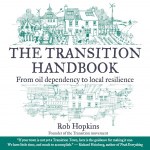
Adapt or Die
“If your town is not yet a Transition Town, here is guidance for making it one. We have little time, and much to accomplish.”
Richard Heinberg, Post Carbon Institute, Santa Rosa, California, author of ‘Power Down’ and ‘Peak Everything’
We live in an oil-dependent world, and have got to this level of dependency in a very short space of time, using vast reserves of oil in the process – without planning for when the supply is not so plentiful. Most of us avoid thinking about what happens when oil runs out (or becomes prohibitively expensive), but The Transition Handbook shows how the inevitable and profound changes ahead can have a positive outcome. These changes can lead to the rebirth of local communities, which will grow more of their own food, generate their own power, and build their own houses using local materials. They can also encourage the development of local currencies, to keep money in the local area.
The book has three sections, Read more
Tags:Peak Oil, Post Carbon Institute, Richard Heinberg, The Transition Handbook, Transition Towns
Posted in Books, Climate Change, Conservation, Environment, Holistic Living, Leadership, Sustainable Living/Communities | Leave a Comment »
03/05/2010
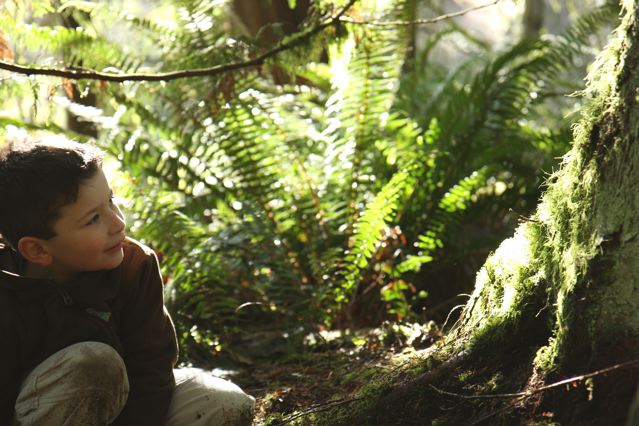
Child in Woods = It's Natural
LONDON – A new study finds that just five minutes of exercise in a “green space” such as a park can boost mental health.
Researchers at the University of Essex looked at 1,250 people and found that walking, cycling, fishing, boating or horseback riding in a park, garden or nature trail can boost mood and self-esteem.
The biggest effect was seen within just five minutes, and even more positive results were seen when people exercised in an area that also contained water, such as a lake or river.
“We believe that there would be a large potential benefit to individuals, society and to the costs of the health service if all groups of people were to self-medicate more with green exercise,” said co-researcher Jo Barton.
The study is detailed in the Environmental Science and Technology journal. Also see Richard Louv’s website. He’s the author of Last Child in the Woods.
Image: MommyFootprint.com
Tags:Green Extercise, Last Child in the Woods, Study, University of Essex
Posted in Books, Experiential Education, Health, Holistic Living | 1 Comment »
11/04/2010

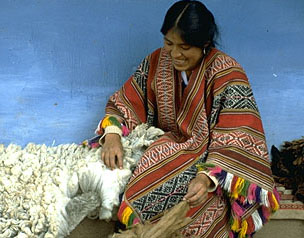
Weaving in the Peruvian Highlands
Handwoven Fabrics: Living History
Handwoven fabrics are the living history and cultural treasure of the Peruvian Highlands. The weavers who create these extraordinary textiles are the keepers of the culture and sustainers of a noble but difficult lifestyle in tune with the earth. This book, Weaving in the Peruvian Andes celebrates their authentic, well-crafted work by showing varied and distinctive styles of traditional clothing, the basics of how fabric is created from spinning to dyeing to weaving, the way traditional crafts are passed from one generation to another, the names and meaning of the myriad textile designs that reflect the culture and history of the people, and the rituals and celebrations in which woven fabrics play such an important role.

N.C. Alvarez
Author Nilda Callañaupa Alverez is founder and director of the Center for Traditional Textiles of Cusco. She has established weaving associations through the Andean highlands to preserve a tradition of handmade textiles and to promote economic development. She lives in Cusco and in her native community of Chinchereo, Peru.
All proceeds from the sale of the book benefit the Center of Traditional Textiles of Cusco.
Mountain Spirit Institute focuses on weaving during our educational programs in Peru. Learn more at www.mtnspirit.org
Tags:Center for Traditional Textiles of Cusco, Chinchereo, Cusco, Mountain Spirit, Nilda Callañaupa Alverez, Peru, textile designs, Weaving in the Peruvian Andes
Posted in Archeology, Books, Fair Trade, Holistic Living, Peru, South America, Sustainable Living/Communities, Sustainable Travel, Traveling | Leave a Comment »
08/04/2010
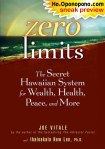
Hopono'ono (Sp!)
Ho’O What?
Old Hawaiian system of communication and engaging with the universe that actually works to make a better world.
I’ve been meaning to write about this book for a while, and a recent email prompted me to follow through. On one hand, while the cover, and some of the book’s precepts are a bit hokey, such as getting the woman and car you want, I doubt I’d be married to the wonderful woman that’s my wife, had I not actively engaged the universe and actually asked for what I want. I was using this technique during the summer just before we met. I was leading a mountaineering course in Alaska at the time, and while in the mountains, practiced the technique about 30 times per day. This book illustrates a technique that has quite a track record and impressive story behind it. Below is an email from a good friend to whom I recommended the book and technique. As Tolle says, “Are you polluting the world or cleaning up the mess?” This technique helps you do your part to clean up the mess.
Hi Randy,
I really enjoyed our conversation today.
Shortly after our conversation, I Googled some reviews of “Zero Limits” as well as several pages of the book itself in the form of a preview. In it are perhaps the most potentially life changing ideas I have ever encountered. I thank you very much for introducing it to me. I am going to order copies for several friends and myself.
Thanks
J.M.
Dear J,
Yes, this technique of simply saying “I love you, I’m sorry, Please forgive me, Thank you”, is still working wonders in my life. It’s time to raise the bar for all of us, isn’t it.
Thanks for the link to Meninger. I’ll check it out.
Looking forward to seeing you.
Warmest regards,
Randy
Tags:Alaska, Health, Ho'Oponopono, Joe Vitali, love, Manifesting, Meditation, Mountain Spirit, wealth, Zero Limits
Posted in Books, Health, Holistic Living, Inner Work, Leadership, MSI News, Spiritual | Leave a Comment »
25/03/2010
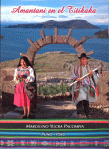
Book on Amantani, Peru
Amantani en el Titikaka by native Amantani islander Marcelino Yucra Pacompia is available in local bookstores in Puno, Peru, and on the island of Amantani, Lake Titicaca, and possibly via the publisher’s website.
This first book available to the public on Amantani Island, is published in Spanish. It covers the geography, attractions, history, culture and customs, natural history plus social and political aspects of the island. Is also includes an important piece on the concept of Ayni or reciprocity, key the sense of community on the island.
Mountain Spirit Institute recommends this book as a good primer before visiting the island. We will see what we can do to have the book available on our website’s Fair Trade webpage.
Tags:Amantani, Amantani en el Titikaka, books on Peru, Marcelino Yucra Pacompia, Mountain Spirit
Posted in Books, Peru | Leave a Comment »
28/01/2010
Media Violence and the Cultivation of Fear
A new film based on the late George Gerbner’s groundbreaking analysis of media influence and media violence

MEA's Mean World Syndrome
In A New Heaven New Earth, Eckart Tolle says that violence for violence sake is the pain body‘s way of seeking food. Violent films are made by pain bodies for pain bodies to view. He also wrote, however, that if a film, such as a documentary or drama about the Vietnam war or World War II for example, use violence to illustrate the madness of the human mind, to wake us up to the insanity of the egoic mind, then violent depictions can have a role in showing us a way to becoming more fully conscious. I’m still on the fence about Tolle’s comments. Meanwhile, the highly respected Media Education Foundation has just produced a new DVD called Mean World Syndrome.
“In an era dominated by simplified assumptions about the impact of television violence, Gerbner insisted on a broader perspective and a sharper analysis, arguing that the primary impact of the media was to reinforce, not to challenge, the structure of power.”
– Larry Gross, Director, USC Annenberg School of Communication
For years, debates have raged among scholars, politicians, and concerned parents about the effects (more…)
Tags:Cultivation of Fear, Eckhart Tolle, George Gerbener, Larry Gross, Mean World Syndrome, Media Education Foundation, New World, Pain Body, USC Annenberg School of Communication
Posted in Books, Film/DVD, Health, Holistic Living, Inner Work | Leave a Comment »
05/01/2010
By R. Richards
If you’re looking for a good website which has, among other things, a good list of human anatomy in Spanish, (it comes in handy when visiting a doctor in Peru), visit this: Intro2Spanish.com. This link (which is actually rcaguilar.com, whatever that is) takes to you the Human Anatomy page. On the left look for titles that will take you any direction you wish to head: Pronunciation Lessons, Numbers, Time, Date, Verbs, Verb Tenses, Verb Conjugation, Grammar, Gender, Grammar Terms, Pronouns, Reflexive, Vocabulary, Adjectives, Noun Cognates, Prepositions, as well as Verb Lists, and Vocabulary Lists
I need all the help I can get. Even after 12 years of working in South America my Spanish has been called “Tarzan Spanish” by a friend of mine. The two-week Spanish school in Baños, Ecuador wasn’t a complete education. In fact, my Spanish is probably a bit worse than it was earlier because I come and go for a few months at a time. Icommunicate OK, but I need drastic help with my verb tenses and sentence structure. There is hope, however.
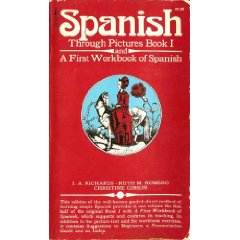
Spanish Through Pictures, my favorite
Other resources which have help me in the past: Spanish Through Pictures, by I.A. Richards, (no relation) which is out of print. We may publish this as an online version, pending permissions. I have a hunch that the Rosetta Stone computer program (which is excellent) may have gotten its ideas from the book series by Richards published in the 1950’s.
Tags:Adjectives, and Vocabulary Lists, as well as Verb Lists, Date, Gender, Grammar, Grammar Terms, human anatomy, I.A. Richards, Intro2Spanish.com, Noun Cognates, Numbers, Prepositions, Pronouns, Pronunciation Lessons, Reflexive, Rosetta Stone, Spanish Through Pictures, Time, Verb Conjugation, Verb Tenses, Verbs, Vocabulary
Posted in Books, Traveling | Leave a Comment »
27/12/2009
By Amanda Richards

An Eco-fable about planting trees
I picked up an excellent book on the week-end – one that I hope you will read. It’s an oldie but a goodie. This book is a magical and inspiring tale about a man who planted trees. It is also known as The Story of Elzéard Bouffier, The Most Extraordinary Character I Ever Met.
It was first published in 1953 and is a timeless eco-fable about what one person can do to restore the earth. The hero of the story, Elzéard Bouffier, spent his life planting one hundred acorns a day in a desolate, barren section of Provence in the south of France. The result was a total transformation of the landscape-from one devoid of life, with miserable, contentious inhabitants, to one filled with the scent of flowers, the songs of birds, and fresh, flowing water.
Tags:Amanda Richards, Elzéard Bouffier he Most Extraordinary Character I Ever Met, Mountain Spirit, Provence
Posted in Books, Conservation, Environment, Sustainable Living/Communities | Leave a Comment »






 Mountain Spirit's Blog