I had the good fortune to meet Tom Shepherd yesterday, here in the little town of Kingston, New Zealand.
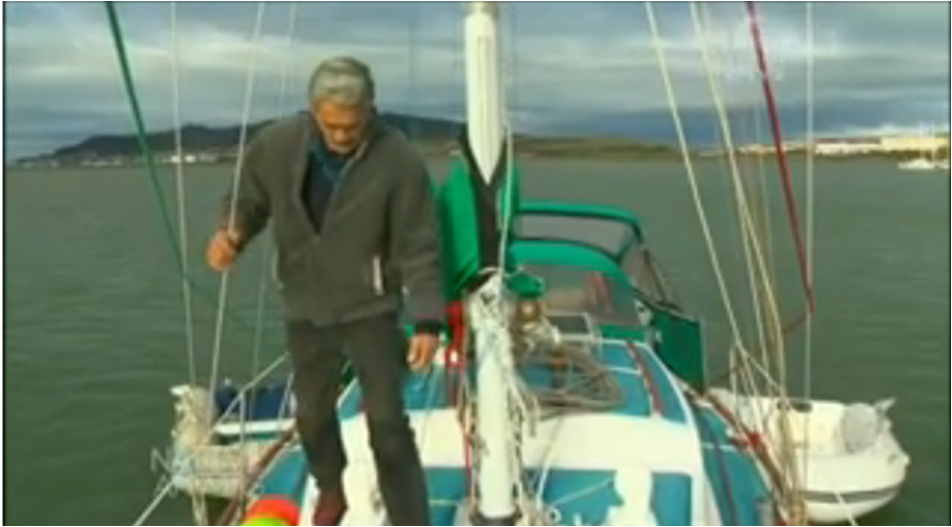
Although he won’t admit it, Tom has a remarkable story to tell, which actually isn’t over yet. He’s half way through a “figure-8 circumnavigation” of the North and South Islands of New Zealand – and he’s learning to sail as he goes along. What’s more impressive is he’s approaching his 84th birthday next month, and, he has been diagnosed with cancer. Seven years ago he was given six months to live. Every six months after that, for two years, nothing happened. He finally decided he wasn’t going to sit around to see would happen. Learn more of his story:
When he sailed in to the docks in Motueka, near Nelson, people were gathering and walking down the dock to greet him with “You must be Tom Shepherd, the fellow sailing down the coast.” Word had traveled before his arrival. Since then he’s been interviewed by the Maori Channel here in New Zealand. He was kind enough to grant me the interview (see above), but, half joking, said he was considering going into hiding.
The next leg of his journey would provide an opportunity as a recluse, as he heads from New Zealand’s southern tip into the deep fjords of the the west coast. I want to keep track of this man – who is an inspiration. He’s getting out there and doing something. He’s not posting on Facebook or blogs, he’s just doing it. Tom’s adventure is about being alive as much as it is the uncharted journey on his yacht. It reminds me of the quote by William G.T. Shedd – “A ship is safe in harbor, but that’s not what ships are for.”
Please see the post interview clip, (below) of how Mr. Shepherd “rubbed off” on a bummed out cab driver in the Christchurch area. It’s been said that one of the tenants of a spiritual person is to serve as a fire that helps kindle the soul of another. Tom Shepherd humble, but the results around him seem to be clear. He’s making this place a better world, just by living.
Thanks to Laura Jean Whitcomb, publisher of Kid Stuff for letting us reprint this article about a ground-breaking move by a small school in central Vermont, The Willow School. One look at the their website almost has me rethinking our departure for New Zealand this fall, and instead, having our young son attend the school!
Outward Bound mandatory for all young people?
Like legendary Headmaster Dave Fowler at Proctor Academy in Andover, NH where he pioneered incorporating Outward Bound principles of experiential education and community building into the school’s fabric in 1971, it sure looks like the founders of the Willow School are doing the same thing for younger students. The article below covers what will hopefully be incorporated in many schools across the U.S. and abroad. In New Zealand as well, (where we’ve been living), bullying appears to be a problem.
Proctor’s experiential model
I’m reprinting this article in hopes that it will fall into the right hands of school teachers and administrators. During my 15-plus teaching years at Outward Bound, the debrief and reflection were key to a successful outcome for the students, and helped insure some strong “takeaways” that they could use as life skills. In fact, Outward Bound Professional Development courses also incorporate these basic techniques (more…)
Expedition 2012: From Vermont to James Bay by Canoe Paddling Forward, Giving Back
Expedition 2012's Route
By R.Richards
Family friend, Tom Bloch is one of ten crew members of Expedition 2012, an epic 1,200 mile canoe trip from Lake Dunmore Vermont to James Bay in Northern Canada, which is underway as we post this.
The expedition is an effort to support the Keewaydin Foundation in its ongoing mission to preserve “the Keewaydin Way”, and extend its benefits to an ever-greater range of today’s youth. The Foundation has three summer camps: Keewaydin Temagami (Ontario, Canada), Keewaydin Dunmore (Salisbury, Vermont), and Songadeewin of Keewaydin (Salisbury, Vermont).
To accomplish their goal, Expedition 2012 is committed to establish a new scholarship endowment for the Foundation. Expedition 2012 is using the extended wilderness canoe trip, which is a tradition at Keewaydin’s as a fundraising platform, . They are paddling the long route over the course of 65 days in wood and canvas boats hand-crafted by the expedition members. During the course of this project, expedition members are additionally dedicated to environmental advocacy towards the preservation of the wilderness we hold dear. To learn more about the progress of the expedition, and to follow the the paddlers go here, or head over to their blog
Keewaydin states on their website, “To live for a summer in a world largely unstructured and shaped only by nature itself… this is an adventure few are privileged to know.” and adds, “Through these programs, Keewaydin builds strong, independent character while exposing young men and women to a bygone lifestyle. Since 1893, Keewaydin has withstood the temptation of change, holding firm to what is dear of the past and leaving it untouched. Keewaydin’s simplicity and special link to the undisturbed wilderness set our programs apart from traditional camp experiences. This is the Keewaydin Way.” To learn more about the camp, visit their website.
The map, drawn up by Johnny Clore, shows the full itinerary of Expedition 2012 from Lake Dunmore down Otter Creek to Lake Champlain, then down the Richelieu River to the St. Lawrence Seaway. From Montreal, we’ll head upstream on the Ottawa River for over three hundred miles and cut west for our resupply at Temagami by following the fabled “Trip In.” From there the route leads over a swift succession of smaller lakes and rivers to the Abitibi River, where we will restock and head for the bay at Moosonee. Resupply locations are indicated with yellow stars. Click the “Itinerary” tab on the left to get a more detailed look at our itinerary.
Tom Bloch, On Expedition 2012
Tom Bloch has written a personal mission statement and essay, as have the other members of the team), which starts out…”I never went to summer camp. Instead of big canvas tents and shiny green canoes, my childhood summers were filled with soccer camps and family hiking trips. Now, here’s the shocker: I turned out just fine. As of my college graduation last May, I was a reasonably well-adjusted, mild-mannered young man with sensible career aspirations and even a few healthy hobbies. The world is rife with friendly, successful people who have never paddled a canoe. In light of this, what is the value of Keewaydin? Why this grand expedition? Read the rest of Tom’s entry here..
A friend just pointed out comedian Lee Camp’s YouTube message calling for a national “buy nothing/strike/call-in-sick” day. This message is worth considering. Post your comments, let us know what you think. For us, we’ll be doing nothing on May 1st.
THE HUNGER GAMES: Dystopian fiction & Predictive Programming
The following piece is by Richard Louv, Author of Last Child in the Woods. I’m glad he’s weighed in on the Hunger Games. One might also google Predictive Programming to learn more about why such movies are made. (ed.) Stuck Inside Apocalypse with Dystopic Blues Again ByRichard Louv
“The Hunger Games,” the book, is a page-turner and the movie is gripping. Some of my colleagues, working hard to reconnect young people to nature, believe the popularity of the book and movie will, like the film “Avatar,” stimulate a deeper interest in the natural world. I hope they’re right, but after leaving the movie theater on Friday (having already read the book), I was, well, ambivalent.
In this story, there are two forests. The first forest is as natural as a forest can be with an electrified fence to keep the largest carnivores out of District 12, Katniss Everdeen’s starving Appalachian homeland.
At the beginning of the book, she describes sitting in a nook in the rocks with her hunting partner, Gale, looking out at a forest that sustains them: “From this place we are invisible but have a clear view of the valley, which is teeming with summer life, greens to gather, roots to dig, fish iridescent in the sunlight.” This forest keeps her family alive. (more…)
Lama Willa Miller, the spiritual leader of a Natural Dharma Fellowship branch in Massachusetts, talks about a new refuge center, and the importance of mindfulness in the mountains. Part 1
Lama Willa Miller
By R. Richards Mountain Spirit Institute
The Dartmouth Lake Sunapee region of New Hampshire, USA has the good fortune of seeing a new Tibetan Buddhist Refuge open in the tiny town of Springfield. After a recent open house, we learned about what Lama Willa Miller, the leader of the Cambridge Mass based branch of The Natural Dharma Fellowship, has in mind for the new retreat center called Wonderwell, as well as the link between Buddhism and the mountains. Learn more, check out this first in series of interviews we conducted on location. See Part II
Mountain Spirit Institute names Ken Wylie to Board of Directors
Ken Wylie
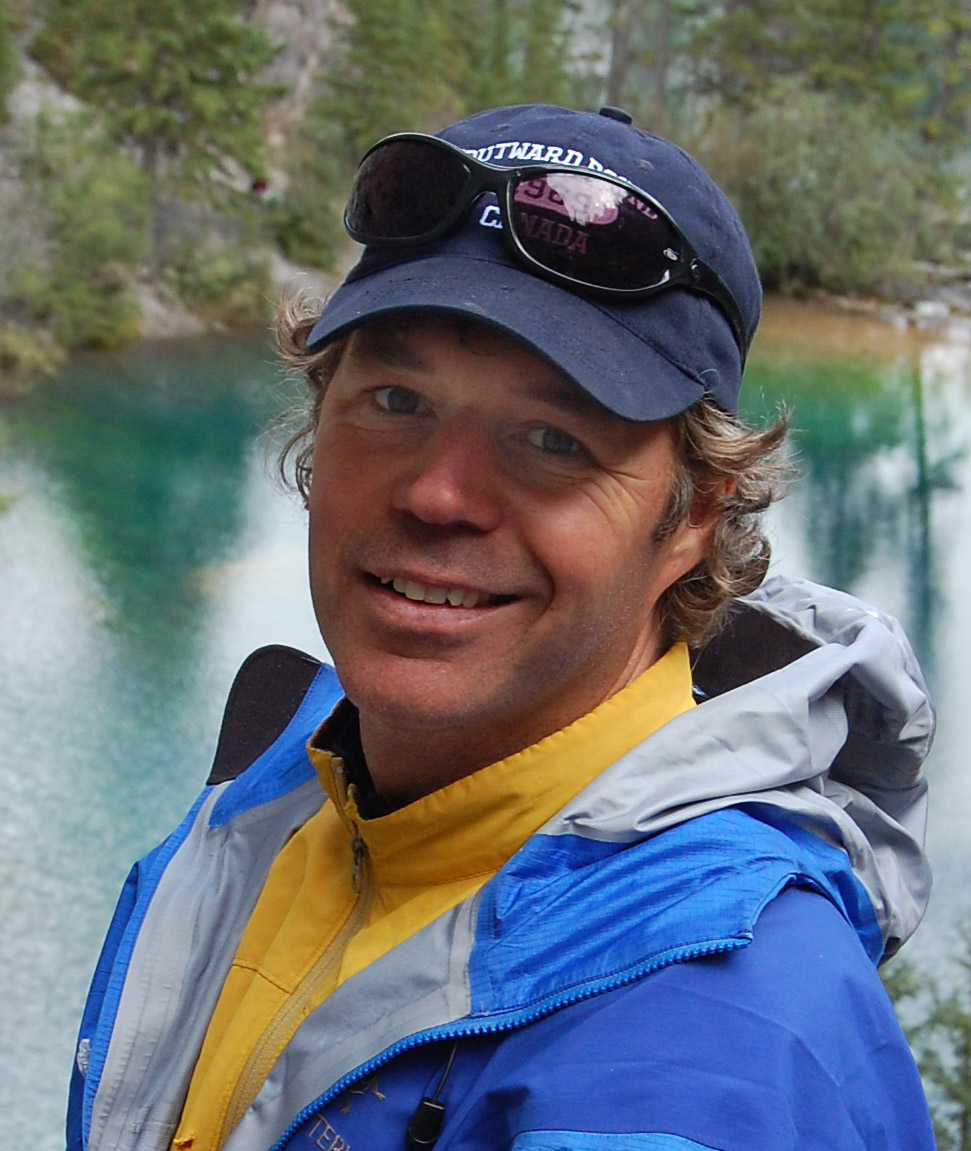
Ken Wylie, a veteran certified mountain guide from Cochrane Alberta, Canada with years as an experiential educator and program manager at Canadian universities as well as Outward Bound Canada and the Outward Bound USA, has recently been named to the board of directors at Mountain Spirit Institute based in the U.S. and New Zealand. In addition to helping guide the U.S. organization, Wylie has plans to launch a Mountain Spirit Institute Canada where he will create mountain programs based on the mission statement. Mr. Wylie and founder Randall Richards along with fellow board members are in discussions about also collaborating on mountain programs in the U.S, New Zealand and possibly the Alps.
Says Wylie, “I am drawn to Mountain Spirit Institute because of the organization’s vision. MSI has the vision for the 21st century in my estimation, and is what I have been searching for in my career.” Adds Wylie, “The mountains are an experience that can change people’s lives, but are more often than not just another consumable, another peak to check off the list. What people need now more than ever, is to connect and MSI helps them do that.” (more…)
What Money Is & What Money Is Not – Living Without Money
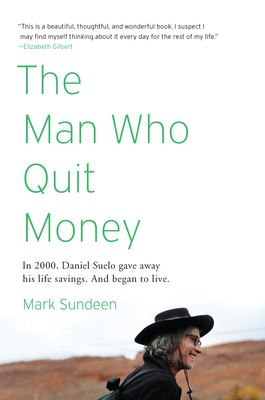
A Walden for the 21st century, the true story of a man who has radically reinvented “the good life”.
In 2000, Daniel Suelo left his life savings-all thirty dollars of it-in a phone booth. He has lived without money-and with a new-found sense of freedom and security-ever since.
The Man Who Quit Money is an account of how one man learned to live, sanely and happily, without earning, receiving, or spending a single cent. Suelo doesn’t pay taxes, or accept food stamps or welfare. He lives in caves in the Utah canyonlands, forages wild foods and gourmet discards. He no longer even carries an I.D. Yet he manages to amply fulfill not only the basic human needs-for shelter, food, and warmth-but, to an enviable degree, the universal desires for companionship, purpose, and spiritual engagement. In retracing the surprising path and guiding philosophy that led Suelo into this way of life, Sundeen raises provocative and riveting questions about the decisions we all make, by default or by design, about how we live-and how we might live better. Editor’s note: It sounds like we have another Outward Bound success story here. I read that Suelo has been an OB instructor. Good to see he’s living the dream, and it looks like some of the OB values rubbed off, but I’m sure he had influences from more than just Outward Bound.
Many of us fear death. We believe in death because we have been told we will die.
Editor’s Note:
Dannion Brinkley
For some reason, death has not been a stranger in my life. Western society is almost totally ignorant of death, it is something to be brushed under the rug, and feared. Stay tuned for a posting on “Death, The Funny Side” a talk by Dannion Brinkley, author of Saved by the Light. I heard Brinkley speak at a Whole-Life Expo in Seattle in the late ’80’s – he was promoting his book. I liked his half-hour talk so much that I bought a copy of it andeventually converted it mp3 format. I plan on posting it here, once I have Brinkley’s permission of course. It’s a classic, that has changed my understanding of what death is, and what it means to be fully alive. His sense of humor perspective, depth and compassion, after having died more than once and come back to talk about it, is remarkable, especially after having been a hit man for the U.S. government. Ykes.
At Mountain Spirit Institute, one of our core values is addressing our “ultimate concerns”. We believe that by helping to reconnect people to the natural environment, each other and a deeper connection to one’s self, we can help participants start looking beyond the veil. Eckhart Tolle writes” The secret to death is to die before you die, and realize there is no death.” Hmm. Maybe he’s onto something. Dannion Brinkley is, as well. R. Richards
Does Death Exist? New Theory Says ‘No’
From: KipNews (Open your mind, Prepare)
A case for staying no death - Biocentrism
We associate ourselves with the body, and we know that bodies die. But a new scientific theory suggests that death is not the terminal event we think.
One well-known aspect of quantum physics is that certain observations cannot be predicted absolutely. Instead, there is a range of possible observations each with a different probability. One mainstream explanation, the “many-worlds” interpretation, states that each of these possible observations corresponds to a different universe (the ‘multiverse’).
A new scientific theory – called biocentrism – refines these ideas. There are an infinite number of universes, and everything that could possibly happen occurs in some universe. Death does not exist in any real sense in these scenarios.
All possible universes exist simultaneously, regardless of what happens in any of them. Although individual bodies are destined to self-destruct, the alive feeling – the ‘Who am I?’- is just a 20-watt fountain of energy operating in the brain. But this energy doesn’t go away at death. One of the surest axioms of science is that energy never dies; it can neither be created nor destroyed. But does this energy transcend from one world to the other?
Consider an experiment that was recently published in the journal Science showing that scientists could retroactively change something that had happened in the past.
Particles had to decide how to behave when they hit a beam splitter. Later on, the experimenter could turn a second switch on or off. It turns out that what the observer decided at that point, determined what the particle did in the past. Regardless of the choice you, the observer, make, it is you who will experience the outcomes that will result. The linkages between these various histories and universes transcend our ordinary classical ideas of space and time. Think of the 20-watts of energy as simply holo-projecting either this or that result onto a screen. Read the rest of this story…
 t interview clip, (below) of how Mr. Shepherd “rubbed off” on a bummed out cab driver in the Christchurch area. It’s been said that one of the tenants of a spiritual person is to serve as a fire that helps kindle the soul of another. Tom Shepherd humble, but the results around him seem to be clear. He’s making this place a better world, just by living.





 Mountain Spirit's Blog