Archive for the ‘Power of Place’ Category

Letting the Place Change You

30/09/2009

Perceiving Without Naming – Why Traveling Can Quiet the Mind

MSI Dir. R. Richards with Children, Lake Titicaca

MSI Dir., Richards with Children, Lake Titicaca

An excerpt from Eckhart Tolle’s A New Earth aptly describes how some people can travel to a country without actually experiencing anything new. I’d not quite heard it put this way, and always felt I had observed two types of travelers, but couldn’t put my finger on it, that is, not until I heard the passage below by Tolle.

Our goal at Mountain Spirit Institute, and the reason we strive to take people to Peru and other such magical places, is to encourage radical growth of inner wisdom and help participants reconnect with one’s self, fellow world community members, and the mountains of a place.

Tolle writes, “Most people are only peripherally aware of the world that surrounds them. Especially if their surroundings are familiar. The voice in the head absorbs a greater part of their attention. Some people feel more alive when they travel and visit unfamiliar places or foreign countries because at those times sense perception, experiencing takes up more of their consciousness than thinking. They become more present.”
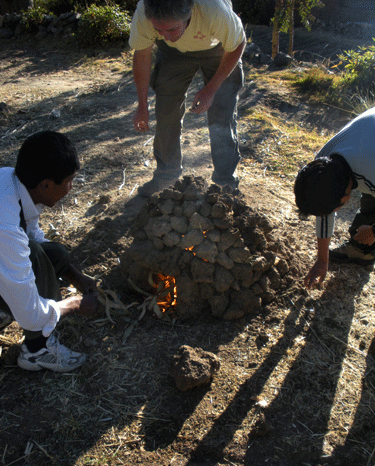
Learning about a Mud Oven, Lake Titicaca

Learning about a Mud Oven, Lake Titicaca

He adds, “Others become completely possessed by the voice in the head even then, their perceptions and experiences are distorted by instant judgments. They really haven’t gone anywhere. Only their body is traveling, while they remain where they have always been, in their head.”

Tolle concludes, “This is most people’s reality. As soon as something is perceived, it is named, interpreted, compared with something else, liked, disliked, or called good or bad by the phantom self, the ego.  They are inprisoned in thought forms, in object consciousness.  [One does] not awaken spiritually until the compulsive and unconsciousness naming ceases, or at least until [one becomes] aware of it.”

This may be why a participant on our Peru program spontaneously had a wave of emotion come over him, at a historical site in Cusco. Maybe it had something to do with the tone setting I’d done a few minutes prior, at the start of the program, where I encouraged participants to step out of their comfort zone, open their minds and try new things.

Our job is to simply put the people, the setting, and situations in place so that the participant may have an insight.  Of course, you don’t need the mountains or a foriegn country to do that, but it can’t hurt.
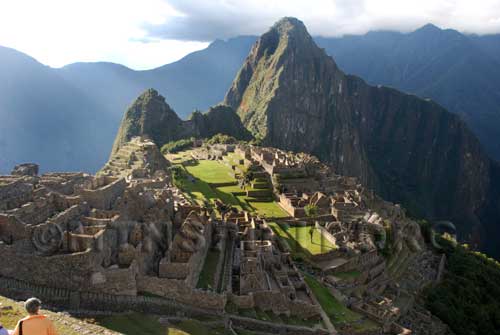
Machu Picchu’s Face

17/08/2009

By Randall Richards

"The Face" peering over Machu Picchu

"The Face" peering over Machu Picchu

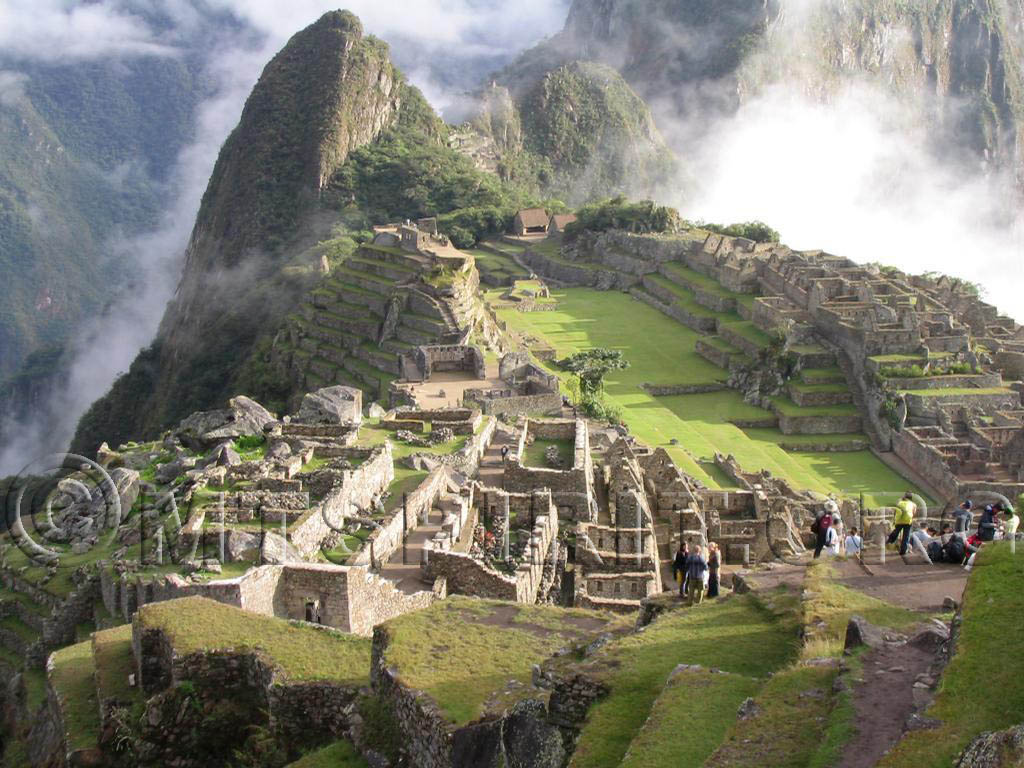
I’ve been to Machu Picchu for over ten years, and I’ve heard tell of “the face on Huayna Picchu Mountain” for years. I have been able to pick out the stylized puma face that everyone talks about,  with its ears and eyes, but the other day, human face  jumped out at me as I looked at these images I’d taken,  from the classic view on the sloping rock just above Machu Picchu. When I was looking through my images of the day, I clearly saw the face of an older man, wearing a “chulla” or Peruvian hat with ear flaps, as he looks over the Machu Picchu Citadel.

Details of Huayna Picchu's Face

Details of Huayna Picchu's Face

I’d recently run across an “optical illusion” website that features the profile of an Inka man looking skyward, shown by a profile of the ridge from the ruins to Huayna Picchu Mountain, but after close examination of the ridgeline in the website’s images, and comparing them to ridgeline in my images, there is clearly some Photoshop imagery going on.  A Peruvian author has used the profile on the cover of his book. I even walked by a hotel here in Cusco the other day which is using a drawing of “the profile” for its logo.  The profile, whether Photoshop enhanced or not, is still a stretch, any way you look at it,  and may not be the real face that has been hidden in plain sight all along.

Back to the face that I’ve observed. It clearly has eyes, a nose mouth, chin and whole face, at least in my mind’s eye. (Let me know if you see it too). The second image at right  is a blow up of the image with my text and pointer lines inserted. A word about Photoshop: these images are un-retouched. Take any other image from the same location, at late afternoon during the southern winter, and you’ll get the same results.

Every time I see an image of Machu Picchu from that angle, the face now jumps out at me. I am interested in hearing your comments or experiences when visiting Machu Picchu. Do you see the face?

Peru by Bike

17/08/2009

By Amanda Richards
Eva and I met while we were both  studying at Copenhagen University about 5 years ago. We were both  sad when we said our good-byes because  neither of us had any idea when we would  see each other again as she was heading home to Germany and I was returning to Australia.  Yet, now here we are in South America!

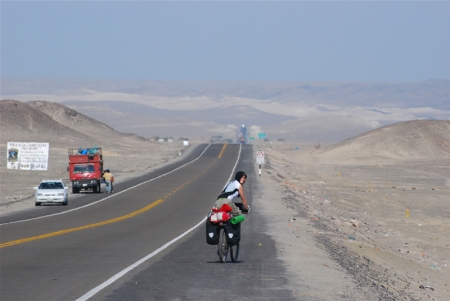
Eva is traveling with Sebastien and they  arrived here in Peru intent on cycling  and  hoping to explore `a strange new world, its countryside, people, cultures and languages for 2.5 months…´ Their adventures began in Lima  and they first  headed down  south to Nazca (a desert area) and then up to Cusco.

On the way to Nazca

On the way to Nazca

They have both been surprised at just how many other cyclists there are on the road – their expectation was that they would be almost the only ones on this big adventure!

After the chaos of Cairo (where they are both currently working) they are particularly enjoying the times when they are higher  up in the mountains (sometimes above 4,000m) where there are fewer people.

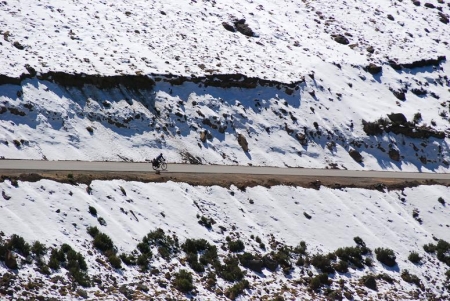
Up up up and down down down

Up up up and down down down

Eva and Sebastien are at Machu Picchu today and will continue with their cycle tour when they return to Cusco tomorrow. Once again Eva and I  will sadly say our good-byes and who knows when or where we will meet again. Somewhere fun!

Ridgewalking Inca Ruins

17/08/2009

This footage was taken today as we explored the ridge high above the Inka ruins above Pisac, the Sacred Valley, near Cusco and Machu Picchu. Although I’ve been bringing groups to Peru and have guided the high peaks of South America, today was my first day in Pisac.
The ridge got our attention when we  descended a narrow staircase leading to an exposed drop off, but at the brink, a sharp turn to the left led into a steep narrow slot with steps. Straightforward, but it cleaned out our cobwebs for the day.
The footage was prior to the descent to the ceremonial center on the ridge below, then to the village and market of Pisac, Peru.

Peru’09- Sacsayhuaman

03/08/2009

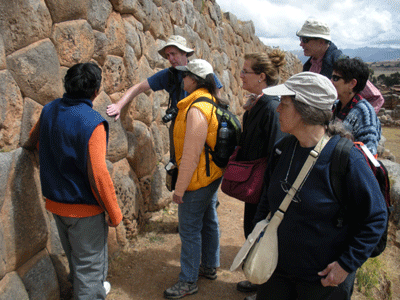
Participants check out the stonework of Sacsayhuaman

Participants check out the stonework of Sacsayhuaman

The citadel ruins overlooking the town of Cuzco called Sacsayhuaman, about a 20 minute hike from the San Blas area is the site of one of the last stands of the Inka Empire. It’s here where the last emperor fought off the Spaniards, but finally lost. Many were lost on the grounds surrounding the battlements. The stonework and size of the stones themselves is legendary.

There are few places that rival the massive 130 ton blocks that are fitted together so well, it’s difficult to wedge a knife between the cracks. Although there’s specualation, they’re still not sure how the stones were fitted together.
This was a good place to start our program.

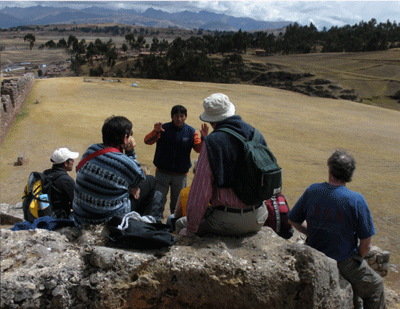
Local Guide tells of the Inti Raymi held annually

Local Guide tells of the Inti Raymi held annually

Participants were shown the area by a local guide who shared information about the  Inti Raymi festival held every year in June, about the stonework and the storehouses of grain and water, and the fact that most of the ruins were taken apart, block by block and used for Spanish buildings and churches in the Cusco center.

Sacsayhuaman is a beautiful place for an early morning walk, which Amanda and I did a few days ago. If you’re there before 7am, they usually don’t charge, plus that’s the best time to be there anyway.

The Enigma of the Nazca Lines

26/07/2009

The Enigma of the Nazca Lines
By Amanda Richards

Trapezoid Designs

Trapezoid Designs

Peru is an incredibly beautiful, diverse and historically rich country. The Peruvian people are an upbeat, warm and friendly culture, with a sense of optimism. The country is a magical place, considered the spiritual center of the Americas. Cusco, the outlying Sacred Valley, and Machu Picchu all have a special feeling to which no picture can do justice, not to mention the physical beauty of the land and the warmth of its people.
The Mountain Spirit Peru ’09 program is in its 11th day and the group are in Ica, having spent the day at the famous Nazca Lines. The Nazca Lines are an enigma. No one has proof who built them or why.
I came across a great article by Holly Hayes on her website
Sacred-Destinations.
Writes Hayes, “The Nazca Lines are giant sketches drawn in the desert of western Peru by ancient peoples. The drawings were created on such a large scale is such that the shapes can be readily discerned only from the air, leading to a variety of theories about their purpose.”
 “Since their discovery, the Nazca Lines have inspired fantastic explanations from ancient gods, a landing strip for returning aliens, a celestial calendar created by the ancient Nazca civilization — putting the creation of the lines between 200 BC and 600 AD, used for rituals probably related to astronomy, to confirm the ayllus or clans who made up the population and to determine through ritual their economic functions held up by reciprocity and redistribution, or a map of underground water supplies. To read the rest of this article on Hayes’s website click here.

Cultural Immersion, The Creative Way

16/07/2009

By Amanda Richards

Machu Picchu

The Mountain Spirit Peru 2009 cultural immersion trip is already into Day 4 of the exciting program. The group  of 7 clients with Randy Richards and Guillermo Seminario as their facilitators,  are currently at Ollantaytambo, staying with Anna Sequiros and her family. Today is a day to learn more about local customs, sustainable agriculture, women’s issues and visit the local school. The group will also help prepare their own meal, which for some will include preparing and eating guinea pig – a national dish of Peru. Tomorrow they will set off for Machu Picchu and discover more about the richness of the Inca Empire. An excellent book to learn more about the ruins is by Peter Frost, ‘Exploring Cusco’.

I am here in Cusco, my fourth day in Peru. Randy has always spoken so fondly of the Peruvian people and I am experiencing what he means.The people are so open and gentle and kind, its a delight to be here. The group will be back in Cusco on Saturday and we will spend some time with the very special Chimu Inkas – Guillermo, Mario and WachChimu Inkasi.

The American Bedouin

05/07/2009

Reconnecting with a Mentor
By R. Richards, MSI Founder

Screen Shot of "American Bedouin"

Screen Shot of "American Bedouin"

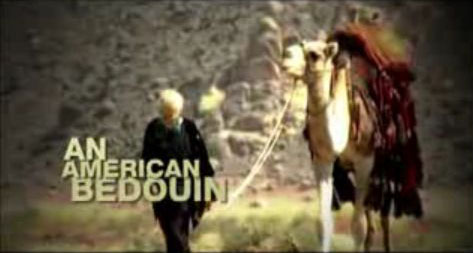
According to an excellent 2007 Aljazeera Feature video, Erga Rehns  has been living the life of a Bedouin in the desert with the Bedouin tribes of Wadi Rum  for seven years. I’m not sure if she still does though. I’ll have to do more research in order to contact her again. The last, (and first) time I saw her in person was in 1981, when we first met at her little art studio and home in Obidos, Portugal.

Some people are lucky enough to be a primed for a turning point in their young lives, and come across just the right person at the right time that poses questions, and challenges one’s view of the world – who plants the seed for a paradigm shift. Most people aren’t’ aware they’re ready for that change, until years later, when they realize the shift was primed by those mentors. (more…)

Inspirational People

20/06/2009

One Boy’s Passion for Wilderness Survival Skills

Marco & Jelena Wells

Marco & Jelena Wells

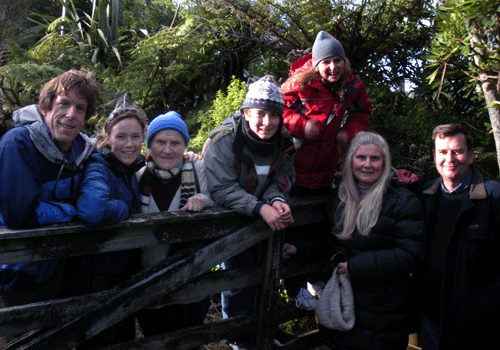
One never knows when an inspirational person will cross one’s path. Today, for me,  it came in the form of Marco Wells, all of 12 years, who visited us in Piha, with his sister Jelena, mother and father Tina and Steve and grandmother Helen from the former republic of Yugoslavia, (who recently attended our wedding a few weeks ago.) From the start, it’s a bit hard to determine who’s the biggest inspiration in this family, whether it’s Helen for starting her journey to New Zealand from eastern Europe years ago, or Marco’s dad who fosters his son’s love of the outdoors and wilderness survival. Then there’s his mother, who gets just as excited as her son, when we got the compass out and starting shooting bearings off the nearby peaks. It could also be his wonderful sister who’s eyes lit up during our day hike, when she looked over the edge of the windy cliff, which dropped a few hundred metres down to the Tasman sea. But this story leads me back to Marco.

A few weeks ago at our wedding, “Grandmother Helen” (we’ve also adopted her as our own), told us about her grandson who “is interested in the out-of-doors”.  Well, when I started talking to Marco today at our home, “interested” was an understatement. Marco is passionate about wilderness skills, wild edibles, feeling the wind, and even a bit of climbing and just being out there. He’s got it in his blood.

Today's Hiking Buddies

Today's Hiking Buddies

My wife and I later wondered aloud, after they had left back for the  Auckland area, what makes one boy passionate about the outdoors and the next, not. I was that boy which started with my romping and winter camping trips around the John F Gile Memorial Forest and Morgan Pond in New Hamsphire. Marco, his dad and I talked about “nature deficit disorder” and, stating the obvious, I mentioned the threat of video games, technology and kid’s lack of nature time.
(Image: L-R:Randy & Amanda Richards, Grandmother Helen, Marco, Yelena, Tina and Steven Wells)

Kare Kare Beach from our Hike Today

Kare Kare Beach from our Hike Today

Not Marco! He’s out back building different types of fires, constructing snares and assembling survival kits in a can. OK, I’m sure he puts his own time on the computer too, but he sure knows quite a few native plants and is working on lots of survival skills. On our walk today he was naming a number of plants and their their uses. He taught me a number of things today, but one stuck in my mind. When collecting and using silver ferns for a emergency shelter, be sure to turn the ferns belly up, otherwise, the tiny seeds, adhered to the bottom sides of the fern, will drop off on you during the night causing irritation and itching. He showed me the tiny seeds. Marco, just so you know, I’ll not forget that. (more…)

KareKare and Piha: Powerful Places

09/06/2009

The Power of Place – Two Black Sand Beaches near Auckland Exude Energy and Ayni*

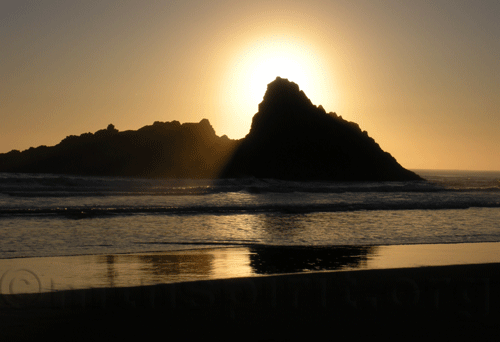
The Big Easy

The Big Easy

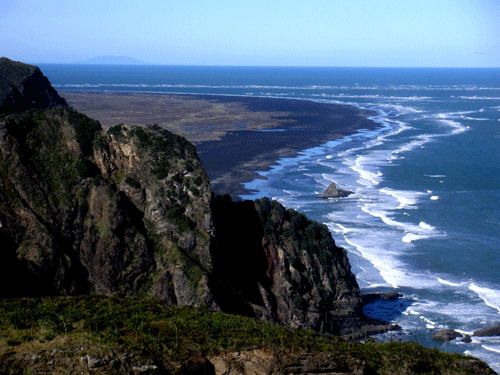
I went for a gander at KareKare beach near our base here in Piha Beach the other day. One reads about deserted beaches that run for miles, and I know I’ve only just gotten a taste of New Zealand’s remote beaches, but I have to write about this place. I’m just settling in to what less population density feels like.

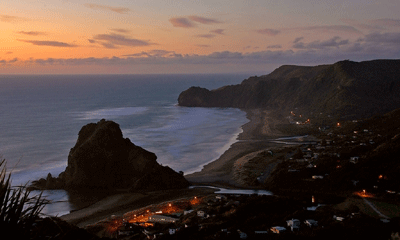
New Zealand  is a country of about 5 million, and Auckland, New Zealand’s largest city,  which is about 25km away, has a population of about 2 million.  By the looks of KareKare Beach, (or the beach village of Piha for that matter) you’d never know we’re near Auckland .   Both KareKare and Piha beach are little hideaways of spirit power spots. One feels the earth energy on the order of Sedona. The power of place exudes from both Piha and Kare Kare.

KareKare Powerspot

KareKare Powerspot

From studying geomancy ( the natural order and patterns of landscape and geography) and natural “Apus” or mountain spirits, my experience and feelings tell me this is one hot spot.  Both Piha and KareKare beaches exhibit rock peaks that protrude directly out of the beaches.

In Piha there exist dramatic caves at the beach’s north end. We got married in front of one last weekend which had two large caves ascending like hallways from the earth. The one on the right is 20-25 feet tall with floors of soft fine sand. The entrances of the two “hallways” are separated at the cliff’s face by a  high wall of about 5 meters wide by 8 meters high, which extends up to roof which forms an alcove.

Roughly in the center of this wall  is a block of lighter denser lava, which appears to have been formed by columnar jointing, but is a single large piece,  protruding out of the surrounding darker rock by 12 inches. It looks like a natural alter, at chest level, facing out to the Tasman Sea. The whole alcove sits about 6 meters above the beach below, and one ascends a huge pile of fine black sand, who’s top forms the uneven sandy floor of the alcove.

Piha Beach-Village

Piha Beach-Village

In Peruvian cosmology the Pacha Mama exhibits mountain or earth spirits in masculine or feminine. In the east, Yin signifies, female, yielding,  yang signifies  active, positive, male, strong. Piha is obviously a powerful place, not only because of its beauty, but  because of the balance in it’s natural layout, between the positive male peak and the female aspect, the caves, not more than a kilometer away.

KareKare Beach exudes power, and solitude.  The movie “The Piano” was made here. The wide black sand beach goes on for miles, with cliffs to the back, broad undulating dunes and a narrow little path from the hamlet of KareKare, which deposits you to the beach.

Mayor  Bob Harvey was asked on a NZ website about his relationship with this area. Says Harvey, “I’ve been the lifeguard here for 50 years. I think there’s a huge spiritual significance here that I reckon on this coastline from Karekare to Whatipu.”  He adds, “Something exists which I…. I can’t put my, my finger on it.”

Peace for two at KareKare

Peace for two at KareKare

The words “The Big Easy” keep coming to mind. I suppose, because it seems easy to be here, easy to reconnect with yourself and nature.  These words, in America have a different connotation –  of New Orleans and all the shenanagins that go with the annual Madigras celebration. But here in KareKare, they are the words  that seem to fit for me.  A place where you can unwind and connect. The place speaks to you. And you are rejuvenated.

*Ayni: A Quechua term meaning ‘reciprocity’ whereby one recieves power from the Apus, or mountain spirits, and one gives power back by offerings and meditation. Reciprocity is a concept that pervades the Quechua way of thinking, and of life  in the Andes.