Archive for the ‘Traveling’ Category

KareKare and Piha: Powerful Places

09/06/2009

The Power of Place – Two Black Sand Beaches near Auckland Exude Energy and Ayni*

The Big Easy

The Big Easy

I went for a gander at KareKare beach near our base here in Piha Beach the other day. One reads about deserted beaches that run for miles, and I know I’ve only just gotten a taste of New Zealand’s remote beaches, but I have to write about this place. I’m just settling in to what less population density feels like.

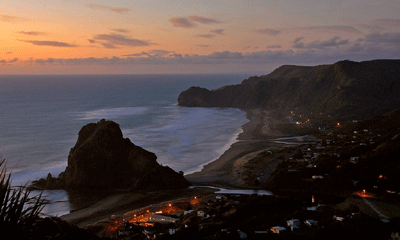
New Zealand  is a country of about 5 million, and Auckland, New Zealand’s largest city,  which is about 25km away, has a population of about 2 million.  By the looks of KareKare Beach, (or the beach village of Piha for that matter) you’d never know we’re near Auckland .   Both KareKare and Piha beach are little hideaways of spirit power spots. One feels the earth energy on the order of Sedona. The power of place exudes from both Piha and Kare Kare.
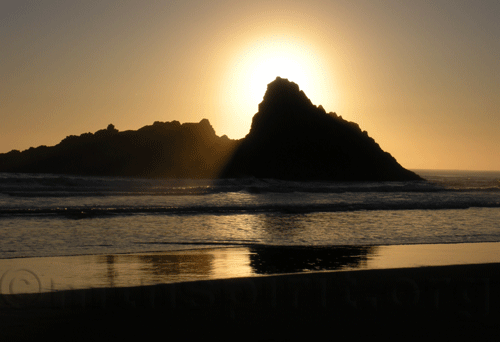
KareKare Powerspot

KareKare Powerspot

From studying geomancy ( the natural order and patterns of landscape and geography) and natural “Apus” or mountain spirits, my experience and feelings tell me this is one hot spot.  Both Piha and KareKare beaches exhibit rock peaks that protrude directly out of the beaches.

In Piha there exist dramatic caves at the beach’s north end. We got married in front of one last weekend which had two large caves ascending like hallways from the earth. The one on the right is 20-25 feet tall with floors of soft fine sand. The entrances of the two “hallways” are separated at the cliff’s face by a  high wall of about 5 meters wide by 8 meters high, which extends up to roof which forms an alcove.

Roughly in the center of this wall  is a block of lighter denser lava, which appears to have been formed by columnar jointing, but is a single large piece,  protruding out of the surrounding darker rock by 12 inches. It looks like a natural alter, at chest level, facing out to the Tasman Sea. The whole alcove sits about 6 meters above the beach below, and one ascends a huge pile of fine black sand, who’s top forms the uneven sandy floor of the alcove.
Piha Beach-Village

Piha Beach-Village

In Peruvian cosmology the Pacha Mama exhibits mountain or earth spirits in masculine or feminine. In the east, Yin signifies, female, yielding,  yang signifies  active, positive, male, strong. Piha is obviously a powerful place, not only because of its beauty, but  because of the balance in it’s natural layout, between the positive male peak and the female aspect, the caves, not more than a kilometer away.

KareKare Beach exudes power, and solitude.  The movie “The Piano” was made here. The wide black sand beach goes on for miles, with cliffs to the back, broad undulating dunes and a narrow little path from the hamlet of KareKare, which deposits you to the beach.

Mayor  Bob Harvey was asked on a NZ website about his relationship with this area. Says Harvey, “I’ve been the lifeguard here for 50 years. I think there’s a huge spiritual significance here that I reckon on this coastline from Karekare to Whatipu.”  He adds, “Something exists which I…. I can’t put my, my finger on it.”

Peace for two at KareKare

Peace for two at KareKare

The words “The Big Easy” keep coming to mind. I suppose, because it seems easy to be here, easy to reconnect with yourself and nature.  These words, in America have a different connotation –  of New Orleans and all the shenanagins that go with the annual Madigras celebration. But here in KareKare, they are the words  that seem to fit for me.  A place where you can unwind and connect. The place speaks to you. And you are rejuvenated.

*Ayni: A Quechua term meaning ‘reciprocity’ whereby one recieves power from the Apus, or mountain spirits, and one gives power back by offerings and meditation. Reciprocity is a concept that pervades the Quechua way of thinking, and of life  in the Andes.
Nose to Nose with Mr. Marmot

08/06/2009

An Unexpected Encounter While Bouldering in Lech, Austria

Marmot scrambling up a boulder

Marmot scrambling up a boulder

Bouldering on the Madloch trail just west of Lech Austria, I had quite a startling experience one afternoon.  I had walked up the summer  trail after working at Strolz Boots one day. During the winter,  this area high above Lech, sees skiers flying by after having taken the lifts up from Zurs.  They then ski around the backside of the Madloch mountain, and take the long trail headed for Lech. But this spring day was quiet, and no hikers in sight. I had found a nice slabby boulder to climb, with small nubbin holds, requiring delicate footwork. I monkeyed around on block for about a ten minutes near the bottom of the face. I decided to go for the top of the boulder, working delicately. The only activity was a small breeze which blew on the cloudless blue sky day.  I reached for the final moves on the boulders ridge line, and pulled up slowly.

Marmot's whistle at point-blank

Marmot's whistle at point-blank

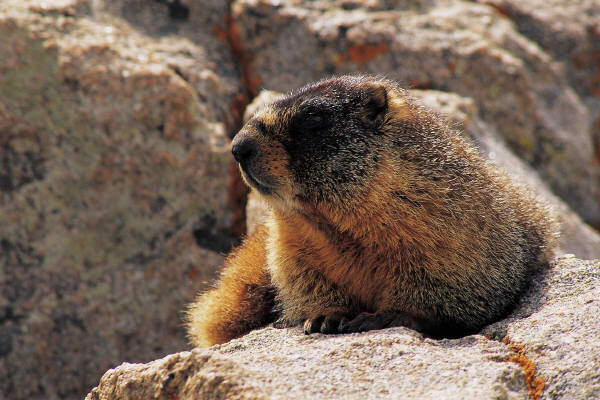
As my face cleared the boulder’s ridgetop, a marmot that had been climbing up the other side, also made his final move for the ridge from his side. We met  nose to nose. For a second, I stared at him, and he stared at me. Second number two- He let out his marmot’s alarm, a shrill whistle at point-blank range.  Without thinking I reached for my ears, covering them, which set me rolling back down the boulder. I assume the marmot didn’t stick around either, and ran back down his side. I saw, (more importantly heard) no sign of him.  I picked myself up, inspected my few minor bruises and continued on the trail for a great afternoon of being in the Austrian Arlberg’s Lechtal.  Aside from the ringing in the ears I had a nice scramble. But I’d had enough bouldering for the day.

Top 10 Travel Tips

06/06/2009
  1. Check the latest travel advice and subscribe to receive free e-mail notification each time the advice for your destination is updated.
  2. Take out appropriate travel insurance to cover hospital treatment, medical evacuation and any activities, like adventure sports, in which you plan to participate.
  3. Before traveling overseas register online or at the local embassy, high commission or consulate of your country, once you arrive so we can contact you in an emergency.
  4. Obey the law. Consular assistance cannot override local laws, even where local laws appear harsh or unjust by Australian standards.
  5. Check to see if you require visas for the country or countries you are visiting or transiting.  Be aware that a visa does not guarantee entry..
  6. Make copies of your passport details, insurance policy, travellers’ cheques, visas and credit card numbers. Carry one copy in a separate place to the originals and leave a copy with someone at home.
  7. Check with health professionals for information on recommended vaccinations or other precautions and find out about overseas laws on travelling with medicines
  8. Make sure your passport has a minimum six months validity. Carry additional copies of your passport photos in case you need a replacement while overseas.
  9. Leave a copy of your travel itinerary with someone at home and keep in regular contact with friends or relatives while overseas.
  10. Before departing your country check whether you’re regarded as a national of the country you intend to visit. Research whether holding dual nationality has any implications for your travel.

From SmartTraveler.gov.au

Sound Travel Tips

06/06/2009
Autralia's TravelSmart Program

Autralia's TravelSmart Program

If you’re looking for some of the most concise, easy to read travel tips and up-to-date travel advisories and advice read on. Included with my wife’s Aussie passport, is a travel brochure supplied by the Australian government. We all know Aussie’s and Kiwi’s are known for their Overseas Expeditions (OE) often lasting years. What better place to go for fine-tuned info. I picked up the brochure this morning, and scanned such titles as travel health,  insurances (exciting topic), reciprocal health care agreements, the law, and tips on each region.  A visit to their website shows the brochure (with assistance of Lonely Planet) in its entirety under different links for each topic on travel advisories and tips. It’s well organized and concise, from a country who’s citizens know travel.

Great Travel Blog in French

23/05/2009
Christophe Pelet, Blogger extrodinaire in NZ's S.Alps

Christophe Pelet, Blogger extrodinaire in NZ's S.Alps

Christophe Pelet from France, shares images and word of New Zealand with heart.

A fellow traveler and volunteer hut warden at *French Ridge, *Frenchman (*coincidence? Maybe not) Christophe Pelet has become a good friend of ours. In fact he’s been hanging here in Auckland before he heads back to France. He’s been traveling New Zealand since late 2008 and been writing a great blog. But it’s in French so you’ll have to sharpen your French reading skills. He’s one of the best photographers I’ve seen, the images he creates through the lens of his camera are stunning and moving.

Author's niece and nephew with Christophe Pelet

Author's niece and nephew with Christophe Pelet

So it’s worth a visit just for the photos. There’s tons of history and background on all sorts of New Zealand aspects, as well as good commentary on his *”Wwoof“ing experiences. *(World Wide Opportunities On Organic Farms)

See Christophe’s Blog where his most recent entry is called “The Top of New Zealand.

Travel Luggage – What’s best?

23/05/2009

Suitcase or Backpack? How about both – A hybrid

Heading to High Camp, Huascaran, Peru

Heading to High Camp, Huascaran, Peru

What you decide to take as your main travel luggage will depend mostly on what you’ll be doing. If you’re climbing Mt. Aconcogua or Mt. Huascaran Sur,  you’ll be needing a “mule bag” full of climbing gear plus an expedition pack, which I usually carry on my back and wheel the mule bag around.  If you’re vagabonding, with overnights in hostels or camping, a backpack is the way to go. If you’re doing a tour where you’ll  mostly be in hotels, a hybrid bag is great.

Travel as lightly as you feel you can,  My rule of thumb is lay out everything you think you want to bring and cut it by at least a third.

But you’ll need some trusty long underwear and possibly a down sweater or something like that if you’re headed to Lake Titicaca in July or August. The reason I mention this, before I answer the size of the luggage and type,  is…  The bulk of  what you may take could be the insulation for the chilly nights in Cusco and Lake Titicaca.

Luggage is a personal preference. I prefer a backpack just because I like the freedom of it, and I have traveled that way for years. (more…)

Reflections on Ice on Water

16/05/2009

From New Zealand to Utah, From Alaska to New Hampshire – Ice bergs to Honeycombs
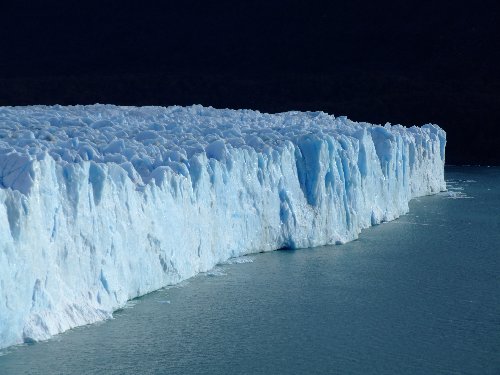
It’s called calving, when a glacier’s edge dramatically breaks off. Many cruise ships take the tour along Alaska’s shores. From Seward and other harbors along the coast, one can sign on for a daily round-trip  to get up close views.

Perito Mereno Glacier, Argentina

Perito Mereno Glacier, Argentina

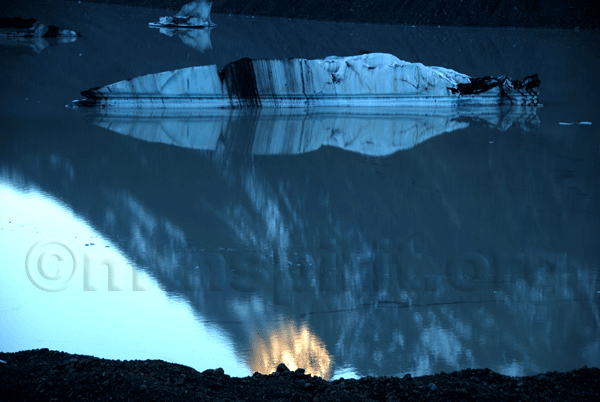
The dramatic Perito Mereno Glacier in Argentina’s Southern windswept Los Glaciares National Park has many visitors.and is possibly the most famous rivers of ice in the world because. It was declared a World Heritage site by UNESCO in 1981.  Amanda and I stopped at Tasman Lake in New Zealand’s Mt. Cook National Park to see the floating ice bergs in the grey-green water thick with rock flower. We hiked up to the top of an old terminal moraine and saw the bergs as the sun was setting.

White Pine Lake, Utah

White Pine Lake, Utah

More than a few times,  I’ve jumped into such frigid waters, after a run or back country mountain sleep, just to wake me up.  While at University of Utah,  when I was still learning about the mountains, I did an overnight up White Pine Canyon in the late fall and jumped into White Pine Lake near Snowbird. A few minutes later, it had a skim of ice on it. That’s chilly, but there were no icebergs or calving going on, just shivering.

Lake Tasman, Mt. Cook

Lake Tasman, Mt. Cook

The Tasman Glacier regularly claves ice bergs but the evening we were there it was calm and each iceberg gave us a show of *“petreflections” of various sizes and patterns.

When the ice goes out in Lake Sunapee, NH, the reader may be curious to know that there usually aren’t big ice bergs.  Then again, I didn’t grow up on the  west side of the lake, where the whole lot piles up on a windy afternoon leaving dramatic piles of ice, as if the town dump truck and just deposited its backlog for the winter.  On the east side of the lake, we observe the ice gradually thinning from the spring melt, and as it thins, darkens to almost a black. It turn into “honeycomb ice” we call it, where its transformed from the meter-thick solid sheet that runs the whole lake, to fragile, loosely held together elongated splinters that fall apart when scooped up in your hand.  Those of us that grew us as kids along the shore of a lake will know what I mean. Daily we watch the progression.

Petroflections Galore

*Petreflections Galore

Official Ice Out day is declared when Artie Osborne can take his boat from the north tip at George’s Mills to Newbury, some 10-13 miles distant without obstruction.  To my knowledge, he still makes the trip, and in the process, closes the informal town bets for the season.  Go swim in an ice-berg filled lake sometime. It’s the right thing to do.
Author’s Note: Also see my earlier entry on largest iceberg breaks off of Tasman Glacier in 100 years.
*Petreflections: A term coined by Kathy Lowe. See her link above.

Traveling Safely in Peruvian Cities

15/05/2009

Traveling in Lima and other Peruvian Cities

Friendly Lima, Peru

Friendly Lima, Peru

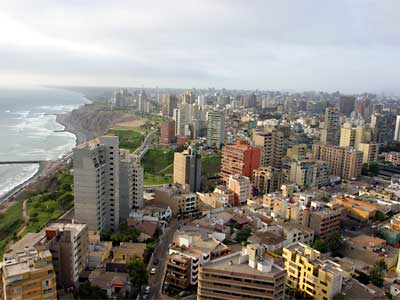
The below commentaries come from entries on virtualtourist.com, which I thought was useful information that mirrors my own perspective of traveling in Lima. I remember my boss, Willie Prittie of Alpine Ascents International cursing Lima for the time he lost a bags of climbing gear at the Airport, when it was stolen from him.  From his horror story, I came to Peru armed to the hilt with mace, chicken wire around my backpack and yes, even a machete. I was traveling south on the Pan American Highway and was still a little uneducated about travel in South America. Within minutes of entering Peru, and catching a ride I realized I could throw away all the armaments. I’ve been in love with Peru ever since.
Hints on Traveling in Lima
Of course, no crime is petty when it happens to you, so take precautions against (more…)

Family Cari on Amantani Island, Peru

15/05/2009

MSI and Family Cari
A Son Helps Build a Family Lodge on a Remote Island

There are times in my life when I’ve  returned to a wonderful place in the world that I’m still getting to know, and by chance, I’ve end up camping in the same field or returning to the same hostel. Only when I  walked into the place, do I remember having stayed there before.

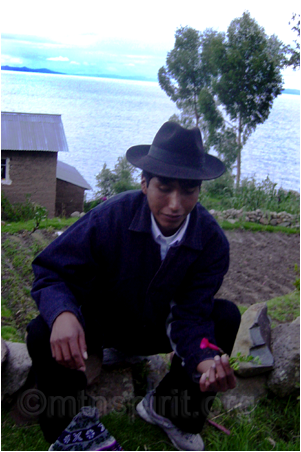
Richard Cari with a Kantuta, National Flower of Peru

Richard Cari with a Kantuta, National Flower of Peru

Richard Cari’s home and the Kantuta Lodge is one of those places. Since I’m on the subject of “chance travel”, the reader might be interested my entry on a similar instance where I was hitch hiking across France and ended up sleeping in the same field I had slept in 15 years prior. But for now, more on Amantani Island on Lake Titicaca.

I’d come to Amantani Island a few times during my travels in Peru. The place and people drew me in. No cars, electricity only a few hours a day, not even cats or dogs, which made the place seem  peaceful. There is hardship on Amantani. The small population living on the 3 mile by 1.5 mile island on Lake Titicaca live at 13000 feet in stunning but somewhat harsh environment. There sustainable crops of Quinoa, potatoes and herbs are rain dependent. There is no irrigation of the crops. People do go hungry, despite the tourism dollars that trickle in from visitors taking boats from the nearby (4 hours!) harbor or Puno, Peru.  Most visitors stay at family homes on the island’s west side, who have formed a cooperative rotating schedule that spreads the wealth and visitor’s dollars so no one family is reaping the homestays.

At Outward Bound we learned as instructors the metaphors of community, and here on Amantani, the population, because of its environment is a clear example of community. The island people work together with the resources they have to create the best possible outcome for all.

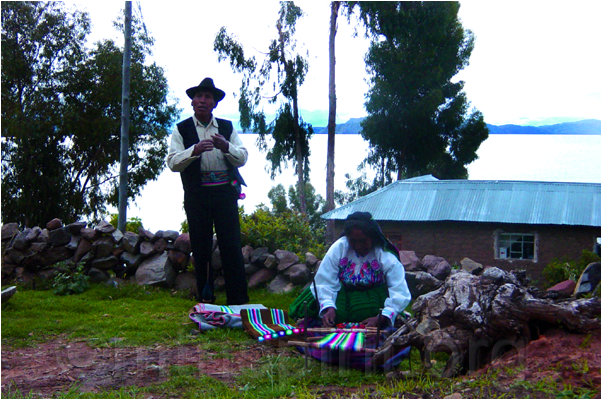
Segundino & Marcelina Cari of Amantani Island

Segundino & Marcelina Cari of Amantani Island

Segundino, the island’s vice-Shaman, if you will,  and his wife Marcelina have what was once a small home like the other villagers near the boat docks. But their son Richard went to University in Puno and majored in Tourism. He has come back with a plethora of “tools” and ideas he learned at school, that have transformed their home into the Kantuta Lodge, complete a separate building dining room, with longer beds for Gringos and Gringas and the only hot shower on the island.

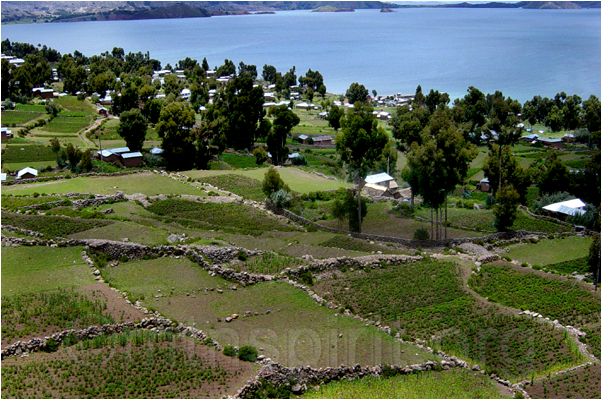
Amantani Island, Lake Titicaca

Amantani Island, Lake Titicaca

Richard has done a spectacular job with his new skills making a better life for his family. He is creating a market. I told him I would submit the family lodge Lonely Planet, and even though I’ve not followed through I suspect the word has already gotten out about his good work.

The last time I visited Family Cari, I enjoyed the stay thoroughly. I got to help Richard’s sister Wilma do some cooking and plant potatoes by digging trenches in the garden below the house. I didn’t do very well by the way. Wilma, showing me the digging technique with a short handled hoe, giggled as I’d dig for a few feet before feeling breathless from the altitude. Her mother and father looked on from the house with a wry smile. (more…)

Hitchhiking Near Paris, x2

14/05/2009

Chance Encounters with Campsites

The most likely scene of the tresspass

The most likely scene of the tresspass

I was hitching through France on my way to Brittany from Chamonix. I vaguely remembered being in a similar situation before as the day progressed.  My ride was approaching the southern outskirts of Paris, and I had to make a decision on where to get dropped off. It was getting late in the afternoon, I had a sleeping bag and a bivy sack, and decided to get out at the next major motorway intersection near Paris. Maybe I’d find a youth hostel, or even a field to throw my sleeping bag on. When we arrived at the interchange, it was a busy place, but it looked a good spot from which to start hitching in the morning for Western France. After hopping the guardrail, I found a an unused grassy path that took off from the motorway, that led to a small field. (more…)