By Peter Williams
It took everyone by surprise. I only got wind of this when I saw the Taxpayers’ Union media release (I’ve copied it to the end of this email) at lunchtime today. My heart sank.
I appreciate that reasonable minds can differ on the urgency of climate change – but I think you’ll agree that sacrificing New Zealand’s economy for no material effect in emissions is the ultimate own goal.
In short the Government has just locked in the Ardern/Shaw anti-farming legacy, and signed New Zealand up for a brand new (2035) commitment that will see thousands of dollars for every man, woman, and child sent overseas for climate credits.
First some background.
You will recall that back in 2021, former Climate Change Minister James Shaw and then Prime Minister Jacinda Ardern flew to Glasgow and signed New Zealand up to a climate change/emissions target of a net reduction in emissions of 50 percent (compared to 2005) by 2030.
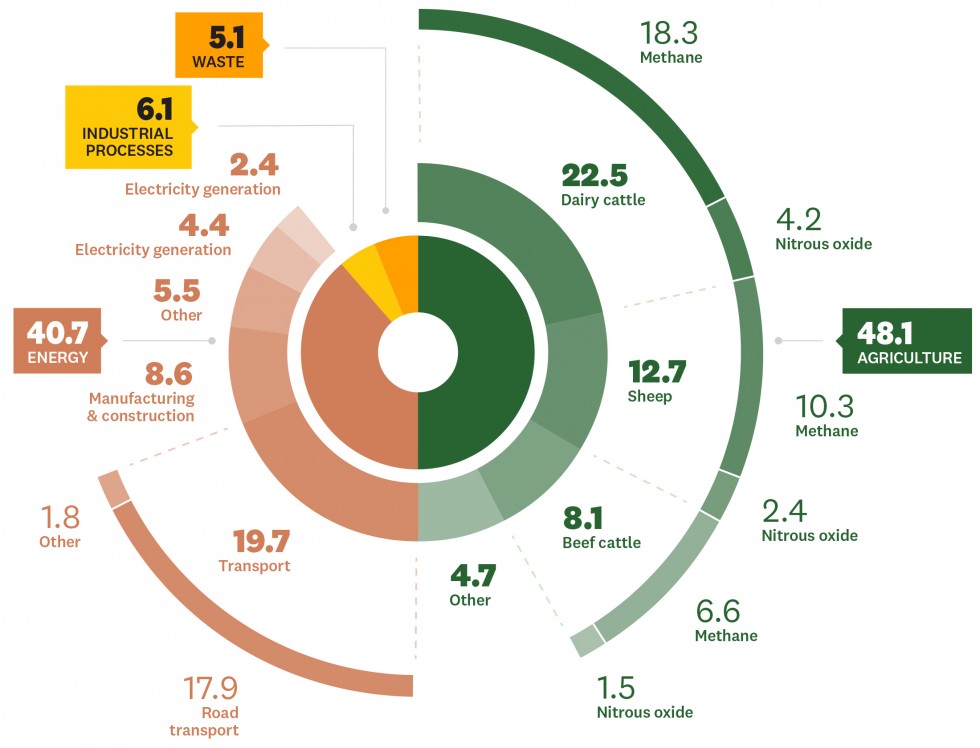
At the time, no meaningful economic analysis, public consultation, or debate occurred. In fact, the Ministry of Business Innovation and Employment voiced their concerns saying “we are concerned that insufficient analysis has been undertaken to understand the fiscal and social impacts” of a 45 percent reduction target, let alone the 50 percent that Ardern and Shaw secretly agreed…
The politicians just took this decision because, in their gut, they just felt it was the right thing to do.
And what caused particular angst, was that the targets NZ signed up to include agricultural emissions (i.e. methane, or cow farts). Short of culling cows (and tanking New Zealand’s largest export industry), those emissions are impossible to avoid.
No other developed country faces the same problem. Because of our small population and disproportionate reliance on agriculture, New Zealand’s emissions makeup is more akin to a developing country, which, under the UN Paris Agreement, doesn’t have to cut emissions in the same way as we have signed up to.
Even if we could cut agricultural emissions, it would be pointless in terms of improving global warming: New Zealand’s agricultural sector is the most emissions-efficient in the world. Any calories/meat/milk-powder New Zealand doesn’t produce will be done elsewhere, and likely result in an overall increase in emissions.
These were the points made by the ‘groundswell’ farming protests, Federated Farmers, and even the National Party when they were in opposition!
To put the 50 percent net reduction target into perspective, half of New Zealand’s emissions relate to agriculture!
So that leaves non-agricultural emissions.
Thanks to Covid, in 2020 New Zealand shut down most of the economy to lockdown for months. Despite the Covid shutdown, official data† shows that emissions declined by only three percent that year!
So the idea New Zealand can or will get to a 50 percent reduction by 2030 is absolutely fanciful. To hit the 2030 target emissions would have to fall by five percent per year!
How much is the 2030 target going to cost households?
There are lots of variables that go into forecasting where New Zealand’s emissions are going to be in five year’s time (e.g. the strength of the economy, how many trees are planted, whether we get wet winters and hydro lakes get rain etc).
But what Ardern/Shaw signed us up for means that missing the target (and there is absolutely no doubt we will miss it) determines how much New Zealand is going to have to cough up and pay for international emission units.
Last year Treasury worked out what New Zealand is on the hook for. Are you sitting down?
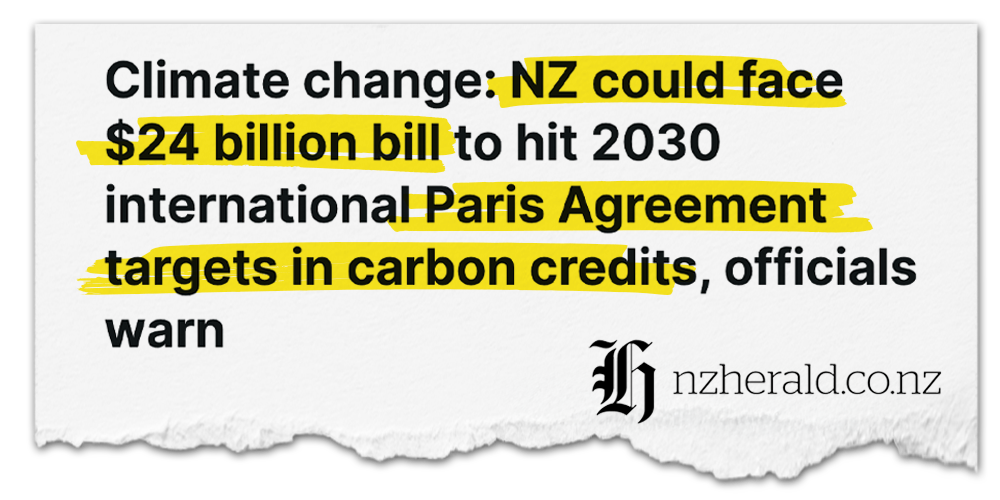
Up to $24 billion is the latest official estimate for the 2030 deadline.
To put that into perspective, $24 billion is more than the current cost of NZ Super. $12,000 per household!
And that’s not even counting the cost of lost economic growth, higher energy costs, and lost exports.
I know these numbers are unbelievable, and it’s been something the Taxpayers’ Union has been struggling to put into perspective and to communicate how on Earth to raise the alarm about the seriousness of what New Zealand faces. It’s a dozen Dunedin Hospitals. Or 34 times larger than the total new spending allowance Nicola Willis has set for this year’s Government budget.
Because the payment isn’t due until 2030, it’s just outside the Treasury’s “forecast horizon” so doesn’t yet appear on any of the Government’s fiscals.
I don’t think it’s an exaggeration to say that it’s Ardern and Shaw’s ticking time fiscal time bomb.
Late last night, Climate Change Minister Simon Watts announced that he is committing New Zealand to even harder targets for 2035!
Simon Watts is set to sign NZ up for a second eye-watering bill for 2035.
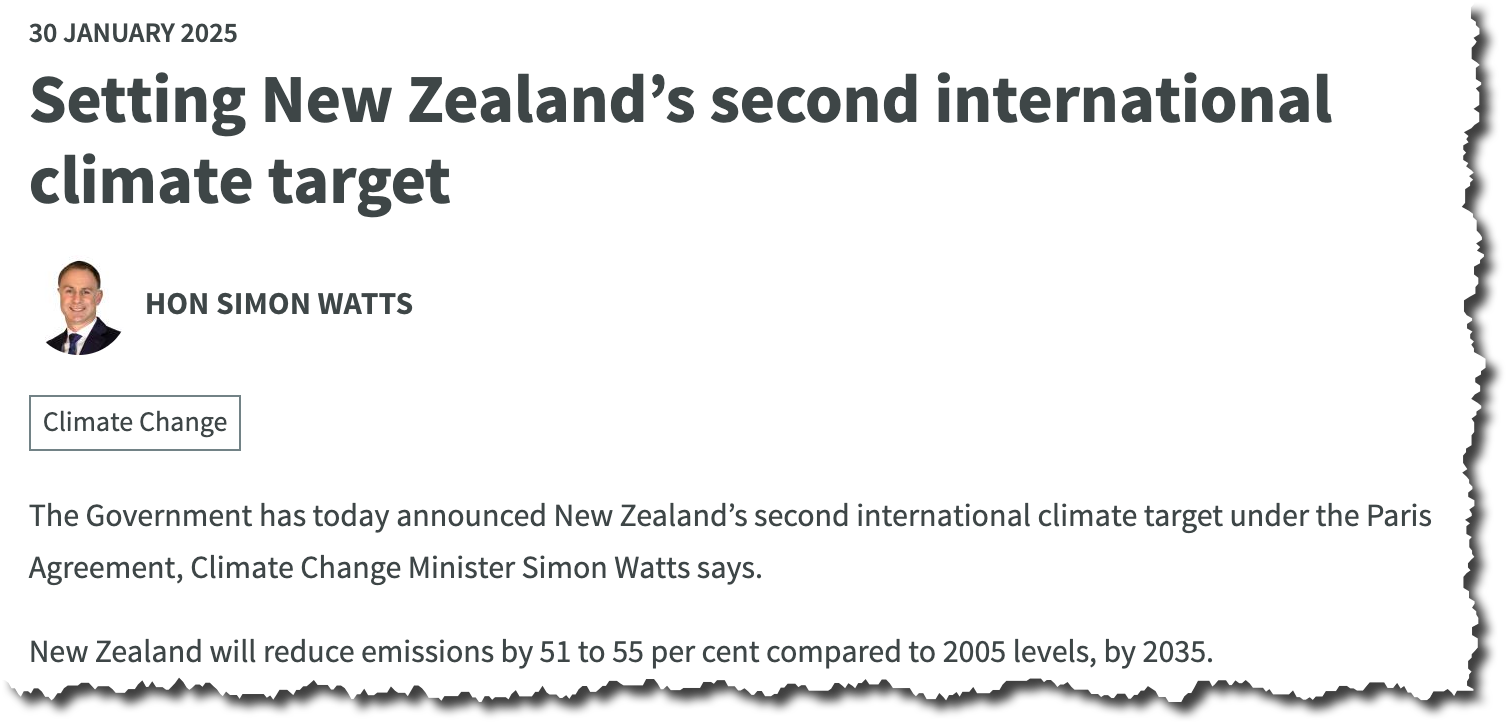
Once signed-up, it means New Zealand will have to pay a second time for a target that Christopher Luxon / the National Party have previously said is totally achievable!
It’s bad enough that New Zealand is hopelessly off track when it comes to meeting the existing 2030 target, and the $24 billion bill left by Ardern and Shaw, but to do it all over again is nothing short of economic sabotage.
Why haven’t the media covered this?
The media are in dire straits. Newsrooms are a fraction of the size they used to be, and those who are left are probably so young they either don’t understand the economics or are so committed to extreme views of ‘climate change mitigation at any cost’ that they just don’t care.
And, I’m sorry to be so blunt, but the only reason Simon Watts’ office would wait until 8:30pm on a Thursday night is so that the morning radio shows are already planned and there won’t be ‘breaking news’ style coverage.
It speaks volumes that Watts waited until after Parliament rose for the week, and with Parliament in recess next week, by the time political journos get back to work, the news will have moved on.
As far as I can see, with the exception of the Taxpayers’ Union, Federated Farmers, and other watchdog and industry groups, this announcement has been totally missed!
If there is any chance for the economy to get back on track, we must ensure Christopher Luxon, Winston Peters, and David Seymour, overrule Simon Watts and set a realistic target.
Will you join me in emailing the Coalition’s Party Leaders?
While the USA has pulled out, and other countries hedge their bets, why is Luxon’s Government doubling down?
Last week, the US pulled out of the Paris Agreement, and with the UK’s ‘net zero’ intentions in question (their Labour Government is ‘going for growth’ too!), it makes no sense for the New Zealand government to sign up for a second round of ‘ambitious’, sorry, ‘impossible’ targets if they are serious about growing the economy.
Simon Watts has got this one wrong. Introducing more ambitious targets to smash the economy harpoons Christopher Luxon’s attempts to ‘Go for Growth’. Take 30 seconds to tell the Government that.
But something needs to be done about climate change, right?
New Zealand is already one of the most emissions-efficient countries in the world. More than 80 percent of our electricity comes from renewable sources. Our farmers are the most emissions-efficient at what they do. We already have an emissions trading scheme that covers more greenhouse gas emissions than any other country in the world. Of course, we need to keep up the momentum, but it’s not right to say we’re not already ‘doing our bit’.
Paying the rest of the world billions of dollars serves to make New Zealand poor – it doesn’t serve to solve global warming when the US, China, and Russia are not part of the same agreement/commitment.
Christopher Luxon gets this – well he did when he was Opposition Leader anyway.
The $24 billion dollar cheque could buy 12 Dunedin Hospitals. It could build 16 Transmission Gully Motorways. It could build 40,000 new school classrooms. It could even be used to fund more in-country climate initiatives!
Simon Watts just turned the $24 billion liability into a potential $48 billion liability. It’s economic sabotage on a grand scale. We need to stop him.
In a country cancelling infrastructure, health, and education investment due to the fiscal crisis can we really afford to burn billions on an unobtainable climate target?
Make no mistake, I want Christopher Luxon and his Government to succeed and deliver for New Zealand. I know the Taxpayers’ Union are committed to sensible climate change mitigation policy. But if last night’s decision stands, Mr Luxon (and the country) is destined to fail. We can’t let that happen.
Email the Prime Minsiter and Party Leaders
This is the media release the Taxpayers’ Union sent out reacting to Watts’ late night announcement:
MEDIA RELEASE
SIMON WATTS JUST HARPOONED THE PRIME MINISTER’S ‘GOING FOR GROWTH’ PLAN
FOR IMMEDIATE RELEASE
At 8pm last night – timed, presumably, to avoid pick up on the morning news shows – Climate Change Minister Simon Watts released New Zealand’s 2035 Nationally Determined Contribution to combatting climate change under the Paris Agreement.
The target, which locks unavoidable agricultural emissions into New Zealand’s international targets, are even more ‘ambitious’ than the 2030 targets made when Jacinda Ardern/James Shaw flew to Glasgow. They will cost future taxpayers literally tens of billions of dollars in penalties.
Taxpayers’ Union Executive Director, Jordan Williams, said “Ardern’s 50% emissions reduction by 2030 target was ludicrous. Treasury estimates that in just five years taxpayers will be on the hook for up to $24 billion – that’s $12,000 per New Zealand household. The Government has now signed us up for another bill for five years later.”
“To not only lock this cost in, but go even harder for 2035 is economic sabotage. Watts and his Cabinet colleagues are not going to be around in a decade to have to pay the bill, but are doubling down on Paris at the very time our trading partners are pulling back.”
“Half of New Zealand’s emissions are agricultural. To achieve the 51-55% reduction Simon Watts has put NZ on the hook for would mean we either must shut down parts of our agricultural sector, or just about everything else. To say this is fantasy does Mickey Mouse a disservice.”
“The only way New Zealand avoids paying tens of billions in international carbon credits is if every square inch of Otago and Southland is planted in pine. But even the Government’s own experts advise that pathway is not credible.”
“So this decision will see New Zealanders having to stump up billions more to buy international credits in a decade’s time.”
“The Taxpayers’ Union has long supported sensible emissions reductions using our world leading Emissions Trading Scheme. But such a scheme can only operate with realistic targets and collective international action. Sacrificing our economic prosperity at the altar of good intentions when other countries are pulling back is nothing short of economic sabotage.”
“Minister Todd McClay was on radio this morning talking about how the Government want to ‘power up’ agricultural exports. He’s sure in for a shock.”
“Meanwhile, Simon Watts has just harpooned the Prime Minister’s ‘Going for Growth’ plan. Mr Luxon, Mr Peters, and Mr Seymour need to step in and overrule this decision.”
ENDS
 snapped this shot of my son and couple of our guests cradling one of our chickens in the nearby hammock. The hammock happens to be next to the “chicken tractor” (movable chicken house) so at the moment so makes for fun relaxing hangout with chickens all underfoot. The guests loved the chickens and were were visiting with them every spare moment. Connecting with nature is vital for children, whether it’s going for a walk in the woods, on a mountain ridge, taking them sailing or just spending time helping them collect the chickens’ eggs. A good book about children and nature, mentioned quite a few times in this blog is







 Mountain Spirit's Blog