Archive for the ‘Environment’ Category
30/03/2009
Sunapee, New Hampshire, (US), is creating a day dedicated to cleaning up, and education. The mission of the group creating this day, ” is to start a new Sunapee tradition; a town-wide road side clean-up day that fosters community spirit & volunteerism; educates about littering & recycling; and is fun for all”. If you’d like more information on the Green-up Day, head to their website.
Community members present at the first meeting were Tony Bergeron, Rhonda Gurney, Kathy & Steve Gray, Heather Cantagollo, Patricia Halpin, Charlotte Brown, RoseMarie Batto, Scott Blewitt, Diana Wyman, Donna Gazelle, Ron Verblauw, Ellie Goddard, Meagan Reed, Barbara Cooper, Denise & Monica Preston, Greg & Kathy Meyer, David Rowell, and Barbara Chalmers. There seems to be good support by the numbers of people who attended this meeting.
Mountain Spirit and its board members are excited about this new development in Sunapee, and will support this event in some form.
Many thanks to the community members listed above.
Tags:Green-up Day, Mountain Spirit, NH, Sunapee, Sustainability
Posted in Climate Change, Environment, Sustainable Living/Communities | Leave a Comment »
24/03/2009
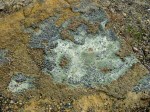
The Earth's Mantle, The Crash Site! Cool
What you’re looking, at the image on the right, is not just a rock in Newfoundland. It tells quite a story. Uplifting of an ancient sea bed some 470 million years ago unveiled the underlying mantle of the earth. As one of the only places in the world where it’s possible to see the earth’s mantle, Newfoundland is of interest to scientists and geologists like.
Although I took this picture on a mountain, it’s a snapshot of an ancient Atlantic sea bed, that was flipped up, way up, as it smashed into the North American plate. Ykes. And here I was standing at the scene of the crime, the collision of two continents!
Newfoundland is one of those out-of-the-way places.
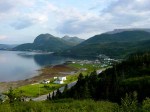
Glenburnie-Birchy Head Shoal area, Newfoundland
You have to want to get there. You have to make a special effort. It’s not part of the eastern megalopolis- small towns, quite roads, out there. It’s like New Hampshire used to be in the ‘50’s-safe, trusting and amicable. Not wired. I was there a few years ago, on a whim. I’d just finished an Outward Bound Professional staff training in Northern Maine and decided to take a trip. I made the decision at 5PM and started driving at 5:15, headed from Old Town, Maine for New Brunswick. I had my sleeping bag, but no stove, no tent, but a toothbrush. My friend and I had a van, but no mosquito netting, which proved problematic. We picked up on old reliable Coleman stove at a second hand store, and were in business.

When Plates Collide
Newfoundland has been the scene of a geological flashpoint. There’s a roadside pullout, with a beautiful half hour walk. At the pullout are some informational plaques explaining that the location was a meeting point where the Atlantic and North American plates met millions of years ago. As I stared at the surface of the inlay, I imagined it as soft muck on the ocean floor. I felt like a geological time explorer.
(more…)
Posted in Environment, Power of Place, Traveling | 2 Comments »
18/03/2009
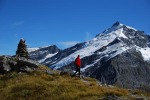
The View from French Ridge Hut
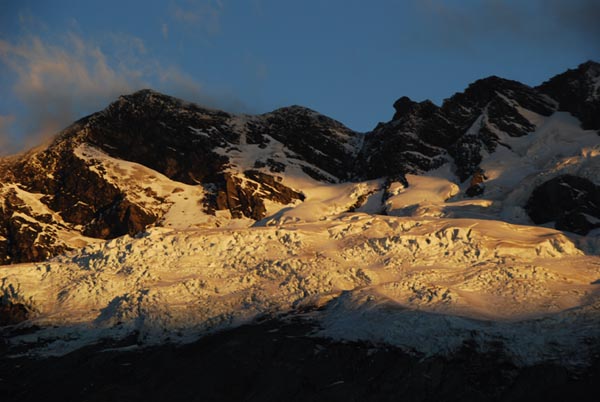
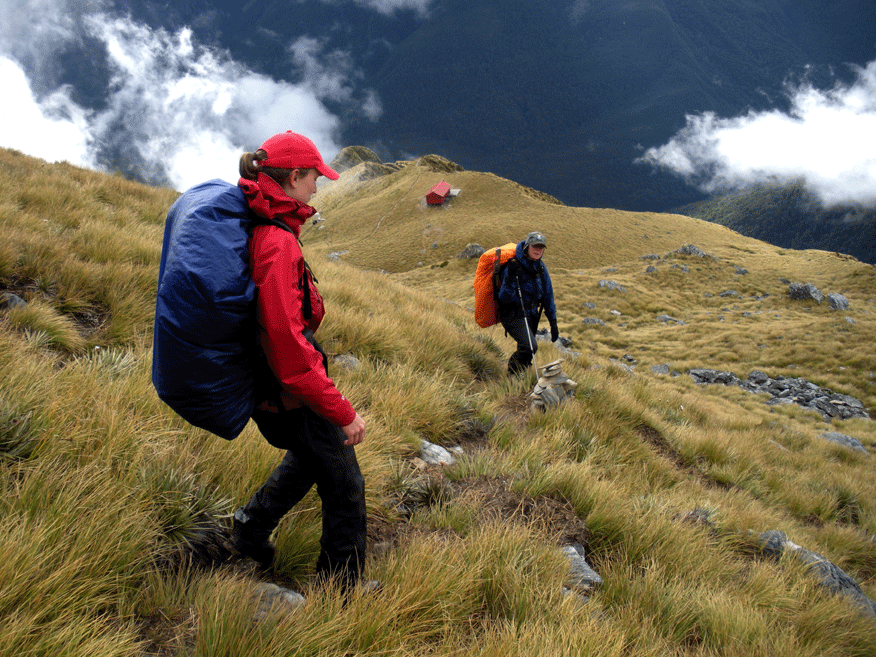
I recently had the opportunity to volunteer at French Ridge Hut last week. We had an unusual clear spell of almost cloudless blue skies, day after day. More times than not, the wind can howl on this ridge, making it difficult to make the journey to the privy, perched on the ridge, (so helicopters can more easily pick up the poop canisters).
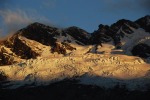
Near Mt. Avalanche-Gloomy Gorge
I recently heard of one fellow who was sent to his death when the hut he was in, was blown off the mountain. I’m sure some of the readers have been on a fire lookout tower in high winds, having complete trust in the structure. Hmmm. Makes one think. Be sure to inquire or check to see if the hut you’re in has tie-down cables. French Ridge does not. I trust the architect, up to a point. It depends on how strong are the gale force winds. This is a bit tongue in cheek, or ice axe in ground.
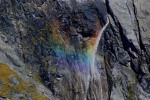
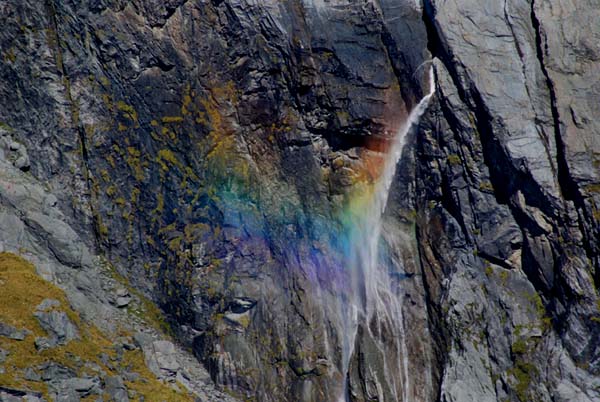
Waterfall Rainbow, Gloomy Gorge
French Ridge and the environs is a magical place. It’s getting a lot of traffic from hikers as well as climbers. I was there later in the season, (just last week), when traffic to and from the Collin Todd Hut, and Mt. Aspiring had been halted due to the Quarterdeck section of glacier coming down from the Bonar Glacier was breaking up too badly to allow passage.

Monkeying around on the "Quarter Deck"
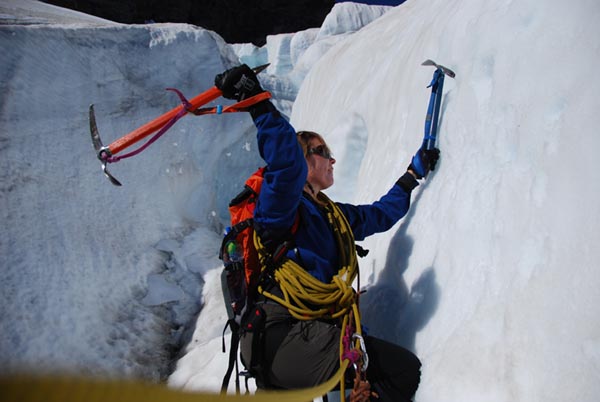
We decided to monkey around on the lower ramparts of the Quarterdeck anyway, for a day of walking, crevasse rescue and rope team travel practice, and a little bit of climbing in some dramatic scenery. While we were rather restricted in where we could actually go, we still had fun. The dry glacier provided some great ice climbing practice. I love glacier ice, which is a far cry from New
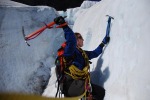
More playing around on some "safe" broken up bits.
Hampshire’s Frankenstein Cliff’s. I’ve just read a piece on climbing on the Fox Glacier that has me interested in doing some glacial ice there.
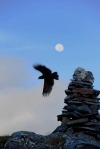
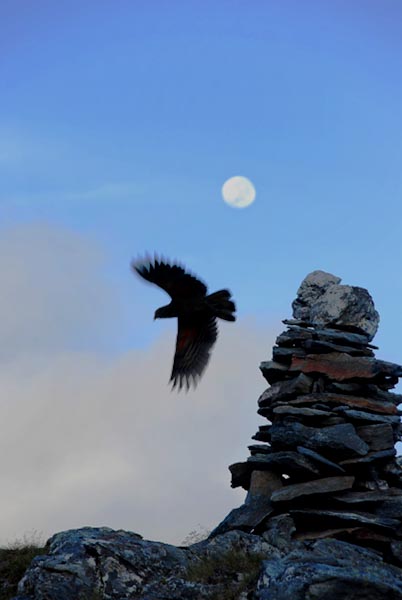
Kea in Flight
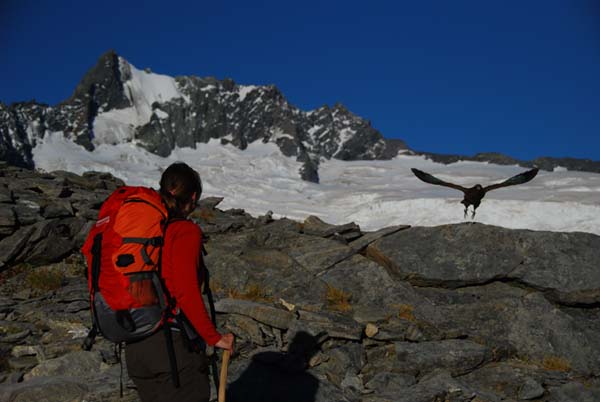
At the hut and just above, Keas, which are amazing Alpine parrots, seemed our constant companions. I figuring out when they would take off, and got some snaps of them in flight. One, at the hut, the other with Mt. Avalanche in the background just above the hut. They are very personable and curious creatures, if not troublesome. When we arrived at the hut on Day 1, the door to the was open, and the keas had made themselves at home, leaving the place a mess.
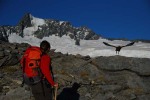
Kea, Amanda, Mt Avalanche
Just across from the Hut, on the ramparts of Rob Roy, is an impressive waterfall. It’s interesting and beautiful because the water comes piling down and hits a flat plateau, shooting the water out into space, like a jet stream. Then when the sun is hitting the wall just right, a rainbow is formed.
Tags:adventure travel, Alpine Parrot, Brenda Dowst, Dexter R. Richards, ecospiritual psychology, Experiential Education, French Ridge, Glacier Travel, Gloomy Gorge, Holistic Living, Ice Climbing, Kea, Mountain Spirit, Mountaineering, Mt. Aspiring, mtnspirit.org, New Hampshire, New Zealand, Quarter Deck, Randy Richards, Spiritual, Sunapee, Sustainability
Posted in Climb/Ski/Mntneering, Environment, Glaciology, MSI News, New Zealand, Power of Place, Traveling | Leave a Comment »
18/03/2009
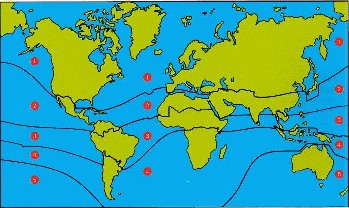
I have taught map & compass for over 25 years, and never really knew there were different magnetic zones. If I were a round-the-world sailor I suppose I’d know that, but guiding in South America I only learned there were northern and southern hemisphere compasses. Not until I stumbled upon an article in New Zealand’s Wilderness Magazine (February 2009) on compasses, did I start to understand a bit more.
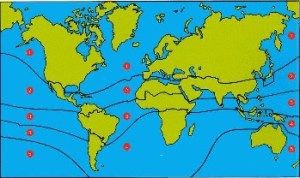
World Compass Zones
The article stated “Compasses are made to suit different geopgraphical zones. NZ and Australia fall into zone 5, the US in zone 1. If the wrong compass is used in any one zone, it can cause the needle to tip and drag on the base plate making for inaccurate or impossible readings. Global models that allow for these variances are available.
I read this after I had purchased what I thought was “southern hemisphere compass”. I returned the compass with article in hand and asked the store clerk if he was familiar with this. No. So we looked it up on the internet there in the store and found the following… (more…)
Posted in Climb/Ski/Mntneering, Environment | 1 Comment »
26/02/2009

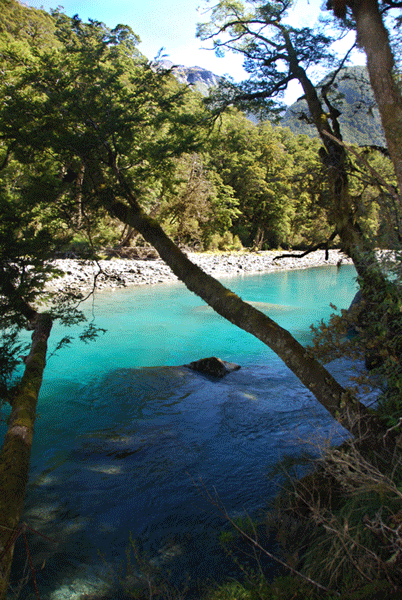
Wilken River, Makarora BC, NZ
Kerin Folks Flat on the Wilkin River is about an hour into an eight-hour trek to the Top Forks Hut area. I’ll include more images of that area soon, but felt I had to post this image ASAP. “Rock flour” colours the water the brilliant turquoise blue that is visible in this image. Rock flour is a result of the glacier a few miles upriver, dragging and grinding rocks and stones between the bottom of the glacier and the ground. The curious color of the fine powder that comes out of the glacier’s terminus is the subject of many a tourist’s query. So I’ve been told, rock flour is simply mud that hasn’t been exposed to the air. Once exposed, after a number of years, it turns brown. In any event it sure makes for good images. This is probably one of my favorite, even after being a professional photographer for a number of years.
Top Forks is a remote part of Aspiring National Park, right in the center of the park, accessible from the Makarora West village area. The highlight of the Top Forks valley is Mt. Castor and Mt. Pollux from which hanging glaciers drop house-sized ice blocks throughout the day and night, making a roaring sound heard from the hut.
Tags:adventure travel, Bob Stremba, Brenda Dowst, Cindy Heath, Dexter R. Richards, ecospiritual psychology, Experiential Education, Glaciology, Kerin Forks Hut, Makarora, Mountain Spirit, Mountaineering, mtnspirit.org, New Zealand, Peru, Rock Flour, Spiritual, Sunapee, Sustainability, Top Forks Hut, Wilkin River
Posted in Environment, Glaciology, New Zealand | 5 Comments »
24/02/2009

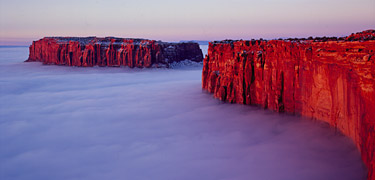
Looking W on Island in the Sky, Utah
Although I was graduated from the University of Utah, and spent as much time in Utah, as in any other state, I had never been to CanyonlandsNational Park. I recently had the opportunity to kill some time while in Salt Lake waiting for a car repair, and decided to spend a few days and nights in the desert near Moab. My first stop was the Island in Sky. I spent a day exploring the plateau, taking pics, and scrambling among the sandstone outcrops. I miss the Utah desert, although New Zealand is hard to beat.
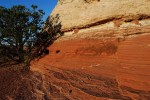
Navajo Sandstone: Canyonlands, Utah
As an aside, I was driving here in New Zealand from Christchurch to Wanaka, and passed through canyon that reminds me of American Fork Canyon in Utah. Anyway, after a couple of days on the Island, I did some work in Moab on MSI’s portable office, (the laptop) then moved on to the Needles area in the southern portion of the park. Here one can day hike or spend the night in the backcountry, and even drive around the park, although the latter is not high on my list. Along those lines, read Edward Abbey’s The Monkeywrench Gang, or Desert Solitaire on brilliant views about America’s relationship to wilderness. Oddly, I’m not sure his books have made it here downunder. I’ll keep you posted.

Island in the Sky, Image:Steve Mulligan/USPS
The Utah desert has a power all its own. So, if you’ve not been I suggest you get there before you die. Put it on your bucket list. For more information on the MSI’s Utah Solo and Wilderness programs, please contact us. The US Park Service has some great resources for Canyonlands
Tags:adventure travel, Bob Stremba, Brenda Dowst, Canyonlands, Cindy Heath, Craig Cimmons, Dexter R. Richards, ecospiritual psychology, Edward Abbey, Experiential Education, Holistic Living, Mountain Spirit, Mountaineering, mtnspirit.org, New Hampshire, Peru, Power of Place, Randy Richards, Solo, Spiritual, Sunapee, Sustainability, Utah, Vision Quests, Wilderness Programs
Posted in Environment, Inner Work, Power of Place, Spiritual, Traveling | Leave a Comment »
23/02/2009
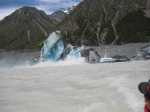
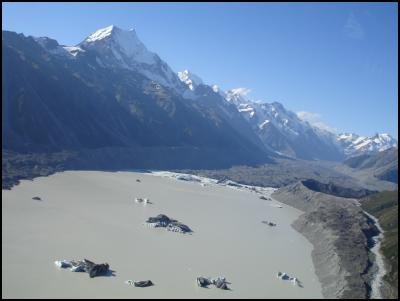
Glacier Calving, NZ
Largest iceberg ‘calved’ in 25 years from Tasman Glacier Terminal Face, Mt. Cook, New Zealand
A three meter tidal wave surging down Aoraki Mount Cook’s Terminal Lake was the first indicator of the largest single iceberg in 25 years calving directly from the Tasman Glacier terminal face yesterday (10 February). The giant slab of ice or ‘calf’, estimated to be 250m long by 250m wide by 80m high, plunged into the Terminal Lake in the early afternoon, the most significant single calving in the lake’s 25-year existence. A second iceberg about quarter of the size calved from the face shortly afterwards.
Glacier Explorers Operations Manager Bede Ward, whose company takes visitors on boat trips to view the Tasman Glacier face from the water, said the calving happened between trips but made quite a splash.
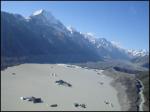
Terminal face calving
Last week passengers onboard Glacier Explorers boat trips witnessed the calving of “The Bomb”, an eight meter wide and 30 meter chunk of turquoise ice.“We thought that took the cake but this new iceberg, is absolutely massive. It supersedes the last significant one named “Sir Edmund Hillary” which calved on January 11, 2008, the same day Sir Edmund Hillary passed away. “We’re getting more and more icebergs now so we’re naming them in order to track and communicate changes and locations. “Since the Terminal Lake began forming in 1973, the Tasman Glacier’s retreat has noticeably quickened because the lake is expanding all the time and is causing a more rapid melt of the terminal face. I think we may be looking at major calving from the terminal face as an annual event now.”
Tags:25 years, adventure travel, Bob Stremba, Brenda Dowst, Calving, Cindy Heath, Craig Cimmons, Dexter R. Richards, ecospiritual psychology, Experiential Education, Holistic Living, Iceberg, Mountain Spirit, Mountaineering, Mt. Cook, mtnspirit.org, New Hampshire, New Zealand, Peru, Randy Richards, Spiritual, Sunapee, Sustainability, Tasman Glacier
Posted in Climate Change, Environment, New Zealand, Sustainable Living/Communities | Leave a Comment »
11/02/2009
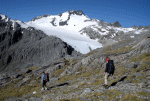
Returning from snow school, Mt. Brewster, NZ
Some friends and I had a great time in the Mt. Brewster area last week. We did the two hour plus verticle hike to the hut from the valley floor, which got us there in the afternoon. As Aspiring Guides Director Martin Hawes writes in their blog, “The track to Brewster Hut wastes no time in saying which way you are going: you leave the car, cross the river and then its straight uphill. At 2575 metres, Mt Brewster is over 2 000 metre above the road and fortunately there is no valley slog to start. There is an honesty to this track. It takes you directly where you want to go – upwards, and no messing about.”
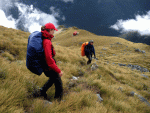
Lisbeth & Amanda headed for Brewster Hut
Amanda is the roving hut ranger for DOC, and her roster took her there to collect hut fees, do maintenance and be a presence at the hut. When we had a bit of free time, she and mutual friend Lizbeth Asserhoj from Denmark, did some basic snow school/ice axe lessons for the afternoon. The following day we worked our way over to Mt. Brewster glacier. But because of poor visiablity rain and slippery glacier polished rock we didn’t make it on the glacier. Even though we were well equipped for glacier travel, we decided to turn back for the hut. Some glaciologist who had earlier in the day been deposited by helicopter also decided to head for the hut. We later caught up with them at the hut, where they described their studies the effects of climate change on the Mt. Brewster Glacier.
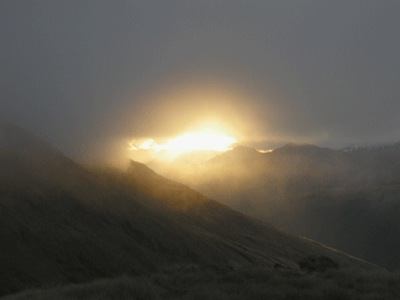
Sunset from Brewster Hut
We based ourselves at the new hut, recently put there by the Department of Conservation in 2007. It replaces a four bunk hut that had been there for years. Even though we didn’t have time to get near the mountain itself, we enjoyed our time doing some ridge walks, snow school and getting towards the base of the mountain. Next time we’re up there we’ll poke around a bit more, time permitting.
Tags:adventure travel, Bob Stremba, Brenda Dowst, Cindy Heath, Craig Cimmons, Dexter R. Richards, ecospiritual psychology, Experiential Education, Glacialogy, Holistic Living, Mountain Spirit, Mountaineering, Mt. Brewster, mtnspirit.org, New Hampshire, New Zealand, Peru, Randy Richards, Snow School, Spiritual, Sunapee, Sustainability
Posted in Climate Change, Climb/Ski/Mntneering, Environment, Mountain People, New Zealand, Power of Place | 1 Comment »
31/01/2009
Greetings from New Zealand. You’ll start to see articles on this blog under the column named “Mountain People Who Inspire” whenever I or other authors should come across them.
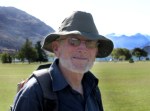
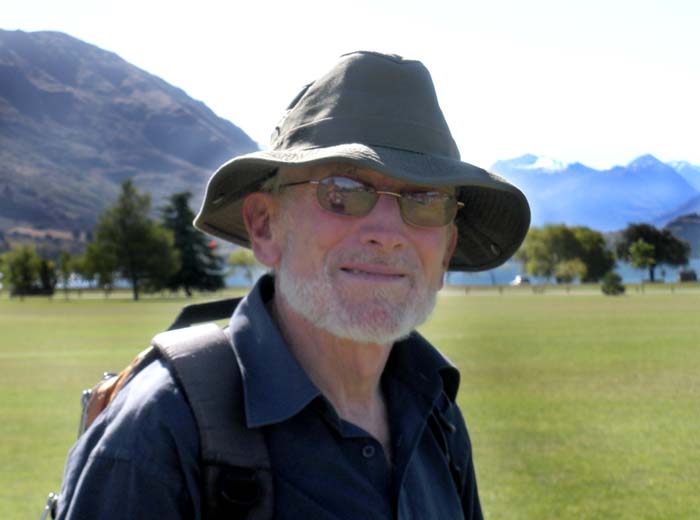
Londoner Mark Rosen, Wanaka, NZ
I’m starting this column with an entry on a retired man from England named Mark Rosen. Mark hails from Norfolk, Sheringham which is a fishing and vacation village on the east coast. We crossed paths in the Matukituki Valley when Mark was on his way to fulfill his annual volunteer stint at the French Ridge Hut near the base of Mt. Aspiring. He has been volunteering at this hut as well as Mueller hut at Mt Cook for a number of years. He’s an inpsiration because of his great attitude about getting out in the mountains, and his ability to continue hitting the trail. He’s a mountain man in the true sense. Getting to the French Ridge Hut is not easy. Once you’ve hiked four hours along the Matukituki Valley, the trail climbs 3000′ in about a mile and a half, to arrive above treeline and at glacier’s edge at the small hut.
I only met him briefly on the trail, and later caught up with him in Wanaka, New Zealand where we asked him a few questions about his thoughts on hut wardening at Mt. Aspiring and Mt. Cook.
MSI:What do you love most about your volunteering?
MR: I love relating to the people, and hearing about their first impressions. Especially at Mt. Cook when many of the visitors are seeing a large glaciated mountain for the first time. They’re enjoying the beauty of the mountains and for most, this is their first experience of going to a place like that. Their eyes are wide with wonder. More though, I come back because of the place, the mountain environment, this special location. I like the time alone too and can retreat to the hut warden’s quarters when need be.
MSI: What do you do in your spare time at the huts?
MR: I like to get out and hike the surrounding routes, read or plug into my ipod and conduct the London Symphony Orchestra or do my aerobic exercises.
MSI: What are some of the challenges of being a hut warden?
MR: Well, in a humorous vein, people tend to ask the same questions over and over, such as, “How do you get your food and water up here?”, or “How do you get up here?” Depending on my mood sometimes, I like to make my answers more interesting. I’ll tell a fibb by replying that I bring my food up in big boxes and haul water from the valley floor in buckets. Oh, and that “The outhouse poop needs to be hauled out in containers strung over my shoulders.” Sometimes I might say “I arrive by private helicopter.”
One thing that can bother me is when parties don’t clean up after themselves and leave the hut or toilet a mess. I almost feel as if I need to inquire about their toilet habits upon their arrival, hopefully stemming their bad behaviour. Of course, this is the minority of the visitors, but it does have a negative impact.
When I met Mr. Rosen the second time in Wanaka, I observed at how well grounded and at peace the man seemed. I guess part of it stems from all that time in the mountains. Keep going Mark.
Tags:adventure travel, Department of Conservation, Dexter R. Richards, DOC, ecospiritual psychology, Experiential Education, French Ridge, Holistic Living, Mark Rosen, Matukituki Valley, Mountain Spirit, Mountaineering, Mt. Aspriring National Park, Mt. Cook, mtnspirit.org, New Hampshire, New Zealand, Randy Richards, Spiritual, Sunapee, Sustainability, Volunteer Hut Warden
Posted in Environment, Health, Holistic Living, Leadership, Mountain People, New Zealand, Power of Place, Spiritual, Sustainable Living/Communities | 3 Comments »







 Mountain Spirit's Blog