Archive for the ‘South America’ Category

Water, The Great Mystery

04/06/2011

Water, Check it out.

Austrian Researcher Alois Gruber states in the movie, Water – The Great Mystery, by Hopscotch Films, “At the level of thought, a person who thinks negative thoughts is polluting his own water of which his body is 75-90% composed, and giving it a negative charge.”  The movie had my attention.
The film’s narrator continues, “As it records new information, water acquires new properties yet its chemical composition remains unchanged. The structure of the water is much more important than the chemical composition.

H2O

The structure of water means how its molecules are organized. Water molecules join together into groups which are called clusters. Scientists *theorize that these clusters work as memory cells of a

certain sort in which water records the whole history of its relationship with the world as if on magnetic tape.”

Water's structure in clusters

“Of course remains water, but its structure, like a nervous system reacts to any irritation. Modern instruments have made it possible to record the fact that within each of the water’s memory cells there are 440,000 information panels each of which is responsible for its own type of interaction with the environment. “

Molecules coming and going

Marc Chaplin, Professor and Laboratory Chief of London University says, “If you consider a cluster as a specific group of molecules, then it can only survive a short amount of time,  but if you consider it as a structure, whereby molecules can leave and other molecules come in, the  cluster will survive in effect, for a very long time. Water can record and store information, like a computer memory.”
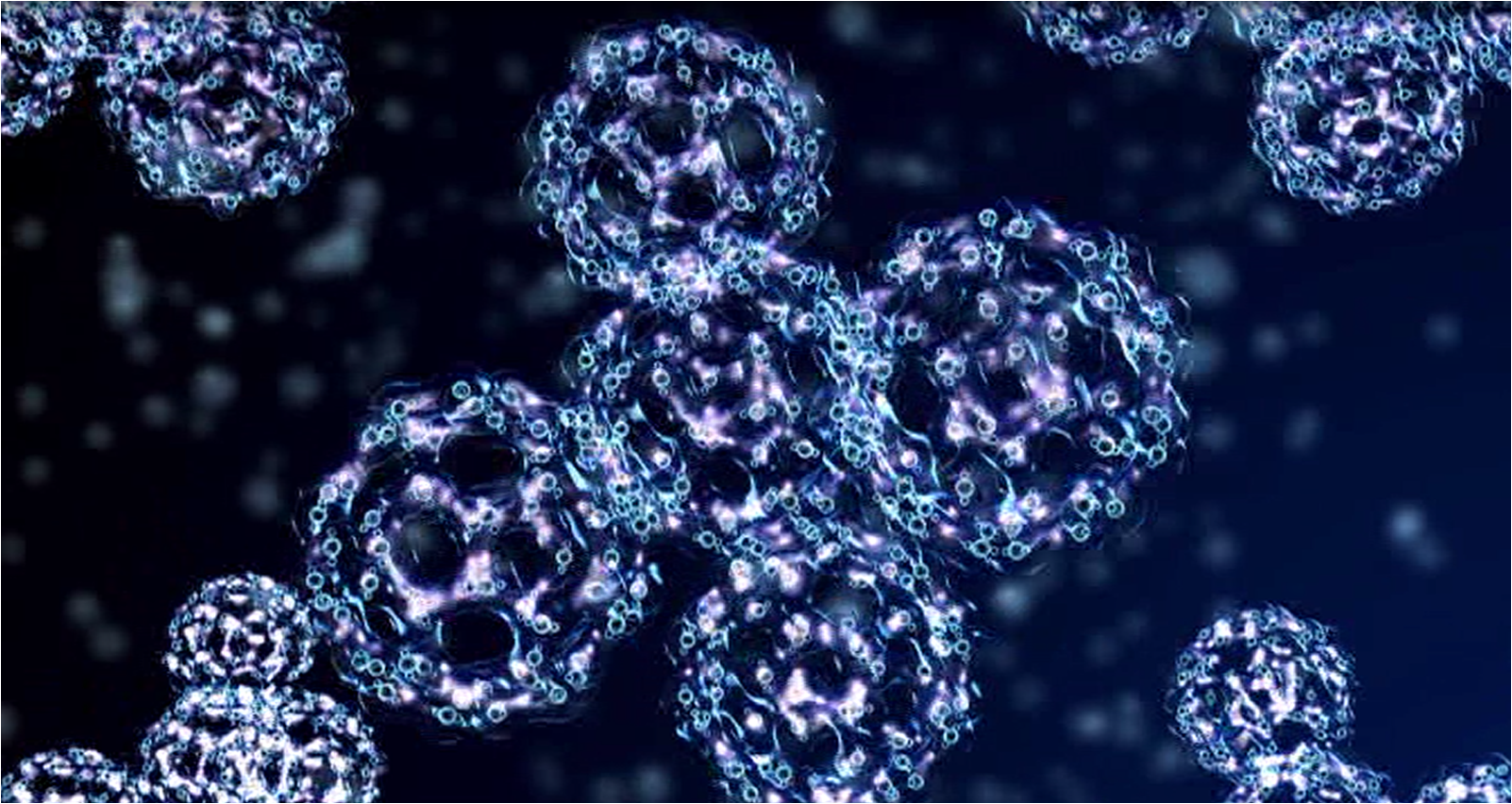
H2O has "memory panels"

“Basically water has photographic memory and you can imprint it with very subtle energies, even from 10,000 km away”  says Professor Rustum Roy, of Penn State University, and Member of the International Academy of Science.  “Does that mean remote communication can happen between human beings who are structures essentially composed of water?” asks the film.

Subject A in Russia

“In Februrary 2005 a professor and colleagues conducted an experiment  to confirm or disconfirm the hypothesis that remote communication between people is possible.  Two people were 10,000 miles apart, one in Moscow, the other in South America. The “virtual brain” of the experiment’s participants showed with EEG’s and EKG’s as well as other systems being monitored.
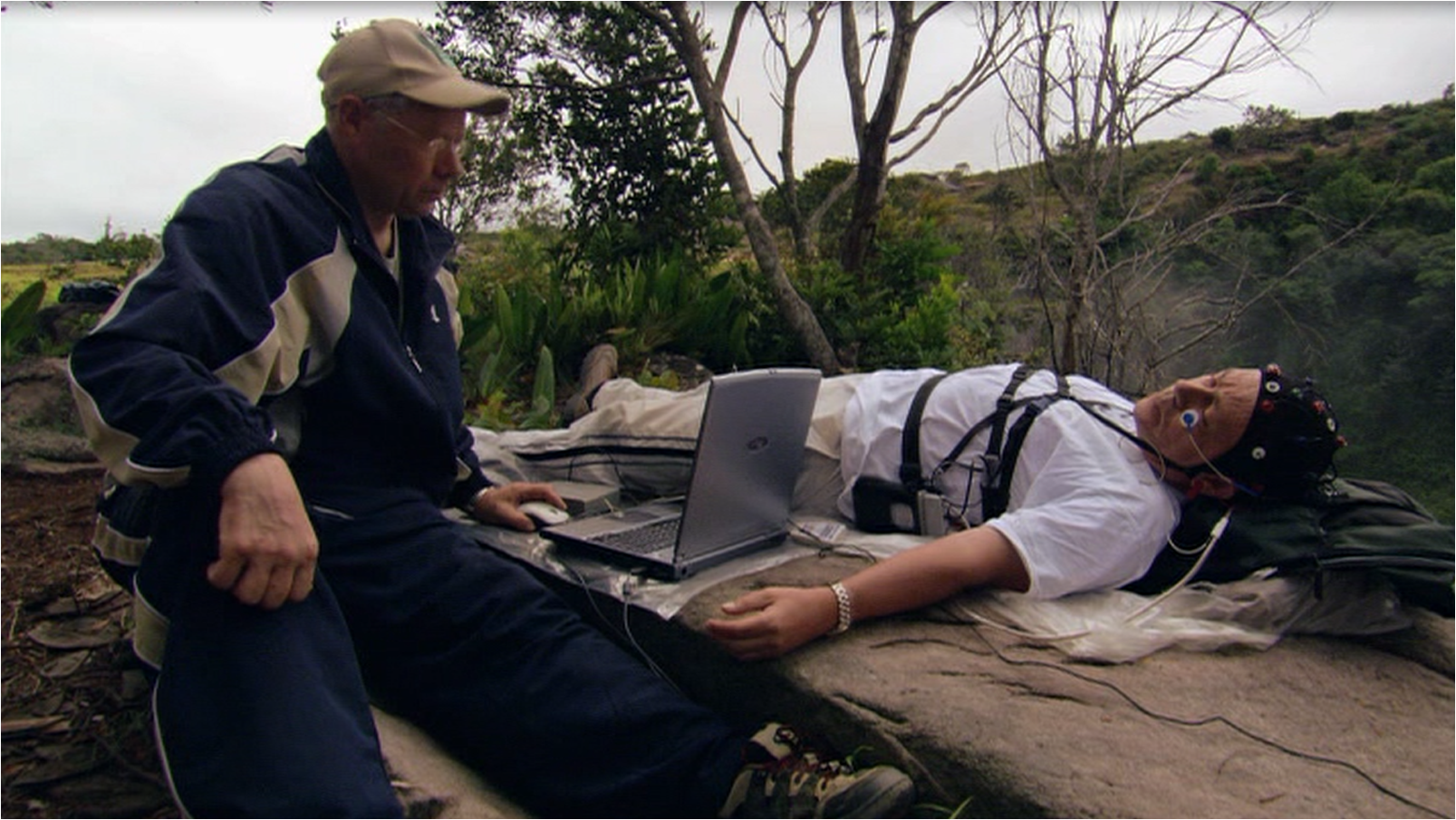
Subject B in S. America

Suddenly the two people had tuned themselves to the same wave, synchronization of areas of their brain, breathing patterns, and pulses. The theory is, liquids in the body carry out an information transmission system.”
The book the Secret Life of Plants was one of the first early works exploring and describing the reactions and relationships of plants to external stimuli in their world.  The author hooked up house plants in his office to a lie detector machine and to his surprise saw the plants react to his thoughts, regardless of whether he was in the same room or not, or the same city for that matter.

Subject A & B's synchronized scans

Dr. Masaru Emoto, author of “The Secret Life of Water”  was also interviewed in the film. Emoto, in his experiments, exposed different water droplets  to different thoughts, words  and intentions.
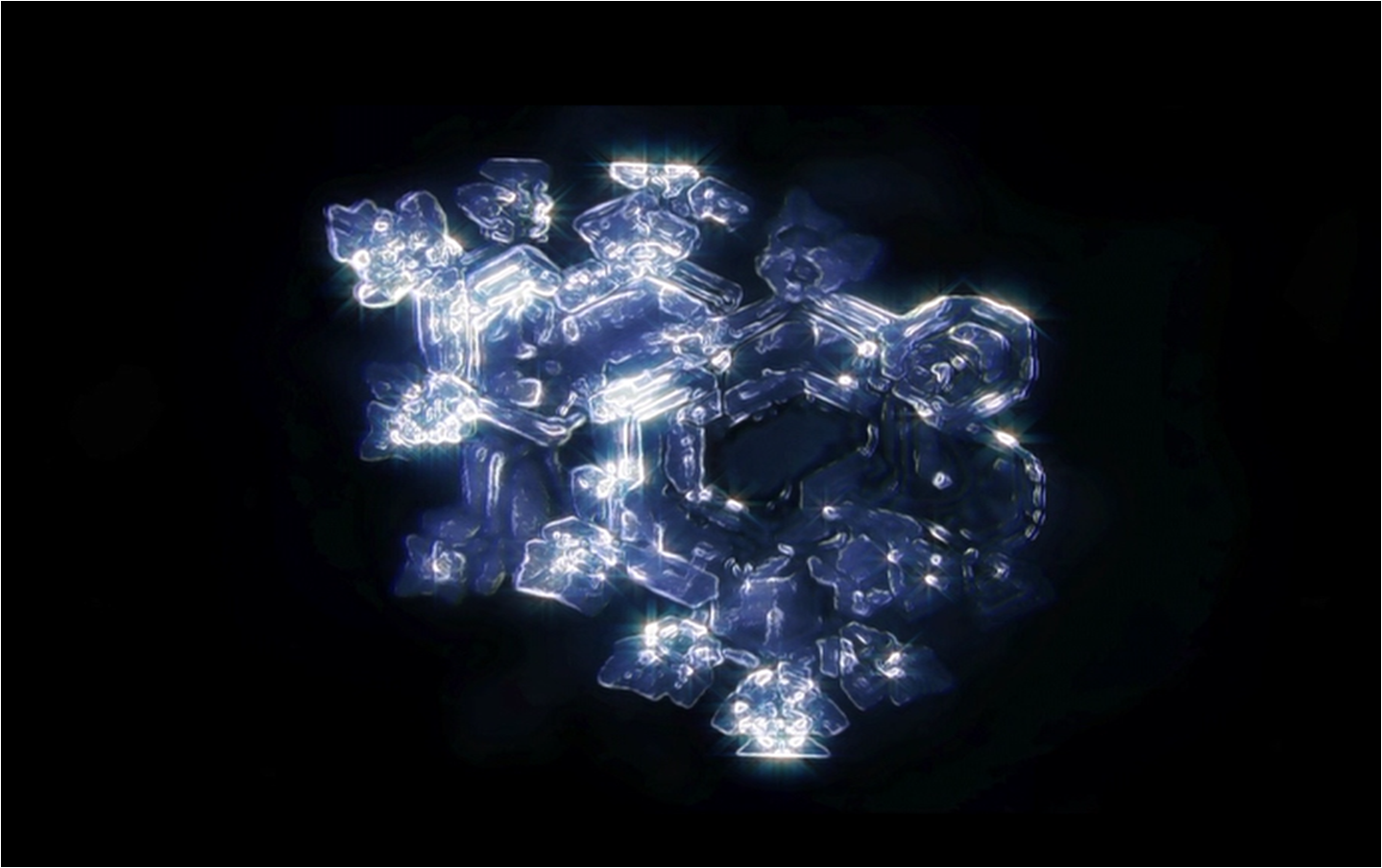
Water Crystals presented with Bach

These words and thoughts were directed at droplets before they were frozen, then images of the resulting water crystals were captured on film. The stunning results, such as  “beautiful” or “ugly” depended upon whether the words or thoughts were positive or negative. Emoto claims this can be achieved through prayer, music or by attaching written words to a container of water.    If you ‘re not familiar with his book or images, one of which is included here, check it out.

This led me to a logical conclusion from my shamanic studies in Peru, where the Inca and Quechua concept of Ayni, (reciprocity) runs throughout the mountain cultures in the Andes.

Q'ero Priests in the Andes

I learned to give words and form to what I had intuitively, (and most likely all of us have) had  known all my life from growing up in woods of New Hampshire, and later, mountain guiding in the mountains of the world –  that the mountains, streams and rivers, and other natural features give off a certain energy, and that we can interact with them as we would a person.  We can exchange energy, ask for support from the mountain, or lake,  and give back that support through emotional prayer, conservation protection and simple acknowledgement of the mountain’s energy and presence.
This might sound silly to the western logical mind, but the indigenous cultures who lived closer to the land knew and lived this life, and many still do, on a daily basis.  The western mind  is too busy, the channels are too clogged with data, to recognize the subtle signals that come from the old oak tree or the master mountain on the horizon.
The people of Cusco have twelve main “Apu’s “ or Mountain Spirits around their city, two of which are named Ausangate, Salkantay, Each main mountain or other geographic feature has its own characteristic such as male or female, strength,  allowance, introspection etc.. and the spirit of Ayni pervades all interactions with these mountain spirits.  As a side note, when I named our organization Mountain Spirit Institute in 1996, I had no awareness of the Andean “Apu’s”.
I took what I had learned, and melded it with my own intuition and experiences. When back in the U.S., I started to give more form to my relationships with the surrounding mountains and water features in my hometown of Sunapee, NH.  I started to see Mt. Sunapee in a different light, and in fact, took a job as a ski patroller mostly because I wanted to interact with the mountain energy on a daily basis. I wanted to, protect it, be in on the mountain, feel its power, and ask for strength from it as well.  Now that I think about it, maybe when Catherine Busheuff and I decided to move forward with those early meetings at the library, that later turned into the Friends of Mount Sunapee, maybe part of the seed that led to the mountain’s protection that exists today, came from those early interactions.  Many individuals have since carried forward  with their own passion to protect the mountain from abuse and over-development. I hope to think I may have had a small part in that.

Communication w/Lake Sunapee from NZ's Lakes District

I also started relating to Lake Sunapee in a different way as well. While I always felt the water was in my bones, this film, and Emoto’s book, gives me some credence that the water memory from where we come is actually part of us.  So after seeing the movie, I spontanisouly  meditated on the waters of Sunapee from here in New Zealand. I started feeling the healing power of the waters of Lake Sunapee, even though I’m down here on New Zealand’s south island,  very long way away. I could feel the exchange of energy, of love and gratitude.
So what’s this all mean – from the shamanic studies in Peru, to experiments in Russia to meditation and communication with a body of water in New Hampshire from New Zealand,  from one water body to another body of water? It means, at least to me, that we can interact more with trees,  mountains, rivers, lakes and each other on a level far deeper than conventional society believes. Traditional societies know about this connection, and its knowledge may just mean we learn to survive as a species.
I started Mountain Spirit Institute because I feel I can contribute to helping people reconnect to the natural environment, each other and a deeper connection to themselves by setting the stage for powerful transformative experiences. This film is an affirmation that I, and our board of directors are on the right track. Visit our website for more information on our core values, and our mission, and do see the movie!

Water's structure as important as chemical make-up

Chapters of the movie Water, The Great Mystery, include:
The Structure of Water
The importance of water,
Dead and Heavy Water
Natural and Artificial Water
The Effect of Water on the Body
Water as the Medium
The Power of Faith
A Water Crisis
Nature Disasters
Love and Gratitude

* While I didn’t look for footnotes to the research mentioned in the movie, nor check into the science, I decided to write this post to share my personal experience of the movie, and in life.

There was much more fascinating information in the movie than I was able to include here. Do see it to learn more about agriculture, hydro power, our public water supply and one of the world’s most pristine water supplies in Brazil.  All images are screen shots from the movie and are intended and used for review purposes only.

Peru: Protests Against Illegal Gold Mining

30/05/2011

Tourists Leave Puno Amid Escalating Protests

By: Andean Air Mail & PERUVIAN TIMES
More than 200 tourists who were stranded in southern Peru’s Puno department due to protests against mining activities have managed to leave the area, according to the president of the Regional Chamber of Tourism (Caretur), Manuel Quiñones.
The tourists were able to leave the region through the airport at Juliaca, state news agency Andina reported.
“The tourists, mostly Europeans, traveled to Cusco, Lima and others to Arequipa,” Quiñones said.
Many of the tourists, taken out of Puno on the small launches to visit the Uros and Taquile and Amantaní islands, spent a night on the islands and sought other exits from Puno the following day, while others returned to the city of Puno in the evening and went ashore at different hotel piers under dark, a lakefront source told, Read the rest of this story..

Bolivia: Fighting the Climate Wars

20/04/2011

From: The Guardian
John Vidal reports from La Paz where Bolivians are living with the effects of climate change every day. Their president has called for an urgent 50% cut in emissions – action that is essential for the country’s survival. Click on the image to view video.

Excellent Video on Bolivias Iniatives

2 More Geoglyphs Discovered on Nazca Lines

26/01/2011

Japanese scientists find two new geoglyphs in Nazca

A New Face at Nazca

Scientists from Yamagata University have reported finding two new geoglyphs in southern Peru’s Nazca province.

The geoglyphs are located close to the Nazca Lines, one of Peru’s most popular attractions where tourist planes routinely fly over the ancient geoglyphs of monkeys, hummingbirds and spiders. The Lines are a UNESCO world heritage, created between 500 B.C. and A.D. 500, and are among the world’s greatest archaeological enigmas. (more…)

Ausangate Traditions and Weavings

07/06/2010

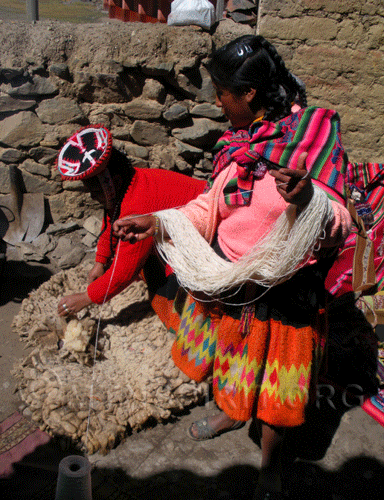
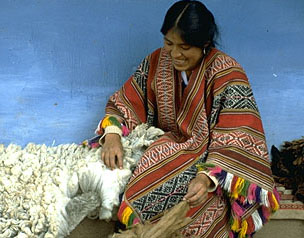
Weavers: Willoc, Peru

Dr. Andrea Heckman an expert on Quechua weavings, will show a documentary film at the South American Explorers Club in Cusco, Peru on Thursday June 10th at 7 p.m.  The film tells the story of Quechua villagers near the sacred peak of Ausangate.

Set against a backdrop of high Andean lakes and mountains, it shows a harsh existence but also a deep interconnectedness with the natural forces and their ritual relationships to the mountain, revealed in various festivals, weaving and other traditions.

If you’re in Cusco, and want see the film, contact the SAE in Cusco.

Experiential Education at Inti Raymi

11/05/2010

Inti Raymi in Cusco

Peru’s Inca History Rich with Experiential Education: At least from what we see at current Inti Raymi Festival
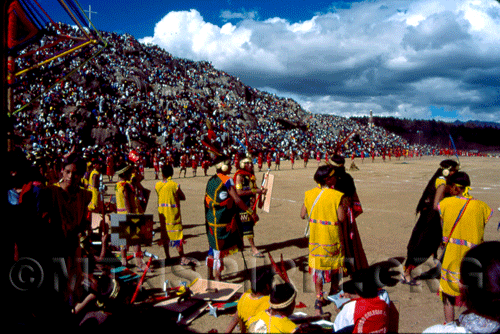
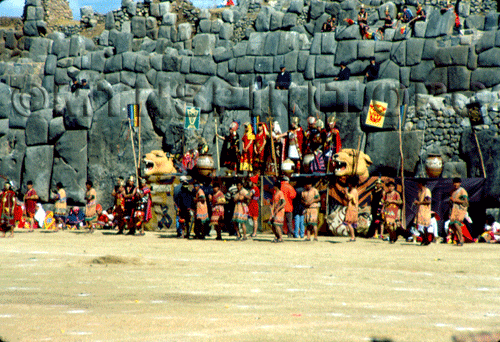
Every year on June 24 Cusco celebrates the festival of Inti Raymi at the Inca Fortress of Sacsayhuaman.
This festival was celebrated by the Incas as the Festival of the Sun in honor of the God of the Sun: Wiracocha. The Inti Raymi symbolizes the eternal consecration of marriage between the Sun and human beings. The festival is

Inca Royalty Observe Inti Raymi

now the second largest festival in Latin America with an expected 200,000 people visiting Cusco.

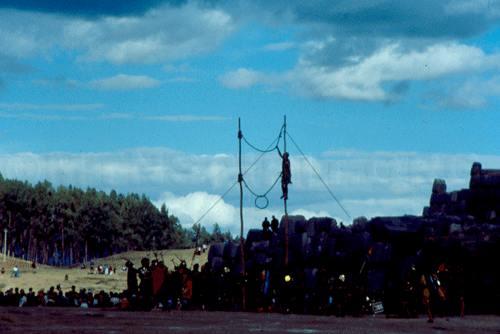
But from an educator’s eye, there is more going on than just a festival. Groups of students from all over Peru but especially from the Quechua speaking, and Inca origins, come to participate in experiential tests of courage and craftsmanship.  It is a wonderful and proud event in which to participate,

An 18-Yr-Old Balances

where young from come to throw, climb and balance, all the while, with elders looking on.  The sense of pride and community at the Inti Raymi is palpable.

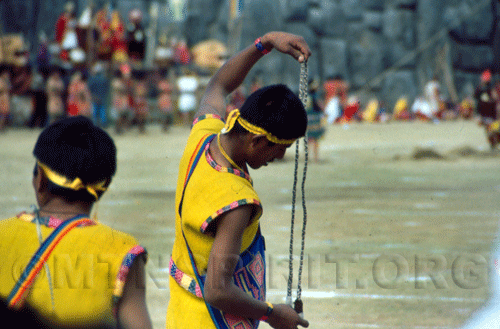
When I first attended some 12 years ago, it had not been so big. So be it. The

Stone Throwing Competition

festival is popular and deservedly so, not only for the sense of history of the Inca, and Quechua heritage, but to see teens competing, representing their communities, here at this historical place, Sacsayhuaman.
Images: R. Richards, Mountain Spirit Institute
Mountain Spirit Institute has been running programs in Peru since the late 1990’s that focus on experientially learning and giving back to the people of the Andean villages we encounter. We pride ourselves in staying off the beaten path. See our website at www.mtnspirit.org for more information. MSI is a non-profit educational organization.

MSI Adds 2nd Peru’10 Program

12/04/2010

Tai Chi, Huaraz, Peru

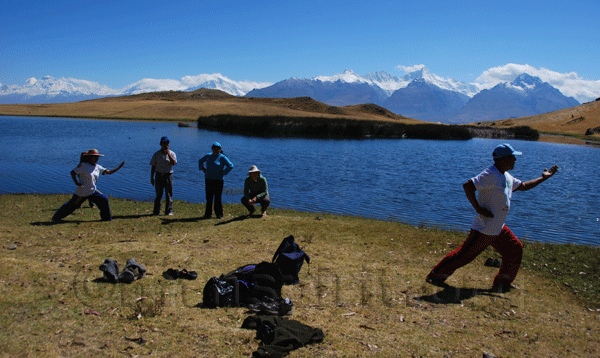
We’ve decided to add a second program headed to Peru for August. If you’d like to learn more about the program, dates and cost, visit our webpage. The program will focus Cusco, Machu Picchu, the Sacred Valley and Lake Titicaca. This is our twelfth year leading educational programs to Peru.  Before that, R. Richards was guiding high altitude summits.
“It’s not about tourism and snapping images” says founder Richards. “Like all our programs, it’s about learning from the culture, giving back with service, a smile and learning the language, and of course stepping out of your comfort zone.”
We will also be working more with Jorge Martel in the Cordillera Blanca on the range’s east side. Stay tuned to see images of this  region. If you’d like information please contact us.

Excellent Book on Peruvian Textiles

11/04/2010

Weaving in the Peruvian Highlands

Handwoven Fabrics: Living History
Handwoven fabrics are the living history and cultural treasure of the Peruvian Highlands. The weavers who create these extraordinary textiles are the keepers of the culture and sustainers of a noble but difficult lifestyle in tune with the earth.  This book, Weaving in the Peruvian Andes celebrates their authentic, well-crafted work by showing varied and distinctive styles of traditional clothing, the basics of how fabric is created from spinning to dyeing to weaving,  the way traditional crafts are passed from one generation to another, the names and meaning of the myriad textile designs that reflect the culture and history of the people, and the rituals and celebrations in which woven fabrics play such an important role.

N.C. Alvarez

Author Nilda Callañaupa Alverez is founder and director of the Center for Traditional Textiles of Cusco. She has established weaving associations through the Andean highlands to preserve a tradition of handmade textiles and to promote economic development. She lives in Cusco and in her native community of Chinchereo, Peru.

All proceeds from the sale of the book benefit the Center of Traditional Textiles of Cusco.

Mountain Spirit Institute focuses on weaving during our educational programs in Peru.  Learn more at www.mtnspirit.org

Aerosmith, Sunapee & Peru

01/04/2010

Tyler and Perry met in Sunapee, NH

We usually don’t write about big rock bands, but Aerosmith, being somewhat local from Sunapee, NH, USA, and having sold out tickets in Peru, seemed like an odd enough connection that we’re posting it here.  If you happen to be in Lima in May, (or in Sunapee at the Anchorage) you might run into them.

by Isabel Guerra
LivinginPeru.com
There’s still two months ahead before their arrival in Lima, Peru, but 10,000 tickets for their concert were sold today, during the opening of sales day.

“A new record has been set,” says MVV Asociados, the agency responsible for this concert’s press, adding that “this is the

Popular in Peru

biggest first sale ever made by any band in Peru. It seems that the tickets will be completely sold out in only a few days,” states a press release.

The concert is scheduled for May 22, and will be held at the Monumental Stadium Esplanade.

Ticket’s prices range from 72 to 624 soles (US $24 to US $208)

The InBox: Amantani Island, Peru

23/03/2010

Sustainable Travel, Off the Beaten Track, Lake Titicaca, Peru
Dear Randall,
I hope you don’t mind my contacting you. I saw your blog post about staying on Amantani Island and I wanted to ask your advice. I had been planning to go to the island and stay with Richard Cari at Kantuta Lodge. However, having read your post I am wondering if I should be staying elsewhere in order to be a bit fairer and in the interest of sustainable tourism – such as going to stay with the islanders who don’t usually see a lot of tourists.

I felt a bit nervous not booking something in advance and am also not sure how easy it would be to organise something like this (I will only have one night and we arrive in Puno the evening before we hope to go to the island). Do you know any responsible tour agencies who give back to the islanders and could help me find somewhere to stay? Or would you recommend just turning up and hoping to find a boat / somewhere to stay on the island?

Many thanks for any help you can give.
Kind regards,
Lucy H.

Hi Lucy,

Family Mamani, Occopampa, Amantani

Thanks for your email, and for your concern about sustainable tourism on Amantani on Lake Titicaca. Here are a few suggestions.
Richard Cari and family are good friends of mine, and we do hire his launch/boat to get our clients to the island, and although we might stay one night at his lodge, the lodge has evolved into something bigger than I want my participants to experience, (semester students excluded, plus Richard will help facilitate these longer programs). So we may bypass the lodge in favor of the other families who are wanting to have guests visit them. However, depending upon your comfort zone, and interest, you would enjoy Richard’s family and small lodge in any event. But more about staying with other families:

There’s no real problem with taking one of the boats run by the community of Amantani which you can pick up (more…)