A wrap-up discussion about what it means to be a local farmer, and who benefits..
Archive for the ‘Conservation’ Category
Your Food Supply #23: Engaging in Life
16/09/2010Your Food Supply #17: A Bottle-free Brew Pub
20/08/2010Andy Lynch is involved in a Burbank, California brew pub which sells only draft beers, eliminating the bottles. Check it out..
Your Food Supply #8: Real Corn
05/08/2010Linda describes what good organic corn looks, feels and tastes like.
The Little Pika & Global Warming
03/08/2010How Global Warming is effecting the Pika, a High Altitude Rock Dweller.
Photographer Wendy Shattil of Denver, Colorado gets great shots in the name of nature. Learn about her efforts to capture and document, on camera, endangered species for future generations. I talk with her about the pika, a rodent in the rabbit family, who can’t go any higher as the temperatures rise in our mountain environment.
Be sure and check out her amazing images on her website.
Your Food Supply #1
20/07/2010The first in a series of video posts about Your Food Supply
#1 The Trip West: An Experiential Rude Awakening
By Randy and Amanda Richards
This was Amanda’s first trip across the U.S., so we thought we’d drive. Destination? Colorado, where we would house-sit for a fellow Mountain Spirit board member. We thought we’d stay off the interstates, instead, crossing rural routes, starting with Indiana Route 24, then Missouri Route 36 west of Macon. Shortly after departing we decided to listen to The Omnivore’s Dilemma, a book on tape by Michael Pollan.

Want to know what’s in your food?
As we traveled through Indiana, Missouri, and then Kansas, the book narrated our trip with views of tightly packed cornfields, and more corn, and then more corn. It turns out, about the only thing the U.S. is growing is corn, at least from what we saw. Sure there are apples in Washington, and spinach, avocados etc, in California, but in the Midwest, there’s corn, and a lot of it. We did see some soybean fields, but nothing much else than corn. We certainly didn’t see many pastoral scenes of cows grazing on open pastures. But we did see lots and lots of corn. As we listened to Pollan’s book, we were shocked to learn where all this corn is ending up in the food supply, plus how many bushels per acre of corn the farmers were squeezing out of the land. Read his book for the stark details of our homogenized food supply, and as you do, imagine seeing it in front of your eyes, passing by the window of your car. It was eery for us. I’ve driven across the U.S. probably over 45 or 50 times, and each time I’ve felt grateful to do so, and very cognizant of my impact by doing so.
I won’t go into detail about all we learned in Pollan’s book. Buy his book. However, one of the major topics he covered was how corn is not only a food, but a commodity, that is in almost all our food in a wide variety of forms. Corn drives the modern industrial food machine, being sent to beef feedlots where cows are forced to eat corn. Grass is their natural diet. Monsanto’s Roundup Ready genetically Modified Corn was another scary thing we learned about, plus how our farmers are forced work for fewer and fewer dollars, while ADM and the other monopolies make the money.
So starts our video series, rows and rows of corn, somewhere in Kansas on Route 36, but it could be anywhere in the Midwest. Stay tuned for Your Food Supply #2, for a feedlot and processing plant scene west of Dodge City Kansas, which may shock you.
“Your Food Supply” Blog Series
18/07/2010Coming soon: New series of blog posts will open your eyes.
Keep an eye out for a new series of video and text posts starting here in a few days. We think you’ll like it.
We’ve just traveled across the U.S.A, listening to an Omnivore’s Dilemma by Micheal Pollan. It was experiential education at its best, and a sobering experience.
What’s more it led to some great footage and interviews here in Durango, CO with local farmers and restaurateurs.
Stay tuned for this informative series of blog posts on your food supply.
Everest Basecamp Clean-up Successful
24/06/2010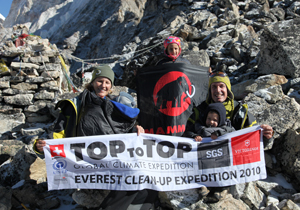
Cleaning Up After Climbers
The Swiss family Schwörer and their companions on the TOPtoTOP Global Climate Expedition have successfully completed their project to clean up Everest Base Camp. Unfortunately, expedition leader Dario Schwörer didn’t manage to reach the summit of the “Roof of the World”.
As already reported, for the last seven years the Mammut-sponsored TOPtoTOP expedition has been traveling all over the world, from Switzerland to Everest Base Camp, freeing our environment from discarded rubbish. The family used carbon-neutral forms of transport, such as walking, cycling or sailing, to reach their destination. Read the rest of this article at Mammut.ch
Individual action IS possible
22/06/2010We are not powerless to what is happening in the Gulf of Mexico.

Gulf of Mexico
Dr Masaru Emoto is the scientist from Japan who is well known for his research and publications about the characteristics of water. Among other things, his research revealed that water physically responds to emotions. Many people have the predominantly angry emotion when we consider what is happening in the Gulf. And while justified in that emotion, we may be of greater assistance to our planet and its life forms if we sincerely, powerfully and humbly pray the prayer that Dr. Emoto, himself, has proposed.
Let’s give energy of love and gratitude to all the living creatures in Mexico Gulf by praying like this. To whales, dolphins, pelicans, fishes, shellfishes, planktons, corals, algae and all creatures ion Gulf of Mexico
I am sorry.
Please forgive me.
Thank you.
I love you.
Masaru Emoto
May, 9th 2010
We are not powerless. We are powerful. Our united energy, speaking this prayer daily…multiple times daily… can literally shift the balance of destruction that is happening.
We don’t have to know how…we just have to recognize that the power of love is greater than any other power active in the Universe today.
To read the article published by Dr Emoto, go to
http://www.masaru-emoto.net/english/dr.emotos_message_2.html
Companies Doing Good
18/06/2010Ragged Mountain Equipment Leads the Way in Giving for the Environment
Donating for the Environment
Ragged Mountain Equipment in Intervale, NH is doing good work. When I was climbing in the North Conway area, Rob Nadler and Cort Hansen were just starting the store in a small space behind the Intervale post office. They made their own chalk bags, ice axe leashes and a few polypro pullovers. Since then, they’ve grown the business to one of the best outdoor and retail outlets in the nation. They might not be the biggest, but in my opinion, one of the best. There’s always a good feeling when you go into their store.
In line with their values, there now contributing .50 cents from every sale of a Ragged Mountain made product over $25.00 retail cost to the Upper Saco Valley Land Trust (USVLT).
USVLT’s mission is to protect the cultural and scenic values of the Upper Saco River Valley by preserving land for farming, forestry, recreation and education. Founded in 2000, USVLT has helped preserve nearly 4,000 acres of open space here in the area. The same program is being used by some of the restaurants and B&B’s in the valley.
Says Cort, “I think we are the only retail/manufacturer doing this at this time. I think it is a great program to raise the awareness of local land conservation issues. ” He adds, “The customer has the choice at the register to opt out and save $.50. Very few have done so.”
Every garment has a hang tag explaining their mission. Says Cort, “We are in the process of expanding hang tags to all our existing inventory which is a major task I can inform you. New styles come through with the tags already on them.”
They’re up to more good. Adds Cort, “We also enrolled the Mount Washington Valley Ski Touring Foundation in the program as well. All ski trail passes sold here at the Touring Center include a $.50 contribution the USVLT. We are the only XC ski touring center participating in this program currently. I think this is vital to making all nordic skiers aware that almost 100% of the valley XC trails use private land which is not protected from development or alternative uses.”
Climber Henry Barber approached Ragged Mountain late last fall about their participating in this this program.
If you’d like to donate and help owners Rob and Cort with this worthwhile project, contact Cort at cort(at)raggedmountain.com
Redford:Protecting America’s Wild Lands
14/06/2010The Denver Post
Guest Commentary
By Robert Redford
Even though the Bush Administration left Washington over a year ago, one of its most destructive public lands policies remains on the books: the tactic of opening wilderness-quality lands to mining, drilling, and off-road vehicles. Read the rest of this article
 Mountain Spirit's Blog