Posts Tagged ‘mtnspirit.org’

Got a Baby? Doesn’t stop this family

11/02/2009
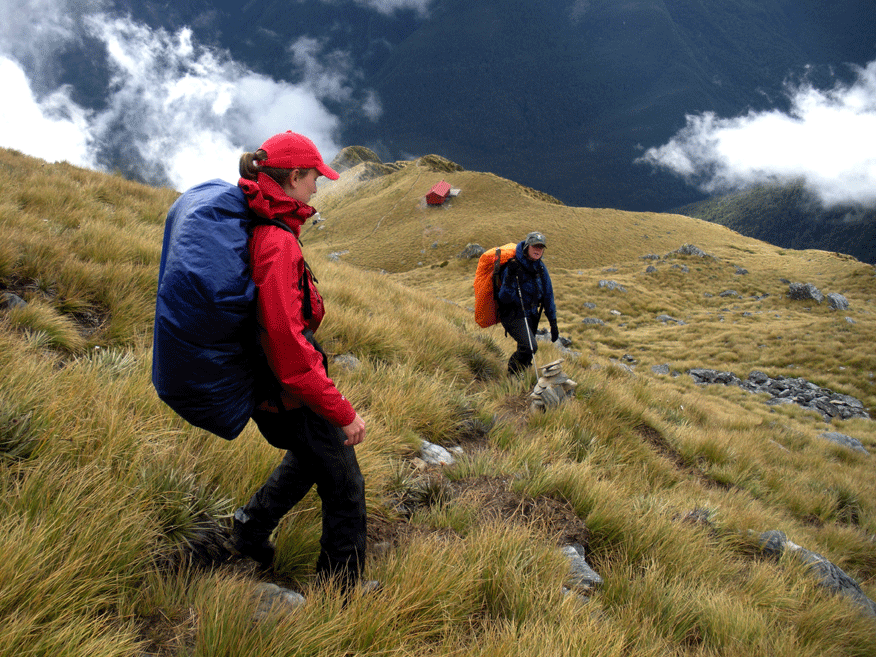
Family heading back from Aspiring Hut

Family heading back from Aspiring Hut

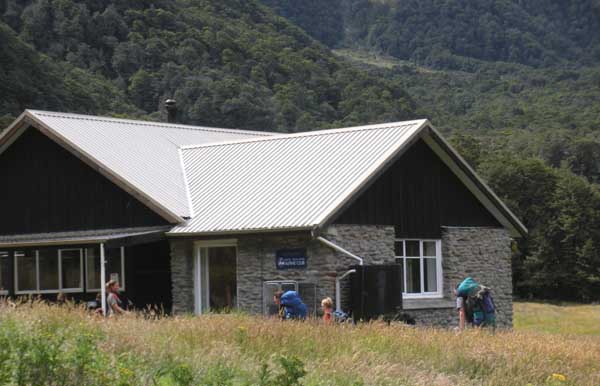
Recently, during a New Zealand national holiday, the Aspiring Hut saw a full house last Saturday night.  There were climbers, trekkers, and people of all ages. Some were making the Aspiring Hut their destination, others were headed further for Cascade Saddle, French Ridge or Mt. Aspiring’s summit.
One family was the most unique there that night. A  young couple was there with there 11 month old baby. I was amazed to see the baby stroller in the hut. It seemed so out of place. Upon quering the couple, they said they had been ill advised about the stoller, and shouldn’t have brought it.  (There is a good portion of the trail where it can be used however, not enough to warrant carrying it as much as they did).

The hike to Aspiring Hut, NZ

The hike to Aspiring Hut, NZ

Congratulations to these two for coming into the mountains with their new baby. They, and others here in New Zealand, show us that the backcountry is a place for the young and the young at heart. The next day, an elderly hiking group from Dunedin, numbering 40 or more, with an average age of 60, hiked to the hut for the day. Well done.

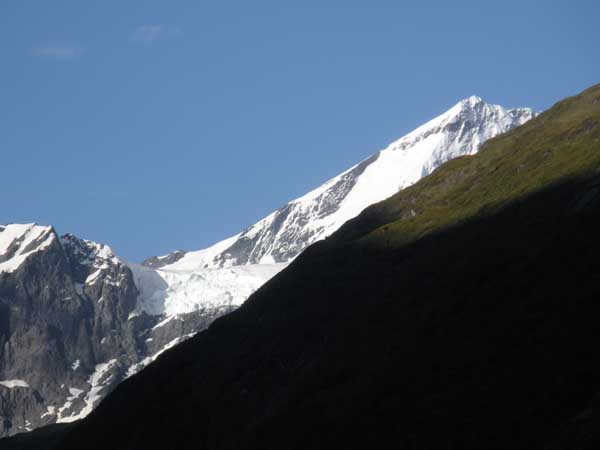
Mt. Brewster, New Zealand

11/02/2009
Returning from snow school, Mt. Brewster, NZ

Returning from snow school, Mt. Brewster, NZ

Some friends and I had a  great time in the Mt.  Brewster area last week. We did the two hour plus verticle hike to the hut from the valley floor, which got us there in the afternoon.  As Aspiring Guides Director Martin Hawes writes in their blog, “The track to Brewster Hut wastes no time in saying which way you are going: you leave the car, cross the river and then its straight uphill. At 2575 metres, Mt  Brewster is over 2 000 metre above the road and fortunately there is no valley slog to start. There is an honesty to this track. It takes you directly where  you want to go – upwards, and no messing about.”

Lisbeth & Amanda headed for Brewster Hut

Lisbeth & Amanda headed for Brewster Hut

Amanda is the roving hut ranger for DOC, and her roster took her there to collect hut fees, do maintenance and be a presence at the hut.  When we had a bit of free time, she and mutual friend Lizbeth Asserhoj from Denmark, did some basic snow school/ice axe lessons for the afternoon. The following day we worked our way over to Mt. Brewster glacier. But because of poor visiablity rain and slippery glacier polished rock we didn’t make it on the glacier. Even though we were well equipped for glacier travel, we decided to turn back for the hut. Some glaciologist who had earlier in the day been deposited by helicopter also decided to head for the hut. We later caught up with them at the hut, where they described their studies the effects of climate change on the Mt. Brewster Glacier. 

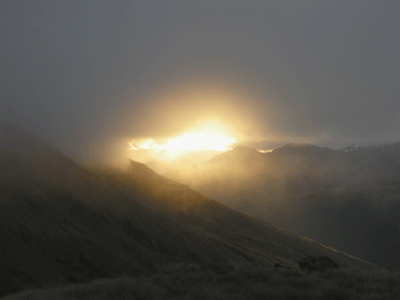
Sunset from Brewster Hut

Sunset from Brewster Hut

We based ourselves at the new hut, recently put there by the Department of Conservation in 2007. It replaces a four bunk hut that had been there for years. Even though we didn’t have time to get near the mountain itself, we enjoyed our time doing some ridge walks, snow school and getting towards the base of the mountain.  Next time we’re up there we’ll poke around a bit more, time permitting.

Mountain People Who Inspire

31/01/2009

Greetings from New Zealand. You’ll start to see articles on this blog under the column named “Mountain People Who Inspire” whenever I or other authors should come across them. 

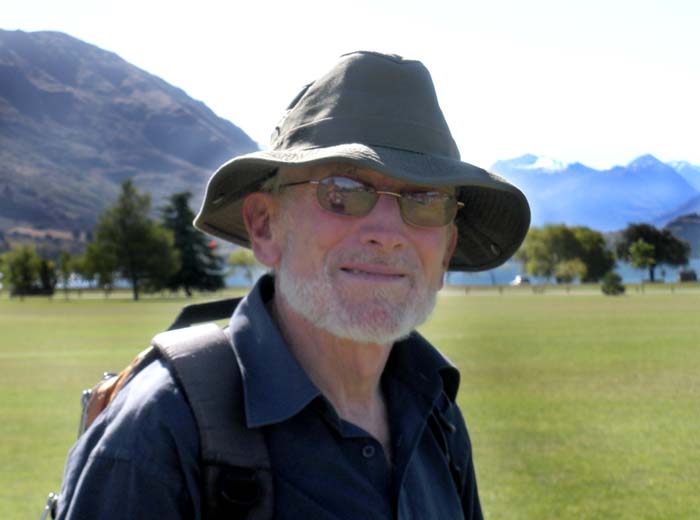
Londoner Mark Rosen, Wanaka, NZ

Londoner Mark Rosen, Wanaka, NZ

I’m starting this column with an entry on a retired man from England named Mark Rosen. Mark hails from Norfolk, Sheringham which is a fishing and vacation village on the east coast. We crossed paths in the Matukituki Valley when Mark was on his way to fulfill his annual volunteer stint at the French Ridge Hut near the base of Mt. Aspiring. He has been volunteering at this hut as well as Mueller hut at Mt Cook for a number of years.  He’s an inpsiration because of his great attitude about getting out in the mountains, and his ability to continue hitting the trail. He’s a mountain man in the true sense. Getting to the French Ridge Hut is not easy. Once you’ve hiked four hours along the Matukituki Valley, the trail climbs 3000′ in about a mile and a half, to arrive above treeline and at glacier’s edge at the small hut.

I only met him briefly on the trail, and later caught up with him in Wanaka, New Zealand where we asked him a few questions about his thoughts on hut wardening at Mt. Aspiring and Mt. Cook.  
MSI:What do you love most about your volunteering?
MR: I love relating to the people, and hearing about their first impressions. Especially at Mt. Cook when many of the visitors are seeing a large glaciated mountain for the first time. They’re enjoying the beauty of the mountains and for most, this is their first experience of going to a place like that. Their eyes are wide with wonder.  More though, I come back because of the place, the mountain environment, this special location.  I like the time alone too and can retreat to the hut warden’s quarters when need be.

MSI: What do you do in your spare time at the huts?
MR: I like to get out and hike the surrounding routes, read or plug into my ipod and conduct the London Symphony Orchestra or do my aerobic exercises.

MSI: What are some of the challenges of being a hut warden?
MR: Well, in a humorous vein, people tend to ask the same questions over and over, such as,  “How do you get your food and water up here?”, or “How do you get up here?” Depending on my mood sometimes, I like to make my answers more interesting.  I’ll tell a fibb by replying that I bring my food up in big boxes and haul water from the valley floor in buckets. Oh, and that “The outhouse poop needs to be hauled out in containers strung over my shoulders.” Sometimes I might say “I arrive by private helicopter.”
One thing that can bother me is when parties don’t clean up after themselves and leave the hut or toilet a mess. I almost feel as if I need to inquire about their toilet habits upon their arrival, hopefully stemming their bad behaviour. Of course, this is the minority of the visitors, but it does have a negative impact.

When I met Mr. Rosen the second time in Wanaka, I observed at how well grounded and at peace the man seemed. I guess part of it stems from all that time in the mountains. Keep going Mark.

The Power of Place

22/01/2009
Matukituki Valley, Mt. Aspiring Nat'l Park

Matukituki Valley, Mt. Aspiring Nat'l Park

The Power of Place
By Randy Richards, MSI Founder

I was debating how I was going to write my first entry from New Zealand. I have already written one article but don’t think it will make the grade. So I guess I’ll write about a magical valley. Oh, I can hear you say, “But all places are spiritual.”  Yes, but, I think there are places where the spirit of the place is so evident it comes over you like a wave.  I think this valley is one of those places. Places like these have a power that is unmistakable, people are drawn to them,  as Boyton Canyon, near Sedona Arizona, or Alta, Utah, and of course Machu Pichu.  All land has an energy, and some places are humming with energy, whether it’s the beauty of the place or the history or both.

NW Ridge, Mt. Aspiring

NW Ridge of Mt. Aspiring

The Matukituki Valley is west of Wanaka , New Zealand in the Mt. Aspiring National Park. The hour drive from Wanaka changes by the mile. The long flat valley with cascading waterfalls begs superlatives.  Mt. Aspiring is the tallest and proudest peak near the back of the long valley. Climbers come from all over the world to do their best on the mountain. But others come to enjoy the valley and glacier edges high above.

In the US, Richard Louv’s book, Last Child in the Woods is gaining traction with his important coinage of the term, Nature

A family group arrives at Aspiring Hut

A family group arrives at Aspiring Hut

Deficit Disorder. Here I have observed many families in the valley for their summer vacations.  One group at right, consisted of  two families with a total of 10 children who hung out at the hut and environs for three days. They did steep day-hikes up to the surrounding ridge lines. The four-year-old didn’t make it all the way up on her daddy’s shoulders though.

The hut ranger at Mt. Aspiring Hut in the valley, and greets both climbers and “trampers”  of all ages.  It’s clear that the valley has its hold on many. One volunteer hut warden makes the annual pilgrimage from London, while others I met from New Zealand come back year after year, and others, after some 30 years away.

Amanda and Lindy

Hut Warden and her sister at Shovel Flat

One who has a special feeling for the place is a hut ranger going on her third season. The coveted position is shared by another Department of Conservation employee as well.  The former, divides her time between Aspiring Hut, French Ridge, precariously perched on the valley’s edge just below the glaciers near Mt. Aspiring,  and other huts in the region.  She beckoned me, “You’ll love the place”.  And I did.

The large trees have a way of calling to you.  The winds that caress the grasses on the valley floor seem to create a rhythm that makes us forget the traffic in town.

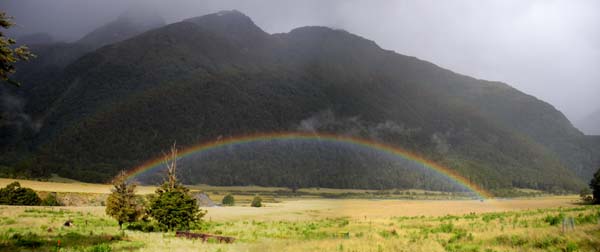
Double Rainbow from the warden's quarters

Double Rainbow from the warden's quarters

It’ s a good reminder of why we need to get to these places, and of course preserve them. Whether it’s Mt. Washington,  Mt. Shasta,  Alta, or the Matukituki,  get out while you still can. I will still post that previous article with tons of revisions, but here’s a start on my impressions of New Zealand and the power of the place.

Touching The Void in Alaska

11/12/2008

Going with the flow
Text and Images: Randy Richards

Last July I found myself sitting and staring at my stuff in a hot storage locker in Park City, UT. I had just moved out of my last relationship, and was practicing being in the moment. “Hmmm,” I thought, “I wonder what spirit may provide for the next big adventure.”  Keeping an open attitude, a sense of humor and staying light-hearted, I pondered.  Just then, I got a call from an old friend at Outward Bound, who I’d not heard from in years.
Denali, The Great One

Denali, The Great One

He was asking me if I’d like to teach a mountaineering program in Alaska. It’s been a while since I’ve been on the role call for OB Wilderness in the West. I’d been busy with Alpine Ascents International, Outward Bound Professional and now Mountain Spirit. He was also stepping back in temporarily at his old admin job. I only got the call because he knew me and had his old contact list out.  I wasn’t even in the OB computer system anymore. Regarding this Alaska proposal, I told him, “Let me think about that…. I’ve thought about it, when do I leave?”

Lost Lake just north of Seward AK

Lost Lake just north of Seward AK

Before long, I was on my way from Alta, Utah (thanks to Bob and Glenda Cottrill by the way), to Seward AK, packing bickies in the food room, checking tents and stoves,  and back in the OB swing. I was prepping to co-instruct a mountaineering segment of a sea/mountain combination program for Outward Bound Wilderness located at their Seward basecamp.  I’ve been pretty busy with Mountain Spirit Institute these days but decided to take a bus-man’s holiday and go back to what, in part,  inspired MSI in the first place. We had 10 bright and motivated kids who were eager to learn, climb and mix it up.
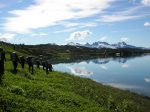
Students near Lost Lake

Students near Lost Lake

When I met the group, they had already been 12 days in kayaks. The thing that strikes me about Alaska is the sense of expansiveness, the “no thing ness”. Of course there is plenty there to see in all it’s splendor, but I wonder, after all these years and miles in the mountains, why this experience was so deeply different than my previous days. It wasn’t about the place as much as the experience I was perceiving.

I’ve spent literally years on the trail and backcountry. I learned to climb in the Alps, where I learned not to kill myself. I took classes with the Austrian Mountain Club, but that was only minimally effective as I missed half the lecture content. My Austrian  was pretty limited at the time. But I learned a few things. But I was young.
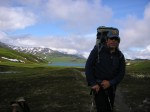
The author, Alaska backcountry

The author, Alaska backcountry

I think having gone through what life can throw at someone over a few years, has change my wilderness experience. I looked about me at my fellow instructors, and at my students. Of course I knew they were having their own “ah hah” moments as well, while out there,  but I felt as if I were “touching the void” (without having to go through Joe Simpson’s epic). I’m not sure why it was that way, but the silence which I’ve heard over the years had a depth to it that I’d not experienced before. Is it because of where I am in my life? I could lean into the wind’s howl, or its whisper, into the void…

Peaceful Rainbows at BaseCamp

Peaceful Rainbows at BaseCamp

Of course I can’t put it into words. It’s  similar to what Byrd Baylor’s writes in her story, “The Other Way To Listen” where she does a very solid job of telling the story of someone suddenly finding a mountain singing back to him while on a hike.

Alaksa’s Mt. Ascension was an admirable and beautiful peak, with spectacular 180 degree views, with the Harding Ice field to the south, and Lost Lake and a minor peak to the north. The north face of Ascension has couloirs and arrets dropping off directly to the valley floor below.
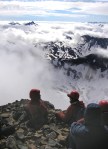
Summit view to SE from Mt. Ascension

Summit view to SE from Mt. Ascension

The students did well, gaining the upper slopes of the glacier, route finding, laying wands, and making the summit. The coastal fog rolled in, which made finding basecamp, on the eastern shelf of the range, a bit of a challenge.  Our back bearings could have been better.  Maybe more on that adventure another time.

I’ve been rambling on a bit about the mechanics of the climb, which are relatively important. But what was absolutely important for me, was my new and improved experience of the mountain vastness. Maybe it was just Alaska, but I doubt it.

You think you remember, after being out for a while. But you don’t. You can only be reminded of the vastness, of your place in it all, by going back out there. And not just climbing a damn peak, but coming to terms with the end of it all, the cold, the wind, the rocks and the snow.
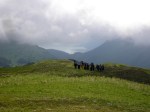
Students heading south to Seward after their expedition

Students heading south to Seward after their expedition

Solo is a big part of Outward Bound and we at Mountain Spirit have our own twist on it as well. Getting out while you still can, stepping away from the machine just makes sense.  Whether with a group or solo. And as Willie Unsoeld used to say, when it’s time to come back to civilization, you’re better equipped to really contribute something to the cutting edge.

Prajna, The Best Knowledge: Do Your Part, Tell Your Story

26/11/2008

It’s amazing how easy it can be to do your part to live just a little more sustainably – individuals, institutions and businesses all have the capacity to reduce environmental impact.  It’s about making the choice.

A personal choice. Check out this list at You Sustain of actions that don’t require a huge shift in thinking or beliefs, just a minor change in behavior.  It could be as simple as saying, “I don’t need a bag, thanks.” Most of the things you can do are free and you just might inspire the next person – a kind of ‘pay it forward’ effect.  For further reading, consider Radical Simplicity, by Jim Merkel, or be informed and calculate your ecological footprint. 

A choice that inspires others. Barbara Duncan, founder of the Vermont Earth Institute, has been an energetic champion of living simply, consuming less, and building community. Over VEI’s 10 year history, she and her team have have connected with more than 5,000 people and numerous institutions through discussion courses and workshops. 

A business choice to use profit and influence for the good. And what about corporate social responsibility? The Conservation Alliance is a group of outdoor related businesses that provide funds to support national conservation and outdoor recreation organizations working to protect natural resources, special outdoor places, and wildlife habitats.  And imagine the impact of ‘doing your part’ if you’re the largest company in the world.  Consider this – by no means a ‘green company’ by their own admission, yet Wal-Mart Stores, Inc., in a partnership with the National Fish & Wildlife Foundation, has committed $35 million over 10 years to permanently conserve at least one acre of priority wildlife habitat for every developed acre of Wal-Mart Stores’ current footprint, as well as future development.  

So what’s your personal sustainability story?

North Mountain Flutes

23/11/2008

By Brenda Dowst,
MSI Board Member
Pictou, Nova Scotia
The potential for making great connections is everywhere, and I seem particularly attracted other music lovers.  Just before I returned to New Hampshire from Nova Scotia, about a week ago, I met Mike Cheney.  Mike was playing a gorgeous Native American two pipe flute at a local craft fair at his display of some thirty handmade wooden flutes.  We spent about 1/2 hour talking, listening,handling the flutes and learning about his interest in Native American flutes.  Mike lives in what Nova Scotian’s refer to as the “Valley” on the Bay of Fundy.   He is a delightful person, an excellent performer and a superb flute maker.  I gave him our web address and told him about the Chimu Inka’s tour.  He expressed an interest in being associated with Mountain Spirit Institute, and making a connection with the Chimu Inka flute players.  I suggested we exchange links to each of our web sites.  His web address is: www.northmountainflutes.com.  We talked briefly about how to include music on our web site and  Mike suggested a video clip of the Chimu Inka as a beginning.  I wanted to purchase one of his flutes, but just couldn’t make up my mind about which one.  Mike is in the process of producing his first CD, and I can’t wait to hear it.  He is a trained piano player and has a deep understanding of the role that music plays in our health and well being.

This week’s Living on Earth at NPR

23/11/2008
NPR

Living On Earth, Sunday Mornings: NPR

Living on Earth, the brilliant environmental show on Sunday mornings on NPR had some very interesting and relevent pieces today. If you didn’t get a chance to hear the show,  check them out at their website where you may listen to their realplayer or mp3 versions. Here are some of the interviews I found important and worth a listen.

Fire Retardants Stoke Controversy
The wildfires in California have been contained, but controversy over the use of fire retardants continues to blaze. (more…)

Yes Magazine Does it Again, Keeping the Face to the Sunshine

23/11/2008

By Randy Richards
A Native American phrase, “keep your face to the sunshine and you won’t see the shadows”, is apropos for todays’ daily doses of bad news. Edward Griffin who wrote the Creature From Jekyll Island was once asked in a radio interview how he was able to keep such a positive attitude with all the information he had learned and written about over the years regarding the shadows of power in American society and government. He replied that he had made up his mind a long time ago to keep the information separate from his outlook on life. He then mentioned he had learned the hard way, inferring he had a rough time early on. In the interview, he look remarkably at peace and well balanced, unlike some of my friends that can’t sleep at night because of what they know.

Yes Magazine by Positive Futures Network

If you’ve not picked up a copy or subscribed to Yes Magazine, I suggest you do so yesterday. We have reprinted one of their articles in one of our newsletters, with the magazine’s gracious permission. The Winter ’09 issue cover story is titled “Sustainable Happiness”, with the subtitle “The Good Life Doesn’t have to Cost the Planet”. Articles include “10 things Science says will make you happy”; “No Gifts? One Family’s Amazing Green Holiday”; “Why is the Dalai Lama Always Smiling?”,  and “Dee Williams Lives Large in 84 Square Feet.” One thing that caught my eye in this issue was the graph on page 20 entitled: “Who Has The Money” Who’s Happier?”. The graph states, “There is no correlation between a country’s per capita GDP and its score on the Happy Planet index”.  “On a bang-for-buck basis, the US is the world’s biggest loser,” states the magazine. You can order a copy and learn more about the magazine at www.yesmagazine.org.

Living Close to the Land, A Lost Art?

22/11/2008
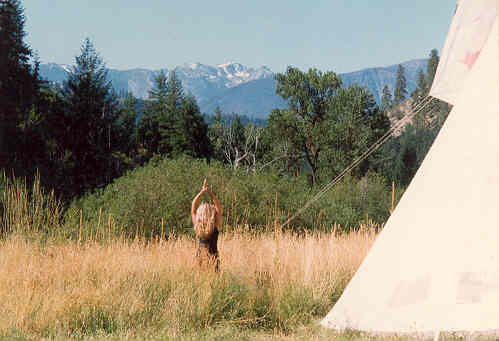
Yoga at the Tipi, North Cascades, Leavenworth, WA

Yoga at the Tipi, North Cascades, Leavenworth, WA

By Randy Richards, Founder
Executive Director
Mountain Spirit Institute
Images: R Richards

Alternative structures are getting more attention these days, especially with the spector of dwindling non-renewable petroleum products for building and heating materials. Simple living is more than an idealist notion. Cody Michaels, a longtime  friend and solo pianist extradonaire, just swung by my town for a performance at our local CoffeeHouse. His performance is a reminder that we actually need to live and  breath outdoors more. He and I went for a walk to the top of a hill overlooking Lake Sunapee just before his gig. We wer just in time to catch the sunset too. It seemed bitterly cold,  (read, There is no bad weather, just bad clothes), but it was worth it. Cody shared his appreciation of the wind whipping through the bare branches, and the artist’s light that cuts through the landscape at an obtuse angle this time of year.
Living outside has become a lost art for the majority of Americans. In my tipi days, I always enjoyed the circular living structure. Occasionally, when a visitor might bring a dog, often times, the a dog would go walk nerveously round and round along the inner walls of the tipi looking for a corner in which to sit. To no avail. Even our domestic pets are used to the square structures in which we all live. 

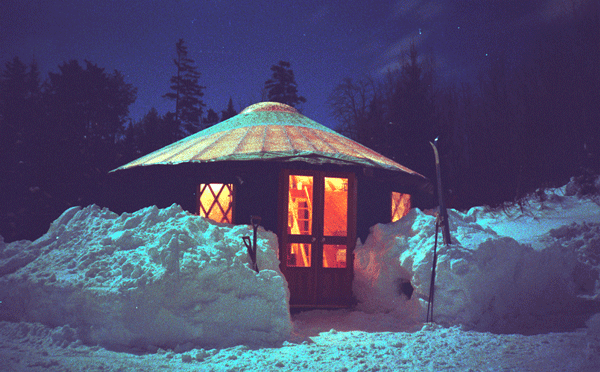
Home base, warm yurt, Sunapee, NH

Home base, warm yurt, Sunapee, NH

My tipi has been put up every year though,  for the Sunapee SunFest, but I don’t live in it any more. My yurt, now that is a cool structure. It’s toasty warm, and clean living off the grid with solar panels, gravity feed shower, composting toilet and a hand dug well. I’ll write more on yurt living in another post.  I had it up for 5 years in Sunapee, NH on Ryder Corner Road. The different reactions I received from different neighors was worth noting. The old time locals, who grew up on local farms thought it was the best thing, a great addition to the neighborhood.  Ohers were less clear about their feelings of the thing.

Yurt interior w/loft

Yurt interior w/loft

Reactions varied from polite disdain, a blank stare, or possibly a somewhat condescending chuckle. It’s only worth mentioning because as illustrated in the movie “Escape from Suburbia” we may be headed for voluntary simplicity whether we want to or not.  I’m not a Chicken Little thinker, however, watching the aformentioned movie made me sit up and take more notice. It might be worth your time.

A confession is due here. I’m not living as close to the land as I’d like. I’m not growing my own food, (although I do eat from friend’s gardens once in a while.) And I’m not in my yurt. However I forsee my partner and I taking action on this. I’m glad I have the background I do, having lived in my tipi and yurt. As Richard Louv says in his lecture and book “Last Child in the Woods”, my past experiences give me a touchstone, a reference point that helps me know my place in the natural world. My life is still more green than most, but I’ve still got goals to reach. I suggest you do the same. 

Living closely to the earth not only makes sense, it can be much more fun than being in the rut of spending all those non-renewables.